

Credit Card Annual Fee Worth It
On June 2, 2026 by pubman
Is a Credit Card Annual Fee Worth It? Unlocking Value in 2026 and Beyond
Affiliate disclosure: This article may contain affiliate links. Recommendations are independent and editorially driven.
For many consumers, the mere mention of a credit card annual fee is enough to trigger an immediate dismissal. Why pay for a card when there are so many free options available? This common sentiment, while understandable, often overlooks a critical truth for savvy points and miles enthusiasts: an annual fee, when chosen strategically, isn’t just a cost—it’s an investment. The question isn’t simply “Is a credit card annual fee worth it?” but rather, “How can an annual fee credit card deliver exceptional net value that far surpasses its cost, especially for those who prioritize travel, premium perks, and maximized loyalty program benefits?”
At goldpoints, we live and breathe credit card rewards, travel points, and intricate loyalty program strategies. Our mission is to help you navigate the complex world of credit cards to unlock unparalleled experiences and savings. This comprehensive guide will equip you with the knowledge and frameworks to definitively answer whether a credit card annual fee is worth it for your specific financial profile and travel aspirations in 2026. We’ll delve deep into evaluating benefits, understanding the true return on investment (ROI), identifying premium card categories, and implementing advanced strategies to ensure your annual fee cards are not just justifying their cost, but actively enhancing your lifestyle and travel adventures.
Forget the fear of fees; embrace the potential of elevated rewards. Let’s uncover how you can transform an annual fee from a deterrent into a cornerstone of your optimized points-and-miles strategy.
Understanding the Anatomy of a Credit Card Annual Fee
Before we can determine if a credit card annual fee is worth it, we must first understand what an annual fee represents and why card issuers charge it. Essentially, an annual fee is a yearly charge levied by the credit card company for the privilege of holding a particular card. Unlike interest rates or late payment fees, it’s a fixed cost regardless of your spending habits (though spending often unlocks benefits that offset it).
Why Do Credit Card Companies Charge Annual Fees?
Credit card issuers are businesses, and annual fees are a significant revenue stream, especially for cards that offer substantial benefits. These fees allow them to fund the impressive array of perks, rewards, and services that distinguish premium cards from their no-annual-fee counterparts. Think of it as a membership fee for an exclusive club—the more exclusive the benefits, typically the higher the fee.
- Funding Premium Benefits: This is the primary driver. High annual fees enable cards to offer lavish travel credits, airport lounge access, elite status upgrades, comprehensive travel insurance, concierge services, and accelerated rewards earning rates. Without the fee, such perks would be financially unsustainable for the issuer.
- Attracting Target Demographics: Cards with annual fees are often designed to appeal to specific segments of the market—frequent travelers, high-spenders, business owners, or those seeking luxury experiences. The fee acts as a filter, ensuring that the card is primarily held by individuals who are likely to utilize and value its premium offerings.
- Enhanced Customer Service: Many premium cards tout dedicated customer service lines, often with shorter wait times and more knowledgeable representatives. The annual fee contributes to maintaining these elevated service standards.
- Exclusive Partnerships: Annual fees can help fund partnerships with airlines, hotels, and travel agencies, allowing cards to offer co-branded benefits like free checked bags, hotel points multipliers, or exclusive access to events.
Common Misconceptions About Annual Fees
It’s crucial to address common misunderstandings that prevent many from considering annual fee cards:
- “All annual fees are bad.” This is perhaps the biggest misconception. While a no-annual-fee card is often suitable for beginners or those with minimal spending, it rarely offers the outsized value proposition found in premium cards. The key is value, not cost.
- “I don’t spend enough to justify it.” Justification isn’t solely about spending volume but about leveraging the card’s specific benefits. A card offering a $300 annual travel credit, for example, can easily justify its $250 annual fee even with moderate spending, provided you use the credit.
- “I’ll just get a huge interest rate too.” Annual fees and interest rates are separate. Many premium cards with high annual fees actually offer competitive (or even lower) APRs than some no-annual-fee cards. Furthermore, the goldpoints philosophy always emphasizes paying your statement balance in full every month to avoid interest charges altogether, making the APR largely irrelevant for responsible cardholders.
- “Once I pay it, I’m stuck.” Card issuers are generally flexible. If you’ve paid an annual fee and realize within a certain window (often 30-60 days) that the card isn’t right for you, you can often cancel or downgrade for a full refund of the fee. After that, you can always product change or cancel before the next annual fee posts.
By understanding the true nature and purpose of annual fees, you can approach the decision of whether a credit card annual fee is worth it with a more informed and strategic mindset.
Evaluating Benefits: What Do You Really Get for Your Money?

[INLINE IMAGE 1: place after second H2 | alt=”credit card annual fee worth it concept illustration”]
The core of determining whether a credit card annual fee is worth it lies in a meticulous evaluation of the benefits offered versus the fee charged. This isn’t a simple comparison; it requires a deep dive into how each perk aligns with your spending habits, travel patterns, and lifestyle. Many cardholders fail to maximize their annual fee cards because they don’t fully understand or utilize all the embedded benefits. Let’s break down the typical categories of benefits and how to assess their real-world value.
Direct Statement Credits and Annual Allowances
These are often the easiest benefits to quantify and are frequently the most compelling reason to pay an annual fee. Many premium cards offer yearly credits that can directly offset a significant portion, or even the entirety, of the annual fee.
- Travel Credits: Perhaps the most common and valuable. Examples include general travel credits (e.g., $300 for any travel purchase), airline fee credits (e.g., $200 for incidental airline fees), hotel credits, or specific credits for services like Uber, CLEAR, or Global Entry/TSA PreCheck. If you regularly incur these expenses, these credits can be as good as cash.
- Dining/Entertainment Credits: Some cards offer monthly or annual credits for specific dining services (e.g., DoorDash, Uber Eats) or entertainment subscriptions.
- Shopping Credits: Less common but can include credits for specific retailers (e.g., Saks Fifth Avenue, PayPal).
- How to Value: If you would naturally spend that money anyway, the credit is worth its face value. If you wouldn’t, or you’re going out of your way to use it, its value diminishes. For instance, a $300 travel credit effectively reduces a $550 annual fee to $250 if you use it entirely on travel you were already planning.
Enhanced Earning Rates and Welcome Bonuses
While not an annual benefit per se, the points-earning structure and initial welcome bonus are critical components of a card’s overall value proposition, especially in the first year.
- Accelerated Earning: Premium cards often offer higher multipliers in specific categories (e.g., 5x points on flights, 3x on dining) that can lead to significant points accumulation over time. If your spending aligns with these categories, you can accrue rewards much faster than with a flat-rate card.
- Welcome Bonuses: The initial sign-up bonus for annual fee cards is typically substantial, often worth hundreds, if not thousands, of dollars in travel value. This bonus alone can make the first year’s annual fee an undeniable bargain.
- How to Value: Calculate the potential points earned annually based on your typical spending patterns. Multiply the total points by your estimated redemption value per point (e.g., 1.5-2 cents per point for flexible travel currencies). For welcome bonuses, consider their immediate impact. A 100,000-point bonus, potentially worth $1,500-$2,000, can easily justify a $550 annual fee for several years.
Luxury Travel Perks and Experiences
These benefits often have a less direct monetary value but can significantly enhance your travel experience, making a credit card annual fee worth it for frequent travelers.
- Airport Lounge Access: Unlimited access to Priority Pass, Centurion Lounges, Delta Sky Clubs, or other airport lounges can save you money on airport food and drinks, provide a comfortable place to work or relax, and significantly reduce travel stress.
- Hotel Elite Status: Automatic mid-tier or even top-tier elite status with hotel chains can unlock benefits like room upgrades, late checkout, free breakfast, and bonus points.
- Rental Car Perks: Complimentary car rental insurance (primary coverage on some cards), elite status, and discounts with car rental agencies.
- Global Entry/TSA PreCheck Fee Credit: Expedited security screening and customs processing is a massive time-saver for international and domestic travelers.
- How to Value: Assign a subjective dollar value based on how much you’d pay for these services if purchased outright. For instance, a Priority Pass membership can cost hundreds, and airport meals easily add up. Late checkout or a room upgrade can be priceless after a long flight.
Robust Travel and Purchase Protections
Often overlooked, these protections can save you thousands of dollars and immense headaches in unforeseen circumstances. For many, these benefits alone make a credit card annual fee worth it.
- Trip Cancellation/Interruption Insurance: Reimburses non-refundable expenses if your trip is canceled or cut short due to covered reasons.
- Trip Delay Insurance: Provides reimbursement for essential expenses (meals, lodging) during covered travel delays.
- Baggage Delay/Loss Insurance: Covers costs for essential items if your luggage is delayed, or reimbursement if it’s lost.
- Primary Car Rental Insurance: Critical for saving money and avoiding claims on your personal auto insurance.
- Extended Warranty Protection: Extends the manufacturer’s warranty on eligible items purchased with the card.
- Purchase Protection: Covers eligible items against damage or theft for a period after purchase.
- How to Value: While you hope never to use them, the peace of mind and potential savings from these insurances are substantial. Consider the cost of similar third-party insurance policies you might otherwise buy, or the potential financial loss if an incident occurs without coverage. For instance, a flight delay that costs $500 in unplanned hotel and food could be fully covered.
Non-Travel Related Perks and Services
- Concierge Service: A dedicated service to assist with dinner reservations, event tickets, or travel planning.
- Exclusive Event Access: Invitations to special events, concerts, or dining experiences.
- Cell Phone Protection: Covers damage or theft to your phone when you pay your monthly bill with the card.
- How to Value: Highly subjective. If you use these services, they can add convenience and value. If not, they have zero monetary worth for you.
The key takeaway is that the perceived high annual fee is often a gateway to a suite of benefits that, when fully utilized, can provide a net positive return. The strategic cardholder doesn’t just pay the fee; they actively extract value from every benefit to ensure the credit card annual fee worth it is not just met, but significantly exceeded.
The Math of Value: Calculating Your Return on Investment (ROI)
Moving beyond a qualitative assessment, the true test of whether a credit card annual fee is worth it lies in quantitative analysis. You need to perform a simple, yet powerful, calculation: Sum the real-world value of all benefits you realistically expect to use, subtract the annual fee, and see if the net result is positive. This is your personal Return on Investment (ROI).
Step-by-Step Calculation for a Card’s Net Value
Let’s use a hypothetical “Premium Travel Card X” with a $550 annual fee as an example.
- List All Benefits and Assign a Realistic Monetary Value:
- $300 Annual Travel Credit: If you spend $300+ on travel annually anyway, this is worth its full face value.
- Value: +$300
- Airport Lounge Access (Priority Pass Select): You value this at $25 per visit, and you typically make 8 lounge visits per year.
- Value: +$200 (8 visits * $25/visit)
- Global Entry/TSA PreCheck Fee Credit: Available once every 4-5 years. Annualizing its value might be tricky, but let’s assume you need it this year or next. The cost is $100.
- Value: +$100 (for the year you use it, or amortize ~$20-25/year)
- Annual Hotel Credit ($100 at specific brands): You regularly stay at these brands.
- Value: +$100
- Elevated Earning (e.g., 3x on travel, 2x on dining): Based on your spending ($10,000 travel, $5,000 dining), you’d earn an extra 10,000 points compared to a 1x card. If your points are worth 1.5 cents each:
- Value: +$150 (10,000 points * $0.015)
- Primary Rental Car Insurance: You rent cars 3 times a year, saving you $15-$30 per rental on insurance you’d otherwise buy, plus peace of mind. Let’s value this at $75 annually.
- Value: +$75
- Trip Delay/Cancellation Insurance: You haven’t used it, but the peace of mind is worth $50 annually to you, or based on the cost of comparable travel insurance.
- Value: +$50
- Other Perks (e.g., cell phone protection, concierge): You might use cell phone protection (saved you $100 last year on a cracked screen) and appreciate concierge once (valued at $25 convenience).
- Value: +$125
- $300 Annual Travel Credit: If you spend $300+ on travel annually anyway, this is worth its full face value.
- Sum the Total Value of Benefits:
- Total Benefit Value = $300 + $200 + $100 + $100 + $150 + $75 + $50 + $125 = $1,100
- Subtract the Annual Fee:
- Net Value = Total Benefit Value – Annual Fee
- Net Value = $1,100 – $550 = +$550
In this scenario, the “Premium Travel Card X” delivers a net positive value of $550. This definitively answers the question: “Is a credit card annual fee worth it?” for this individual, in this hypothetical example, it clearly is.
Key Considerations for Accurate Valuation
- Realistic Usage: Don’t count benefits you won’t use. If you never fly, an airline fee credit has no value to you. If you already have lounge access through another channel, additional lounge access is redundant.
- Opportunity Cost: Consider what you might miss out on by *not* getting a particular card. Sometimes, the benefits of a premium card far outweigh the forgone benefits of a no-annual-fee alternative.
- Redemption Value of Points/Miles: This is highly variable. goldpoints always advocates for maximizing point value, aiming for 1.5-2 cents per point or higher, especially with flexible travel currencies. If you consistently redeem for less (e.g., cash back at 1 cent per point), the value of your earning rates diminishes.
- First-Year vs. Subsequent Years: The initial welcome bonus often makes the first year an undeniable winner. Subsequent years require a recalculation of value based purely on recurring benefits and earning rates.
- Annual Fee Waivers/Retention Offers: Remember that annual fees are sometimes waivable for military personnel or can be offset by retention offers if you call the issuer before your renewal date. Factor this potential into your long-term strategy.
This systematic approach provides a robust framework for assessing the true financial impact of an annual fee card. By conscientiously tallying up the benefits you will genuinely use and assigning them a conservative monetary value, you can confidently determine whether a credit card annual fee is worth it for your unique situation. This process moves you from guesswork to informed decision-making.
Types of Cards Where Annual Fees Shine Brightest
While an annual fee can be worth it across various card types, certain categories consistently offer a strong value proposition, particularly for goldpoints readers focused on maximizing travel and rewards. These are the cards where the benefits are so robust that the annual fee is often a mere entry ticket to a world of elevated experiences.
1. Premium Travel Rewards Cards
These are the flagship cards for many issuers, designed for frequent travelers who prioritize comfort, convenience, and luxury. They typically come with the highest annual fees but also the most comprehensive suite of travel-focused benefits.
- Hallmark Benefits:
- Extensive airport lounge access (Priority Pass, Centurion Lounges, airline-specific lounges).
- Generous annual travel credits (general travel, airline incidental, hotel specific).
- Enhanced points earning on travel and dining.
- Complimentary elite status with hotel chains or car rental companies.
- Global Entry/TSA PreCheck fee credit.
- Comprehensive travel insurance protections (trip cancellation/interruption, delay, lost luggage, primary rental car).
- Transferable points to airline and hotel loyalty programs.
- Who They’re For: Individuals who travel multiple times a year, value airport amenities, appreciate travel protections, and want flexibility in redeeming points for maximum value. If you spend significant amounts on flights, hotels, and dining, these cards can be incredibly lucrative.
- Example Value Proposition: A card with a $550 annual fee might offer $300 in travel credits, Priority Pass (worth $429), and elite status perks (worth $200+). Even before considering points earned or other insurance, the tangible benefits already surpass the fee.
2. Co-Branded Airline Credit Cards (Mid-Tier to Premium)
Designed for loyalists of a specific airline, these cards offer benefits directly tied to flying with that carrier. While some entry-level airline cards have low or no annual fees, the most valuable perks often come with an annual fee.
- Hallmark Benefits:
- Free checked bags for the cardholder and companions on the same reservation.
- Priority boarding.
- In-flight discounts (food, beverages).
- Reduced-price or complimentary airport lounge access (e.g., airline-specific lounges).
- Opportunities to earn elite qualifying miles/segments/dollars.
- Companion certificates or annual flight credits.
- Who They’re For: Frequent flyers who consistently fly with one or two specific airlines. The value of free checked bags alone for a family can easily offset a mid-tier annual fee ($95-$150).
- Example Value Proposition: A $99 annual fee card that gives you and a companion a free checked bag on every flight. If you take just two round trips a year with a companion, you’ve saved $160-$240+ in baggage fees, making the credit card annual fee worth it.
3. Co-Branded Hotel Credit Cards (Mid-Tier to Premium)
Similar to airline cards, these cater to those loyal to a particular hotel chain, offering benefits that enhance stays and accelerate point accumulation.
- Hallmark Benefits:
- Automatic hotel elite status (e.g., Gold, Platinum, Titanium).
- Annual Free Night Certificates (often tied to a points value or category).
- Bonus points on stays at the co-branded hotel chain.
- Enhanced benefits at hotels (late checkout, room upgrades, free breakfast).
- Opportunities to earn additional elite night credits.
- Who They’re For: Individuals who frequently stay at hotels, particularly within a specific brand family. A single free night certificate can often be worth more than the annual fee itself.
- Example Value Proposition: A $95 annual fee card offers a free night certificate redeemable for a hotel room up to 35,000 points. If you redeem that for a night costing $250, you’ve gained $155 in net value.
4. Business Credit Cards with Premium Perks
Business cards often mirror their consumer counterparts in terms of premium travel benefits, but also add features specifically useful for business owners, like spending categories, employee cards, and accounting integrations. Many of the premium travel cards also have business versions.
- Hallmark Benefits:
- High spending limits.
- Bonus rewards on business-related categories (e.g., advertising, shipping, office supply stores).
- Employee cards with spending controls.
- Access to business lounges or specific business travel benefits.
- Comprehensive spend tracking tools.
- Who They’re For: Small business owners, freelancers, and independent contractors who want to separate business and personal expenses while maximizing rewards on business spending and leveraging travel perks for business trips.
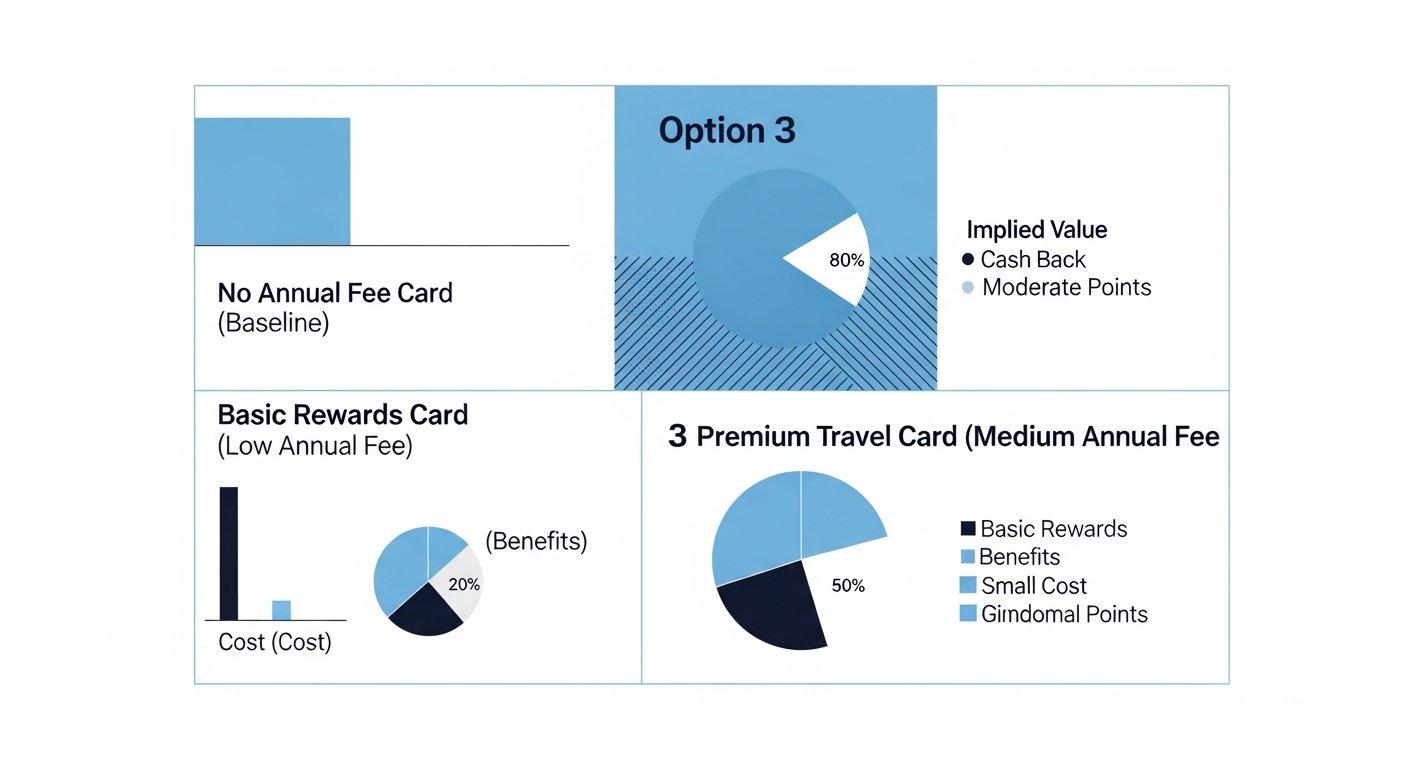
The table below provides a hypothetical comparison to illustrate how various annual fee cards align with different travel profiles and how their benefits can quickly offset their costs, making a credit card annual fee worth it for the right user:
| Card Type (Hypothetical) | Annual Fee (2026) | Key Benefits & Credits | Who It’s Best For |
|---|---|---|---|
| Goldpoints Premier Travel Card | $595 | $300 Annual Travel Credit, Priority Pass Select, Global Entry/TSA PreCheck Credit, 5x on Air/Hotel, 3x on Dining, Comprehensive Travel Insurance, Hotel Elite Status. | Frequent flyers and luxury travelers seeking maximum flexibility and comfort, high spenders in travel/dining. |
| Goldpoints Preferred Hotel Card | $99 | Annual Free Night (up to 35k points), Automatic Mid-Tier Hotel Elite Status, 10x on Hotel Stays, 2x on Everyday Purchases. | Loyalists of a specific hotel chain, budget-conscious travelers valuing free nights and upgrades. |
| Goldpoints SkyMiles Elite Card | $150 | First Checked Bag Free (cardholder + 8 companions), Priority Boarding, Annual Companion Certificate (limited), Discounted Airline Lounge Access, 2x on Airline Purchases. | Families or individuals who fly frequently with a specific airline, value baggage savings and basic convenience. |
| Goldpoints Business Advantage Card | $295 | $200 Annual Shipping/Software Credit, 4x on Top 2 Spending Categories, Employee Cards, Primary Rental Car Insurance, Airport Lounge Access (limited). | Small business owners with significant expenses in specific categories, appreciate business-specific credits and travel perks. |
[INLINE IMAGE 2: place after fourth H2 | alt=”credit card annual fee worth it comparison illustration”]
By understanding these categories, you can more precisely identify which annual fee cards align with your existing habits and aspirations, thereby making a more informed decision on whether a credit card annual fee is worth it for your personal financial ecosystem.
Strategic Card Combinations & Downgrades: Sustaining Value
The goldpoints philosophy extends beyond simply opening a premium annual fee card. True mastery of points and miles involves a dynamic, long-term strategy that often includes combining cards from different issuers or product families, as well as knowing when and how to downgrade or product change. These advanced tactics are crucial for ensuring your credit card annual fee remains worth it year after year.
The Power of a Credit Card Ecosystem
Few individuals will find that a single credit card, even a premium one, perfectly covers all their spending and reward needs. The real magic happens when you combine cards strategically to create a complementary ecosystem. This approach allows you to maximize rewards across various spending categories while leveraging the premium benefits of annual fee cards.
- Example: Premium Travel Card + No-Annual-Fee Daily Driver:
- Use a premium travel card (e.g., Goldpoints Premier Travel Card with a $595 annual fee) for its high earning rates on travel and dining, airport lounge access, and travel credits.
- Pair it with a no-annual-fee card from the same ecosystem (e.g., Goldpoints Everyday Rewards Card) for 2x points on groceries or gas, where the premium card might only offer 1x.
- All points often pool into a single account, allowing you to transfer them to airline/hotel partners for maximum value, effectively making the premium card’s annual fee “cover” the value of points earned on other cards too.
- Example: Multiple Premium Cards for Diverse Benefits:
- One card provides lounge access for Delta flights and free checked bags.
- Another card offers flexible transferrable points, a general travel credit, and primary car rental insurance.
- A third offers a valuable annual free night certificate and hotel elite status.
The key is to ensure the benefits from different cards don’t overlap redundantly and that the combined value of all benefits still significantly outweighs the sum of all annual fees. This strategy works best for very frequent travelers or those with diverse spending patterns.
By strategically combining cards, you can ensure that you’re always earning the highest possible return on every dollar spent, while simultaneously enjoying a robust suite of premium perks. This diversified approach makes the overall investment in annual fees much more justified.
When and How to Downgrade or Product Change
Sometimes, a credit card annual fee simply stops being worth it. Your travel habits might change, the card’s benefits might be devalued, or you might find a better option. In such cases, canceling the card outright isn’t always the best solution, as it can negatively impact your credit score by reducing your overall credit limit and average age of accounts. A better strategy is often a “product change” or “downgrade.”
- What is a Product Change/Downgrade?
This involves switching your existing credit card to a different card offered by the same issuer, typically one with a lower or no annual fee. Your account number often remains the same, as does your credit history for that account, preserving your average age of accounts.
- Reasons to Consider a Downgrade:
- Reduced Value: The benefits no longer outweigh the annual fee for your specific situation.
- Newer, Better Options: A different card (even from the same issuer) now offers a better fit for your spending/travel.
- Reduced Travel: You’re no longer traveling frequently enough to utilize premium travel perks.
- Redundant Benefits: You’ve acquired another card that offers similar or better benefits, making the first card’s annual fee redundant.
- How to Execute a Downgrade:
- Evaluate Timing: Plan to make the change shortly after your annual fee posts. Most issuers will refund the fee if you downgrade within 30-60 days. This allows you to utilize any annual credits (like a travel credit or free night certificate) before making the change, effectively getting the benefits for free for that year.
- Identify Target Card: Research which no-annual-fee or lower-annual-fee cards your issuer offers that you qualify for and would still find useful (e.g., a simple cash-back card, or a points-earning card that still allows point pooling).
- Contact the Issuer: Call the number on the back of your card and clearly state you’d like to “product change” to a specific card. Be polite but firm.
- Confirm Details: Ensure you understand any changes to rewards, interest rates, or account numbers. Confirm the annual fee refund if applicable.
- Important Considerations for Product Changes:
- You typically won’t receive a new welcome bonus for a card you product change to (as you’re not opening a new account).
- You can generally only product change within the same “family” of cards from a single issuer (e.g., Chase Sapphire Preferred to a Chase Freedom card).
- Your credit limit usually remains the same, which is beneficial for your credit utilization ratio.
By mastering the art of the product change, you ensure that you’re never “stuck” with an annual fee that isn’t pulling its weight. This flexibility is a cornerstone of smart points-and-miles management and ensures that your credit card annual fee is always worth it in the context of your evolving financial landscape. Learn more about optimal card combinations and product change strategies in our advanced points strategy guide.
Maximizing Annual Fee Cards for Travel Rewards: Pro Tips from goldpoints
It’s one thing to understand that a credit card annual fee can be worth it; it’s another to consistently extract maximum value from it. The experts at goldpoints employ a range of strategies to ensure premium cards aren’t just offsetting their fees, but actively propelling us towards our travel goals. Here are our top tips for truly maximizing annual fee cards for travel rewards.
1. Leverage Transfer Partners for Outsized Value
This is arguably the most powerful aspect of premium travel cards, especially those that earn flexible points currencies (like Chase Ultimate Rewards, American Express Membership Rewards, Capital One Miles, or Citi ThankYou Points). While cash back often yields 1 cent per point, transferring points to airline or hotel loyalty programs can unlock significantly higher values—often 1.5 cents, 2 cents, or even more per point.
- Strategy: Don’t just redeem for cash or through the issuer’s travel portal if you’re chasing premium experiences. Research sweet spots within transfer partner award charts. A business class flight that costs $5,000 might be available for 50,000 points transferred to an airline partner, effectively giving you 10 cents per point in value.
- Goldpoints Insight: We regularly use transfer partners to book luxury hotel stays and international business/first class flights that would be prohibitively expensive with cash. This alone can make a $500+ annual fee seem trivial compared to the value extracted. Stay updated with our guide to maximizing transfer partners.
2. Stack Credits and Benefits
Many premium cards offer a variety of statement credits (travel, dining, streaming, CLEAR, Global Entry). The savvy cardholder ensures they are using every single one of these credits annually.
- Strategy: Keep a running list or set calendar reminders for when credits reset or need to be used. Integrate them into your natural spending. If your card offers a $15 monthly Uber credit, use it for your regular commute or a takeout order. If it offers an airline incidental credit, consider buying gift cards from your preferred airline (check if it triggers the credit) or using it for seat upgrades or baggage fees.
- Goldpoints Insight: Don’t let a single credit go to waste. Even small monthly credits add up significantly over a year. A card with a $250 annual fee that offers $100 in dining credits and a $100 travel credit effectively costs just $50 out of pocket if you use both.
3. Maximize Welcome Bonuses Strategically
The first year of a premium annual fee card is almost always a net positive due to the lucrative welcome bonus. Planning which cards to apply for and when is crucial.
- Strategy: Don’t apply for multiple premium cards simultaneously unless you have very high spending or a specific travel goal in mind, and you’re well aware of issuer-specific application rules (e.g., Chase 5/24 rule). Focus on meeting the minimum spend requirement organically and don’t overspend to hit a bonus.
- Goldpoints Insight: We view welcome bonuses as the most efficient way to inject a large sum of points or miles into our loyalty accounts, often providing enough value to cover the annual fee for multiple years. This is a core part of ensuring the credit card annual fee worth it calculus is always favorable.
4. Leverage Elite Status Perks and Free Night Certificates
Automatic elite status and annual free night certificates are cornerstone benefits of many co-branded hotel cards. Don’t let them expire or go unused.
- Strategy: Understand the benefits of your elite status (e.g., late checkout, room upgrades, free breakfast) and always request them when checking in. Plan your travel around using free night certificates; they often have blackout dates or value limits, so research optimal redemption opportunities.
- Goldpoints Insight: A free night certificate at a luxury property can easily be worth $300-$500, far exceeding a typical $95-$150 annual fee. Elite status perks, like free breakfast for two, can save $50+ per day on a multi-day stay.
5. Utilize Travel and Purchase Protections
These benefits are often overlooked because they’re only valuable when things go wrong, but they offer immense peace of mind and financial savings.
- Strategy: Always book flights, hotels, and rental cars with the card that offers the best travel insurance. Pay your cell phone bill with the card that offers cell phone protection. Know what’s covered before you travel or make a significant purchase.
- Goldpoints Insight: Primary rental car insurance, for example, can save hundreds on a week-long rental and prevents a claim on your personal auto policy. Trip delay insurance has covered our unexpected hotel stays and meals during countless travel disruptions. These silent benefits make a credit card annual fee worth it many times over.
6. Don’t Be Afraid to Call for Retention Offers
As your annual fee approaches its renewal date, if you’re on the fence about keeping the card, call the issuer and ask for a retention offer.
- Strategy: Be polite and explain you’re considering canceling or downgrading due to the annual fee, but you enjoy the card. Ask if there are any retention offers available. They might offer statement credits, bonus points for meeting a spending threshold, or even a partial fee waiver.
- Goldpoints Insight: A successful retention call can save you anywhere from $50 to hundreds of dollars, making your annual fee continue to be worth it for another year without extra effort. It’s always worth a 5-10 minute phone call.
By implementing these expert strategies, you can transform your annual fee credit cards from mere payment tools into powerful engines for accumulating valuable travel rewards and enjoying elevated travel experiences. The annual fee isn’t a barrier; it’s an access key.
When an Annual Fee Card is NOT Worth It: Identifying Red Flags
While goldpoints champions the strategic use of annual fee cards, it’s equally important to recognize when such a card is *not* a good fit. Not every annual fee is justified for every individual, and understanding the red flags can save you money and simplify your wallet. The question “Is a credit card annual fee worth it?” sometimes has a definitive “no.”
1. You Don’t Utilize the Key Benefits
This is the most common reason an annual fee card becomes a poor value. If the core benefits that justify the fee go
Is a Credit Card Annual Fee Worth It? Unlocking Value in 2026 and Beyond
Affiliate disclosure: This article may contain affiliate links. Recommendations are independent and editorially driven.
For many consumers, the mere mention of a credit card annual fee is enough to trigger an immediate dismissal. Why pay for a card when there are so many free options available? This common sentiment, while understandable, often overlooks a critical truth for savvy points and miles enthusiasts: an annual fee, when chosen strategically, isn’t just a cost—it’s an investment. The question isn’t simply “Is a credit card annual fee worth it?” but rather, “How can an annual fee credit card deliver exceptional net value that far surpasses its cost, especially for those who prioritize travel, premium perks, and maximized loyalty program benefits?”
At goldpoints, we live and breathe credit card rewards, travel points, and intricate loyalty program strategies. Our mission is to help you navigate the complex world of credit cards to unlock unparalleled experiences and savings. This comprehensive guide will equip you with the knowledge and frameworks to definitively answer whether a credit card annual fee is worth it for your specific financial profile and travel aspirations in 2026. We’ll delve deep into evaluating benefits, understanding the true return on investment (ROI), identifying premium card categories, and implementing advanced strategies to ensure your annual fee cards are not just justifying their cost, but actively enhancing your lifestyle and travel adventures.
Forget the fear of fees; embrace the potential of elevated rewards. Let’s uncover how you can transform an annual fee from a deterrent into a cornerstone of your optimized points-and-miles strategy.
Understanding the Anatomy of a Credit Card Annual Fee
Before we can determine if a credit card annual fee is worth it, we must first understand what an annual fee represents and why card issuers charge it. Essentially, an annual fee is a yearly charge levied by the credit card company for the privilege of holding a particular card. Unlike interest rates or late payment fees, it’s a fixed cost regardless of your spending habits (though spending often unlocks benefits that offset it).
Why Do Credit Card Companies Charge Annual Fees?
Credit card issuers are businesses, and annual fees are a significant revenue stream, especially for cards that offer substantial benefits. These fees allow them to fund the impressive array of perks, rewards, and services that distinguish premium cards from their no-annual-fee counterparts. Think of it as a membership fee for an exclusive club—the more exclusive the benefits, typically the higher the fee.
- Funding Premium Benefits: This is the primary driver. High annual fees enable cards to offer lavish travel credits, airport lounge access, elite status upgrades, comprehensive travel insurance, concierge services, and accelerated rewards earning rates. Without the fee, such perks would be financially unsustainable for the issuer.
- Attracting Target Demographics: Cards with annual fees are often designed to appeal to specific segments of the market—frequent travelers, high-spenders, business owners, or those seeking luxury experiences. The fee acts as a filter, ensuring that the card is primarily held by individuals who are likely to utilize and value its premium offerings.
- Enhanced Customer Service: Many premium cards tout dedicated customer service lines, often with shorter wait times and more knowledgeable representatives. The annual fee contributes to maintaining these elevated service standards.
- Exclusive Partnerships: Annual fees can help fund partnerships with airlines, hotels, and travel agencies, allowing cards to offer co-branded benefits like free checked bags, hotel points multipliers, or exclusive access to events.
Common Misconceptions About Annual Fees
It’s crucial to address common misunderstandings that prevent many from considering annual fee cards:
- “All annual fees are bad.” This is perhaps the biggest misconception. While a no-annual-fee card is often suitable for beginners or those with minimal spending, it rarely offers the outsized value proposition found in premium cards. The key is value, not cost.
- “I don’t spend enough to justify it.” Justification isn’t solely about spending volume but about leveraging the card’s specific benefits. A card offering a $300 annual travel credit, for example, can easily justify its $250 annual fee even with moderate spending, provided you use the credit.
- “I’ll just get a huge interest rate too.” Annual fees and interest rates are separate. Many premium cards with high annual fees actually offer competitive (or even lower) APRs than some no-annual-fee cards. Furthermore, the goldpoints philosophy always emphasizes paying your statement balance in full every month to avoid interest charges altogether, making the APR largely irrelevant for responsible cardholders.
- “Once I pay it, I’m stuck.” Card issuers are generally flexible. If you’ve paid an annual fee and realize within a certain window (often 30-60 days) that the card isn’t right for you, you can often cancel or downgrade for a full refund of the fee. After that, you can always product change or cancel before the next annual fee posts.
By understanding the true nature and purpose of annual fees, you can approach the decision of whether a credit card annual fee is worth it with a more informed and strategic mindset.
Evaluating Benefits: What Do You Really Get for Your Money?
[INLINE IMAGE 1: place after second H2 | alt=”credit card annual fee worth it concept illustration”]
The core of determining whether a credit card annual fee is worth it lies in a meticulous evaluation of the benefits offered versus the fee charged. This isn’t a simple comparison; it requires a deep dive into how each perk aligns with your spending habits, travel patterns, and lifestyle. Many cardholders fail to maximize their annual fee cards because they don’t fully understand or utilize all the embedded benefits. Let’s break down the typical categories of benefits and how to assess their real-world value.
Direct Statement Credits and Annual Allowances
These are often the easiest benefits to quantify and are frequently the most compelling reason to pay an annual fee. Many premium cards offer yearly credits that can directly offset a significant portion, or even the entirety, of the annual fee.
- Travel Credits: Perhaps the most common and valuable. Examples include general travel credits (e.g., $300 for any travel purchase), airline fee credits (e.g., $200 for incidental airline fees), hotel credits, or specific credits for services like Uber, CLEAR, or Global Entry/TSA PreCheck. If you regularly incur these expenses, these credits can be as good as cash.
- Dining/Entertainment Credits: Some cards offer monthly or annual credits for specific dining services (e.g., DoorDash, Uber Eats) or entertainment subscriptions.
- Shopping Credits: Less common but can include credits for specific retailers (e.g., Saks Fifth Avenue, PayPal).
- How to Value: If you would naturally spend that money anyway, the credit is worth its face value. If you wouldn’t, or you’re going out of your way to use it, its value diminishes. For instance, a $300 travel credit effectively reduces a $550 annual fee to $250 if you use it entirely on travel you were already planning.
Enhanced Earning Rates and Welcome Bonuses
While not an annual benefit per se, the points-earning structure and initial welcome bonus are critical components of a card’s overall value proposition, especially in the first year.
- Accelerated Earning: Premium cards often offer higher multipliers in specific categories (e.g., 5x points on flights, 3x on dining) that can lead to significant points accumulation over time. If your spending aligns with these categories, you can accrue rewards much faster than with a flat-rate card.
- Welcome Bonuses: The initial sign-up bonus for annual fee cards is typically substantial, often worth hundreds, if not thousands, of dollars in travel value. This bonus alone can make the first year’s annual fee an undeniable bargain.
- How to Value: Calculate the potential points earned annually based on your typical spending patterns. Multiply the total points by your estimated redemption value per point (e.g., 1.5-2 cents per point for flexible travel currencies). For welcome bonuses, consider their immediate impact. A 100,000-point bonus, potentially worth $1,500-$2,000, can easily justify a $550 annual fee for several years.
Luxury Travel Perks and Experiences
These benefits often have a less direct monetary value but can significantly enhance your travel experience, making a credit card annual fee worth it for frequent travelers.
- Airport Lounge Access: Unlimited access to Priority Pass, Centurion Lounges, Delta Sky Clubs, or other airport lounges can save you money on airport food and drinks, provide a comfortable place to work or relax, and significantly reduce travel stress.
- Hotel Elite Status: Automatic mid-tier or even top-tier elite status with hotel chains can unlock benefits like room upgrades, late checkout, free breakfast, and bonus points.
- Rental Car Perks: Complimentary car rental insurance (primary coverage on some cards), elite status, and discounts with car rental agencies.
- Global Entry/TSA PreCheck Fee Credit: Expedited security screening and customs processing is a massive time-saver for international and domestic travelers.
- How to Value: Assign a subjective dollar value based on how much you’d pay for these services if purchased outright. For instance, a Priority Pass membership can cost hundreds, and airport meals easily add up. Late checkout or a room upgrade can be priceless after a long flight.
Robust Travel and Purchase Protections
Often overlooked, these protections can save you thousands of dollars and immense headaches in unforeseen circumstances. For many, these benefits alone make a credit card annual fee worth it.
- Trip Cancellation/Interruption Insurance: Reimburses non-refundable expenses if your trip is canceled or cut short due to covered reasons.
- Trip Delay Insurance: Provides reimbursement for essential expenses (meals, lodging) during covered travel delays.
- Baggage Delay/Loss Insurance: Covers costs for essential items if your luggage is delayed, or reimbursement if it’s lost.
- Primary Car Rental Insurance: Critical for saving money and avoiding claims on your personal auto insurance.
- Extended Warranty Protection: Extends the manufacturer’s warranty on eligible items purchased with the card.
- Purchase Protection: Covers eligible items against damage or theft for a period after purchase.
- How to Value: While you hope never to use them, the peace of mind and potential savings from these insurances are substantial. Consider the cost of similar third-party insurance policies you might otherwise buy, or the potential financial loss if an incident occurs without coverage. For instance, a flight delay that costs $500 in unplanned hotel and food could be fully covered.
Non-Travel Related Perks and Services
- Concierge Service: A dedicated service to assist with dinner reservations, event tickets, or travel planning.
- Exclusive Event Access: Invitations to special events, concerts, or dining experiences.
- Cell Phone Protection: Covers damage or theft to your phone when you pay your monthly bill with the card.
- How to Value: Highly subjective. If you use these services, they can add convenience and value. If not, they have zero monetary worth for you.
The key takeaway is that the perceived high annual fee is often a gateway to a suite of benefits that, when fully utilized, can provide a net positive return. The strategic cardholder doesn’t just pay the fee; they actively extract value from every benefit to ensure the credit card annual fee worth it is not just met, but significantly exceeded.
The Math of Value: Calculating Your Return on Investment (ROI)
Moving beyond a qualitative assessment, the true test of whether a credit card annual fee is worth it lies in quantitative analysis. You need to perform a simple, yet powerful, calculation: Sum the real-world value of all benefits you realistically expect to use, subtract the annual fee, and see if the net result is positive. This is your personal Return on Investment (ROI).
Step-by-Step Calculation for a Card’s Net Value
Let’s use a hypothetical “Premium Travel Card X” with a $550 annual fee as an example.
- List All Benefits and Assign a Realistic Monetary Value:
- $300 Annual Travel Credit: If you spend $300+ on travel annually anyway, this is worth its full face value.
- Value: +$300
- Airport Lounge Access (Priority Pass Select): You value this at $25 per visit, and you typically make 8 lounge visits per year.
- Value: +$200 (8 visits * $25/visit)
- Global Entry/TSA PreCheck Fee Credit: Available once every 4-5 years. Annualizing its value might be tricky, but let’s assume you need it this year or next. The cost is $100.
- Value: +$100 (for the year you use it, or amortize ~$20-25/year)
- Annual Hotel Credit ($100 at specific brands): You regularly stay at these brands.
- Value: +$100
- Elevated Earning (e.g., 3x on travel, 2x on dining): Based on your spending ($10,000 travel, $5,000 dining), you’d earn an extra 10,000 points compared to a 1x card. If your points are worth 1.5 cents each:
- Value: +$150 (10,000 points * $0.015)
- Primary Rental Car Insurance: You rent cars 3 times a year, saving you $15-$30 per rental on insurance you’d otherwise buy, plus peace of mind. Let’s value this at $75 annually.
- Value: +$75
- Trip Delay/Cancellation Insurance: You haven’t used it, but the peace of mind is worth $50 annually to you, or based on the cost of comparable travel insurance.
- Value: +$50
- Other Perks (e.g., cell phone protection, concierge): You might use cell phone protection (saved you $100 last year on a cracked screen) and appreciate concierge once (valued at $25 convenience).
- Value: +$125
- $300 Annual Travel Credit: If you spend $300+ on travel annually anyway, this is worth its full face value.
- Sum the Total Value of Benefits:
- Total Benefit Value = $300 + $200 + $100 + $100 + $150 + $75 + $50 + $125 = $1,100
- Subtract the Annual Fee:
- Net Value = Total Benefit Value – Annual Fee
- Net Value = $1,100 – $550 = +$550
In this scenario, the “Premium Travel Card X” delivers a net positive value of $550. This definitively answers the question: “Is a credit card annual fee worth it?” for this individual, in this hypothetical example, it clearly is.
Key Considerations for Accurate Valuation
- Realistic Usage: Don’t count benefits you won’t use. If you never fly, an airline fee credit has no value to you. If you already have lounge access through another channel, additional lounge access is redundant.
- Opportunity Cost: Consider what you might miss out on by *not* getting a particular card. Sometimes, the benefits of a premium card far outweigh the forgone benefits of a no-annual-fee alternative.
- Redemption Value of Points/Miles: This is highly variable. goldpoints always advocates for maximizing point value, aiming for 1.5-2 cents per point or higher, especially with flexible travel currencies. If you consistently redeem for less (e.g., cash back at 1 cent per point), the value of your earning rates diminishes.
- First-Year vs. Subsequent Years: The initial welcome bonus often makes the first year an undeniable winner. Subsequent years require a recalculation of value based purely on recurring benefits and earning rates.
- Annual Fee Waivers/Retention Offers: Remember that annual fees are sometimes waivable for military personnel or can be offset by retention offers if you call the issuer before your renewal date. Factor this potential into your long-term strategy.
This systematic approach provides a robust framework for assessing the true financial impact of an annual fee card. By conscientiously tallying up the benefits you will genuinely use and assigning them a conservative monetary value, you can confidently determine whether a credit card annual fee is worth it for your unique situation. This process moves you from guesswork to informed decision-making.
Types of Cards Where Annual Fees Shine Brightest
While an annual fee can be worth it across various card types, certain categories consistently offer a strong value proposition, particularly for goldpoints readers focused on maximizing travel and rewards. These are the cards where the benefits are so robust that the annual fee is often a mere entry ticket to a world of elevated experiences.
1. Premium Travel Rewards Cards
These are the flagship cards for many issuers, designed for frequent travelers who prioritize comfort, convenience, and luxury. They typically come with the highest annual fees but also the most comprehensive suite of travel-focused benefits.
- Hallmark Benefits:
- Extensive airport lounge access (Priority Pass, Centurion Lounges, airline-specific lounges).
- Generous annual travel credits (general travel, airline incidental, hotel specific).
- Enhanced points earning on travel and dining.
- Complimentary elite status with hotel chains or car rental companies.
- Global Entry/TSA PreCheck fee credit.
- Comprehensive travel insurance protections (trip cancellation/interruption, delay, lost luggage, primary rental car).
- Transferable points to airline and hotel loyalty programs.
- Who They’re For: Individuals who travel multiple times a year, value airport amenities, appreciate travel protections, and want flexibility in redeeming points for maximum value. If you spend significant amounts on flights, hotels, and dining, these cards can be incredibly lucrative.
- Example Value Proposition: A card with a $550 annual fee might offer $300 in travel credits, Priority Pass (worth $429), and elite status perks (worth $200+). Even before considering points earned or other insurance, the tangible benefits already surpass the fee.
2. Co-Branded Airline Credit Cards (Mid-Tier to Premium)
Designed for loyalists of a specific airline, these cards offer benefits directly tied to flying with that carrier. While some entry-level airline cards have low or no annual fees, the most valuable perks often come with an annual fee.
- Hallmark Benefits:
- Free checked bags for the cardholder and companions on the same reservation.
- Priority boarding.
- In-flight discounts (food, beverages).
- Reduced-price or complimentary airport lounge access (e.g., airline-specific lounges).
- Opportunities to earn elite qualifying miles/segments/dollars.
- Companion certificates or annual flight credits.
- Who They’re For: Frequent flyers who consistently fly with one or two specific airlines. The value of free checked bags alone for a family can easily offset a mid-tier annual fee ($95-$150).
- Example Value Proposition: A $99 annual fee card that gives you and a companion a free checked bag on every flight. If you take just two round trips a year with a companion, you’ve saved $160-$240+ in baggage fees, making the credit card annual fee worth it.
3. Co-Branded Hotel Credit Cards (Mid-Tier to Premium)
Similar to airline cards, these cater to those loyal to a particular hotel chain, offering benefits that enhance stays and accelerate point accumulation.
- Hallmark Benefits:
- Automatic hotel elite status (e.g., Gold, Platinum, Titanium).
- Annual Free Night Certificates (often tied to a points value or category).
- Bonus points on stays at the co-branded hotel chain.
- Enhanced benefits at hotels (late checkout, room upgrades, free breakfast).
- Opportunities to earn additional elite night credits.
- Who They’re For: Individuals who frequently stay at hotels, particularly within a specific brand family. A single free night certificate can often be worth more than the annual fee itself.
- Example Value Proposition: A $95 annual fee card offers a free night certificate redeemable for a hotel room up to 35,000 points. If you redeem that for a night costing $250, you’ve gained $155 in net value.
4. Business Credit Cards with Premium Perks
Business cards often mirror their consumer counterparts in terms of premium travel benefits, but also add features specifically useful for business owners, like spending categories, employee cards, and accounting integrations. Many of the premium travel cards also have business versions.
- Hallmark Benefits:
- High spending limits.
- Bonus rewards on business-related categories (e.g., advertising, shipping, office supply stores).
- Employee cards with spending controls.
- Access to business lounges or specific business travel benefits.
- Comprehensive spend tracking tools.
- Who They’re For: Small business owners, freelancers, and independent contractors who want to separate business and personal expenses while maximizing rewards on business spending and leveraging travel perks for business trips.
The table below provides a hypothetical comparison to illustrate how various annual fee cards align with different travel profiles and how their benefits can quickly offset their costs, making a credit card annual fee worth it for the right user:
| Card Type (Hypothetical) | Annual Fee (2026) | Key Benefits & Credits | Who It’s Best For |
|---|---|---|---|
| Goldpoints Premier Travel Card | $595 | $300 Annual Travel Credit, Priority Pass Select, Global Entry/TSA PreCheck Credit, 5x on Air/Hotel, 3x on Dining, Comprehensive Travel Insurance, Hotel Elite Status. | Frequent flyers and luxury travelers seeking maximum flexibility and comfort, high spenders in travel/dining. |
| Goldpoints Preferred Hotel Card | $99 | Annual Free Night (up to 35k points), Automatic Mid-Tier Hotel Elite Status, 10x on Hotel Stays, 2x on Everyday Purchases. | Loyalists of a specific hotel chain, budget-conscious travelers valuing free nights and upgrades. |
| Goldpoints SkyMiles Elite Card | $150 | First Checked Bag Free (cardholder + 8 companions), Priority Boarding, Annual Companion Certificate (limited), Discounted Airline Lounge Access, 2x on Airline Purchases. | Families or individuals who fly frequently with a specific airline, value baggage savings and basic convenience. |
| Goldpoints Business Advantage Card | $295 | $200 Annual Shipping/Software Credit, 4x on Top 2 Spending Categories, Employee Cards, Primary Rental Car Insurance, Airport Lounge Access (limited). | Small business owners with significant expenses in specific categories, appreciate business-specific credits and travel perks. |
[INLINE IMAGE 2: place after fourth H2 | alt=”credit card annual fee worth it comparison illustration”]
By understanding these categories, you can more precisely identify which annual fee cards align with your existing habits and aspirations, thereby making a more informed decision on whether a credit card annual fee is worth it for your personal financial ecosystem.
Strategic Card Combinations & Downgrades: Sustaining Value
The goldpoints philosophy extends beyond simply opening a premium annual fee card. True mastery of points and miles involves a dynamic, long-term strategy that often includes combining cards from different issuers or product families, as well as knowing when and how to downgrade or product change. These advanced tactics are crucial for ensuring your credit card annual fee remains worth it year after year.
The Power of a Credit Card Ecosystem
Few individuals will find that a single credit card, even a premium one, perfectly covers all their spending and reward needs. The real magic happens when you combine cards strategically to create a complementary ecosystem. This approach allows you to maximize rewards across various spending categories while leveraging the premium benefits of annual fee cards.
- Example: Premium Travel Card + No-Annual-Fee Daily Driver:
- Use a premium travel card (e.g., Goldpoints Premier Travel Card with a $595 annual fee) for its high earning rates on travel and dining, airport lounge access, and travel credits.
- Pair it with a no-annual-fee card from the same ecosystem (e.g., Goldpoints Everyday Rewards Card) for 2x points on groceries or gas, where the premium card might only offer 1x.
- All points often pool into a single account, allowing you to transfer them to airline/hotel partners for maximum value, effectively making the premium card’s annual fee “cover” the value of points earned on other cards too.
- Example: Multiple Premium Cards for Diverse Benefits:
- One card provides lounge access for Delta flights and free checked bags.
- Another card offers flexible transferrable points, a general travel credit, and primary car rental insurance.
- A third offers a valuable annual free night certificate and hotel elite status.
The key is to ensure the benefits from different cards don’t overlap redundantly and that the combined value of all benefits still significantly outweighs the sum of all annual fees. This strategy works best for very frequent travelers or those with diverse spending patterns.
By strategically combining cards, you can ensure that you’re always earning the highest possible return on every dollar spent, while simultaneously enjoying a robust suite of premium perks. This diversified approach makes the overall investment in annual fees much more justified.
When and How to Downgrade or Product Change
Sometimes, a credit card annual fee simply stops being worth it. Your travel habits might change, the card’s benefits might be devalued, or you might find a better option. In such cases, canceling the card outright isn’t always the best solution, as it can negatively impact your credit score by reducing your overall credit limit and average age of accounts. A better strategy is often a “product change” or “downgrade.”
- What is a Product Change/Downgrade?
This involves switching your existing credit card to a different card offered by the same issuer, typically one with a lower or no annual fee. Your account number often remains the same, as does your credit history for that account, preserving your average age of accounts.
- Reasons to Consider a Downgrade:
- Reduced Value: The benefits no longer outweigh the annual fee for your specific situation.
- Newer, Better Options: A different card (even from the same issuer) now offers a better fit for your spending/travel.
- Reduced Travel: You’re no longer traveling frequently enough to utilize premium travel perks.
- Redundant Benefits: You’ve acquired another card that offers similar or better benefits, making the first card’s annual fee redundant.
- How to Execute a Downgrade:
- Evaluate Timing: Plan to make the change shortly after your annual fee posts. Most issuers will refund the fee if you downgrade within 30-60 days. This allows you to utilize any annual credits (like a travel credit or free night certificate) before making the change, effectively getting the benefits for free for that year.
- Identify Target Card: Research which no-annual-fee or lower-annual-fee cards your issuer offers that you qualify for and would still find useful (e.g., a simple cash-back card, or a points-earning card that still allows point pooling).
- Contact the Issuer: Call the number on the back of your card and clearly state you’d like to “product change” to a specific card. Be polite but firm.
- Confirm Details: Ensure you understand any changes to rewards, interest rates, or account numbers. Confirm the annual fee refund if applicable.
- Important Considerations for Product Changes:
- You typically won’t receive a new welcome bonus for a card you product change to (as you’re not opening a new account).
- You can generally only product change within the same “family” of cards from a single issuer (e.g., Chase Sapphire Preferred to a Chase Freedom card).
- Your credit limit usually remains the same, which is beneficial for your credit utilization ratio.
By mastering the art of the product change, you ensure that you’re never “stuck” with an annual fee that isn’t pulling its weight. This flexibility is a cornerstone of smart points-and-miles management and ensures that your credit card annual fee is always worth it in the context of your evolving financial landscape. Learn more about optimal card combinations and product change strategies in our advanced points strategy guide.
Maximizing Annual Fee Cards for Travel Rewards: Pro Tips from goldpoints
It’s one thing to understand that a credit card annual fee can be worth it; it’s another to consistently extract maximum value from it. The experts at goldpoints employ a range of strategies to ensure premium cards aren’t just offsetting their fees, but actively propelling us towards our travel goals. Here are our top tips for truly maximizing annual fee cards for travel rewards.
1. Leverage Transfer Partners for Outsized Value
This is arguably the most powerful aspect of premium travel cards, especially those that earn flexible points currencies (like Chase Ultimate Rewards, American Express Membership Rewards, Capital One Miles, or Citi ThankYou Points). While cash back often yields 1 cent per point, transferring points to airline or hotel loyalty programs can unlock significantly higher values—often 1.5 cents, 2 cents, or even more per point.
- Strategy: Don’t just redeem for cash or through the issuer’s travel portal if you’re chasing premium experiences. Research sweet spots within transfer partner award charts. A business class flight that costs $5,000 might be available for 50,000 points transferred to an airline partner, effectively giving you 10 cents per point in value.
- Goldpoints Insight: We regularly use transfer partners to book luxury hotel stays and international business/first class flights that would be prohibitively expensive with cash. This alone can make a $500+ annual fee seem trivial compared to the value extracted. Stay updated with our guide to maximizing transfer partners.
2. Stack Credits and Benefits
Many premium cards offer a variety of statement credits (travel, dining, streaming, CLEAR, Global Entry). The savvy cardholder ensures they are using every single one of these credits annually.
- Strategy: Keep a running list or set calendar reminders for when credits reset or need to be used. Integrate them into your natural spending. If your card offers a $15 monthly Uber credit, use it for your regular commute or a takeout order. If it offers an airline incidental credit, consider buying gift cards from your preferred airline (check if it triggers the credit) or using it for seat upgrades or baggage fees.
- Goldpoints Insight: Don’t let a single credit go to waste. Even small monthly credits add up significantly over a year. A card with a $250 annual fee that offers $100 in dining credits and a $100 travel credit effectively costs just $50 out of pocket if you use both.
3. Maximize Welcome Bonuses Strategically
The first year of a premium annual fee card is almost always a net positive due to the lucrative welcome bonus. Planning which cards to apply for and when is crucial.
- Strategy: Don’t apply for multiple premium cards simultaneously unless you have very high spending or a specific travel goal in mind, and you’re well aware of issuer-specific application rules (e.g., Chase 5/24 rule). Focus on meeting the minimum spend requirement organically and don’t overspend to hit a bonus.
- Goldpoints Insight: We view welcome bonuses as the most efficient way to inject a large sum of points or miles into our loyalty accounts, often providing enough value to cover the annual fee for multiple years. This is a core part of ensuring the credit card annual fee worth it calculus is always favorable.
4. Leverage Elite Status Perks and Free Night Certificates
Automatic elite status and annual free night certificates are cornerstone benefits of many co-branded hotel cards. Don’t let them expire or go unused.
- Strategy: Understand the benefits of your elite status (e.g., late checkout, room upgrades, free breakfast) and always request them when checking in. Plan your travel around using free night certificates; they often have blackout dates or value limits, so research optimal redemption opportunities.
- Goldpoints Insight: A free night certificate at a luxury property can easily be worth $300-$500, far exceeding a typical $95-$150 annual fee. Elite status perks, like free breakfast for two, can save $50+ per day on a multi-day stay.
5. Utilize Travel and Purchase Protections
These benefits are often overlooked because they’re only valuable when things go wrong, but they offer immense peace of mind and financial savings.
- Strategy: Always book flights, hotels, and rental cars with the card that offers the best travel insurance. Pay your cell phone bill with the card that offers cell phone protection. Know what’s covered before you travel or make a significant purchase.
- Goldpoints Insight: Primary rental car insurance, for example, can save hundreds on a week-long rental and prevents a claim on your personal auto policy. Trip delay insurance has covered our unexpected hotel stays and meals during countless travel disruptions. These silent benefits make a credit card annual fee worth it many times over.
6. Don’t Be Afraid to Call for Retention Offers
As your annual fee approaches its renewal date, if you’re on the fence about keeping the card, call the issuer and ask for a retention offer.
- Strategy: Be polite and explain you’re considering canceling or downgrading due to the annual fee, but you enjoy the card. Ask if there are any retention offers available. They might offer statement credits, bonus points for meeting a spending threshold, or even a partial fee waiver.
- Goldpoints Insight: A successful retention call can save you anywhere from $50 to hundreds of dollars, making your annual fee continue to be worth it for another year without extra effort. It’s always worth a 5-10 minute phone call.
By implementing these expert strategies, you can transform your annual fee credit cards from mere payment tools into powerful engines for accumulating valuable travel rewards and enjoying elevated travel experiences. The annual fee isn’t a barrier; it’s an access key.
When an Annual Fee Card is NOT Worth It: Identifying Red Flags
While goldpoints champions the strategic use of annual fee cards, it’s equally important to recognize when such a card is *not* a good fit. Not every annual fee is justified for every individual, and understanding the red flags can save you money and simplify your wallet. The question “Is a credit card annual fee worth it?” sometimes has a definitive “no.”
1. You Don’t Utilize the Key Benefits
This is the most common reason an annual fee card becomes a poor value. If the core benefits that justify the fee go