
Skip to content
  • About
  • Our Top Picks
  • Products
  • Tech
  • Services

Calendar

June 2026
M T W T F S S
1234567
891011121314
15161718192021
22232425262728
2930  
« May    

Archives

  • June 2026
  • May 2026
  • April 2026
  • March 2026

Categories

  • General
  • Our Top Picks
  • Products
  • Services
  • Tech
  • Uncategorized
Gold Points
  • About
  • Our Top Picks
  • Products
  • Tech
  • Services
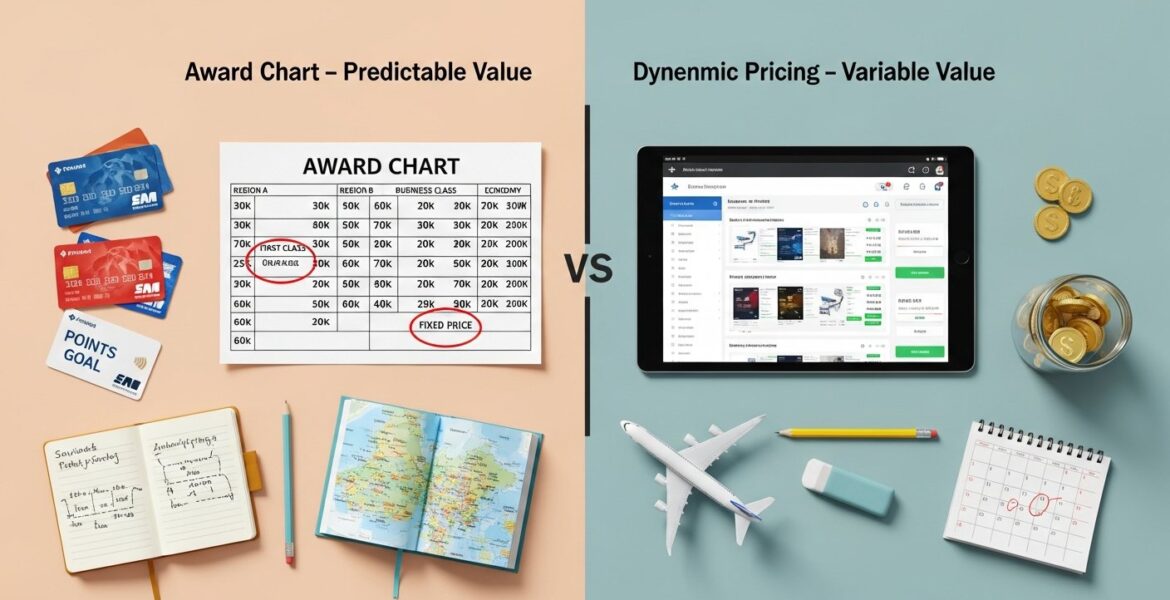
Illustration comparing airline award chart vs dynamic pricing for rewards, loyalty programs, and smart shopping
Uncategorized

Airline Award Chart Vs Dynamic Pricing

On June 2, 2026 by pubman


Airline Award Chart vs Dynamic Pricing: Navigating the Shifting Skies of Travel Rewards in 2026

By goldpoints Editorial Team — Senior editors with 10+ years of subject-matter experience.
Published 2026-05-26 · Last Updated 2026-05-26

Affiliate disclosure: This article may contain affiliate links. Recommendations are independent and editorially driven.

The landscape of airline loyalty programs has undergone a profound transformation over the past decade, leaving many travelers bewildered when trying to redeem their hard-earned points. At the heart of this evolution lies the fundamental divergence between two primary redemption models: the traditional airline award chart vs dynamic pricing. Understanding these distinct approaches is not merely academic; it is absolutely crucial for anyone aiming to maximize the value of their credit card rewards, travel points, and airline loyalty program balances. For the savvy points-and-miles strategist, distinguishing between these models can mean the difference between a luxurious international first-class redemption and an underwhelming economy ticket.

For decades, the airline award chart was the undisputed standard. These predictable tables offered a clear, albeit sometimes restrictive, path to free travel. A fixed number of miles would get you from point A to point B, or to a specific region, regardless of the cash price of the ticket. This simplicity allowed for meticulous planning and the identification of “sweet spots” – redemptions where the value per point soared. However, as the airline industry became more competitive and technologically advanced, the rigid award chart began to give way to a more fluid, market-driven system: dynamic pricing.

Dynamic pricing, by contrast, ties the number of points required for a flight directly to its fluctuating cash price. This means that if a cash ticket is expensive, the points required will also be high, and vice versa. While offering greater availability and often eliminating blackout dates, this model introduces significant volatility and unpredictability, challenging traditional points valuation strategies. It mirrors the real-time adjustments seen in ticket prices based on demand, season, route popularity, and even competitor pricing.

At goldpoints, we are dedicated to demystifying these complex systems. This comprehensive guide will delve deep into the intricacies of airline award chart vs dynamic pricing, providing you with the expert knowledge and strategic insights needed to navigate both models effectively. We will explore their mechanics, advantages, disadvantages, and the practical implications for your travel planning and points strategy in 2026 and beyond. Whether you’re a seasoned points earner or just beginning your journey into the world of travel rewards, mastering these concepts is your key to unlocking incredible value.

Understanding Airline Award Charts: The Fixed Value Proposition

Before the widespread adoption of dynamic pricing, the airline award chart reigned supreme. This model represented a covenant between the airline and its loyal customers, promising a fixed redemption rate for a given flight or region, irrespective of the fluctuating cash price. For many years, this predictability was the cornerstone of savvy points-and-miles strategies, allowing travelers to extract outsized value from their loyalty balances.

What is an Award Chart?

An award chart is essentially a published table that outlines the number of points or miles required for a free flight, typically broken down by cabin class (economy, business, first), geographic region, and sometimes distance. For instance, an airline might state that a round-trip economy flight from North America to Europe requires 60,000 miles, while a business class ticket on the same route costs 120,000 miles. These values are fixed and generally do not change day-to-day based on ticket demand or pricing, though airlines may update their charts annually or biannually.

The beauty of an award chart lies in its transparency and simplicity. Once you know your desired destination and cabin, you can consult the chart and immediately know how many miles you need. This clarity allows for long-term planning, saving towards a specific redemption goal, and identifying premium cabin redemptions that often deliver exceptional value compared to their cash price.

How Award Charts Work

Historically, award charts have followed several common structures:

  • Region-Based Charts: This is the most common type, where miles required depend on the origin and destination regions. For example, all flights between North America and Europe might cost the same number of miles, regardless of the specific cities.
  • Distance-Based Charts: Some airlines, particularly certain international carriers or alliance partners, use distance-based charts. The longer the flight, the more miles it costs. These can be particularly valuable for shorter, expensive flights or for constructing complex itineraries with multiple segments.
  • Zone-Based Charts: Similar to region-based, but often more granular, defining specific zones within continents.

When an airline utilizes an award chart, it allocates a certain number of seats on each flight for award redemptions. These are known as “award space” or “saver award availability.” The challenge for travelers is often finding this specific award space, especially for popular routes and premium cabins. While the miles cost is fixed, the availability of seats at that fixed price is not always guaranteed. Airlines often release a limited number of these seats, making early booking or flexible travel dates essential for securing desirable redemptions.

Advantages of Award Charts

  • Predictability and Planning: The greatest advantage is knowing exactly how many miles you need for a specific trip, enabling long-term savings and strategic earning. This predictability empowers travelers to set clear redemption goals.
  • High Potential Value: Award charts are famous for offering “sweet spots” – instances where the cash price of a ticket is exceptionally high (e.g., international business or first class), but the miles required are comparatively low. This can lead to a value of 3, 5, or even 10 cents per mile, far exceeding typical cash-back values.
  • Inflation Hedge: In a world of rising cash prices, the fixed nature of award charts can act as a hedge. While airlines may devalue their charts periodically, these changes are usually announced in advance, giving members time to redeem.
  • Premium Cabin Accessibility: For many, premium cabin travel would be prohibitively expensive with cash. Award charts make aspirational redemptions in business or first class a tangible goal, often at a fraction of the cash cost.

Disadvantages of Award Charts

  • Limited Availability: This is often the biggest hurdle. Airlines do not release all seats for award redemption, especially in premium cabins or on high-demand routes. Finding “saver” award space can be akin to hunting for treasure, requiring flexibility, persistence, and often the use of specialized search tools.
  • Blackout Dates: Although less common now than in the past, some award charts may still have blackout dates, restricting redemptions during peak travel periods.
  • Fixed Routes/Regions: The rigidity of region or distance definitions might not always align perfectly with a traveler’s exact itinerary, potentially leading to inefficient redemptions for complex routes.
  • Devaluation Risk: While predictable, award charts are subject to periodic devaluations (known as “surcharges” or “program changes”) where airlines increase the miles required for a given redemption. This reduces the value of accumulated miles.

Historical Context and Evolution

Award charts have a storied history, dating back to the inception of frequent flyer programs in the 1980s. They were designed to reward loyalty and foster repeat business, offering a tangible benefit for choosing a particular airline. Early charts were often incredibly generous, leading to iconic redemptions for a fraction of today’s mileage requirements. Over time, as programs matured and airlines faced increasing financial pressures, these charts began to tighten, with some devaluations occurring without prior notice. The shift towards alliance-based redemption (e.g., Star Alliance, Oneworld, SkyTeam) also added complexity, allowing members to redeem miles on partner airlines, each with their own rules and award space release strategies. The slow but steady erosion of easily accessible “saver” space on many routes ultimately paved the way for the rise of dynamic pricing as airlines sought more flexibility and revenue optimization.

Deciphering Dynamic Pricing: The Market-Driven Model

airline award chart vs dynamic pricing - photo 2 illustration

In stark contrast to the fixed values of award charts, dynamic pricing represents a fluid, market-responsive approach to point redemption. This model has gained significant traction among major airlines, fundamentally altering the way travelers earn and redeem their loyalty currency. For the goldpoints reader, understanding dynamic pricing is crucial for adapting your strategy and continuing to extract value in a less predictable environment.

[INLINE IMAGE 1: place after second H2 | alt=”airline award chart vs dynamic pricing concept illustration”]

What is Dynamic Pricing?

Dynamic pricing, in the context of airline loyalty programs, means that the number of points or miles required for a flight is directly tied to the current cash price of that same flight. There is no published award chart. Instead, the points cost fluctuates in real-time, mirroring the ebb and flow of ticket prices based on demand, seasonality, booking class availability, and even competitor pricing. If a cash ticket is cheap, the points price will generally be lower. If the cash ticket is expensive, the points required will likewise be high.

This model is often referred to as “revenue-based” redemption, as the value of your points is frequently linked to a fixed percentage of the ticket’s cash price. For example, an airline might price their points at 1 cent per point, meaning a $200 cash ticket would cost 20,000 points, and a $1,000 ticket would cost 100,000 points. While this offers simplicity in understanding the underlying valuation, the lack of fixed tiers eliminates the traditional “sweet spots” that award charts once provided.

How Dynamic Pricing Works

When you search for an award flight on an airline’s website that uses dynamic pricing, the system performs a real-time calculation. It looks at the current cash price for your desired flight, applies an internal algorithm, and then displays the corresponding points required. This calculation often incorporates:

  • Cash Fare: The primary driver. Higher cash fares mean higher point redemptions.
  • Demand: Flights with high demand (e.g., holidays, weekends, popular routes) will see cash prices rise, and thus, points required will also increase.
  • Time to Departure: As a flight gets closer to departure, cash prices often climb, especially for last-minute bookings. Dynamic pricing reflects this, making last-minute point redemptions potentially very expensive.
  • Cabin Class: Premium cabins, which have higher cash values, will naturally require more points under a dynamic pricing model.
  • Elite Status: Some airlines might offer slight discounts or improved availability for members with elite status, though this is less common than with award charts.

A key difference is that dynamic pricing usually means all seats (or almost all) are technically available for points redemption, as long as they are available for cash purchase. The question is not “is there award space?” but “how many points will it cost?” This eliminates the frustration of searching for elusive “saver” availability but replaces it with the challenge of finding a good points-to-cash value.

Advantages of Dynamic Pricing

  • Increased Availability: Generally, if there’s a seat available for cash, it’s available for points. This significantly reduces the frustration of finding award space and provides more flexibility, particularly for last-minute travel or less popular routes.
  • No Blackout Dates: Since redemptions are tied to cash prices, traditional blackout dates are effectively eliminated. You can fly when you want, provided you’re willing to pay the corresponding points.
  • Convenience: For many travelers, the simplicity of seeing a points price directly linked to a cash price is appealing. It requires less research and strategizing than deciphering award charts and hunting for availability.
  • Good Value for Cheap Cash Fares: When cash fares are very low (e.g., during sales, off-peak seasons, or on less popular routes), dynamic pricing can offer a decent redemption value, sometimes even matching or exceeding what a fixed award chart might offer for an economy ticket.

Disadvantages of Dynamic Pricing

  • Reduced “Sweet Spot” Potential: The biggest drawback for points-and-miles enthusiasts is the erosion of high-value redemptions. It becomes exceptionally rare to achieve significantly more than 1-1.5 cents per point, especially for premium cabins, as the points required scale directly with the high cash cost.
  • Unpredictability: Without a published chart, it’s impossible to know exactly how many points a flight will cost until you search. This makes long-term planning and saving for specific aspirational trips much harder.
  • Poor Value for Expensive Cash Fares: When cash prices skyrocket, so do the points required. Redeeming for peak-season, last-minute, or premium international flights often yields very poor value, sometimes less than 1 cent per point.
  • Difficulty in Valuation: Because the points price constantly changes, it’s harder to establish a consistent “value” for your miles, making it challenging to assess whether a particular redemption is “good” or “bad.”
  • Devaluation is Constant: Unlike award chart devaluations that happen periodically, dynamic pricing essentially devalues your points every time cash prices rise. Your points are constantly losing purchasing power when ticket prices increase.

Factors Influencing Dynamic Pricing

Airlines employ sophisticated algorithms to determine dynamic award pricing, considering numerous variables:

  • Route Popularity: High-demand routes, like major business corridors or popular tourist destinations, will typically see higher point requirements.
  • Time of Year/Seasonality: Holiday periods, school vacations, and peak travel seasons (e.g., summer in Europe) will drive up point costs significantly.
  • Day of Week: Weekends and specific travel days (e.g., Fridays/Sundays) often cost more points than mid-week travel.
  • Booking Lead Time: Last-minute bookings are almost universally more expensive in points, just as they are in cash. Conversely, booking far in advance (when cash prices are typically lower) can sometimes yield better point values.
  • Competitor Pricing: Airlines will adjust their cash fares, and thus their points fares, based on what competing airlines are charging for similar routes.
  • Ancillary Fees: While the base points price covers the ticket, some dynamic systems may still add carrier-imposed surcharges or taxes, though often less punitive than some award chart programs.

The prevalence of dynamic pricing is a clear indicator of airlines striving for revenue optimization and greater flexibility. For the traveler, it necessitates a shift in strategy from hunting for fixed “sweet spots” to diligently comparing cash prices against point requirements to ensure a reasonable return on their loyalty investment. This makes the choice between credit card travel rewards and cash back more nuanced than ever.

The Head-to-Head Battle: Award Chart vs. Dynamic Pricing

The core distinction between an airline award chart vs dynamic pricing lies in their fundamental approach to point valuation and redemption. One offers predictability and potential for outsized value, while the other prioritizes availability and real-time market alignment. For the discerning goldpoints reader, understanding how these models stack up against each other is paramount for optimizing travel strategies in 2026.

Redemption Value Comparison

This is arguably the most critical aspect for points strategists.

With award charts, the redemption value can be highly variable but has the potential to be extraordinarily high. For example, redeeming 70,000 miles for a business class flight that costs $5,000 cash yields a value of approximately 7.1 cents per mile. These are the fabled “sweet spots” that frequent flyer forums obsess over. However, if you redeem 25,000 miles for an economy ticket that costs $250, your value is 1 cent per mile. The key is that the *potential* for high value exists, though it often requires flexibility and diligent searching for “saver” availability.

Dynamic pricing, on the other hand, tends to cap the redemption value at a much lower, more consistent rate. Most dynamically priced programs aim for a redemption value of around 1 to 1.5 cents per point. This means a $5,000 business class flight might cost 350,000 to 500,000 points. While you’ll almost always get at least 1 cent per point, you’ll rarely, if ever, achieve the 5+ cents per point values possible with award charts. The trade-off is often guaranteed availability for whatever cash price is being offered.

Therefore, if your primary goal is to achieve maximum value per point for aspirational, premium cabin travel, award charts generally offer superior potential. If your goal is simply to offset the cost of any flight, regardless of extreme value, and you prioritize convenience and availability, dynamic pricing can be perfectly adequate.

Flexibility and Availability

This is where dynamic pricing typically shines, at least in terms of being able to book *a* flight.

Award charts, with their fixed mileage requirements, often come with significant restrictions on availability. Airlines release a limited number of “award seats” at the chart price. Once these seats are gone, you cannot redeem at that price, even if cash seats are still available. This means travelers often need to be flexible with their travel dates, times, or even destinations to find award space. Booking well in advance is frequently necessary for premium cabin awards. This model also often involves “blackout dates” or “peak pricing” periods where fixed awards are harder to find or cost more.

Dynamic pricing virtually eliminates these availability concerns. If a seat is available for cash, it’s generally available for points. This offers unparalleled flexibility for last-minute bookings, travel during peak seasons, or on popular routes. The trade-off, as discussed, is that these desirable flights will command a significantly higher number of points. For travelers with less flexibility in their dates but plenty of points, dynamic pricing can be a godsend, allowing them to travel when they need to, even if the per-point value isn’t stellar. This makes it a compelling choice for many travel points and loyalty programs.

Predictability vs. Volatility

The difference in predictability is stark.

An airline award chart offers a high degree of predictability. You know, generally, how many miles you’ll need for a flight between two regions. While award charts can be devalued, these changes are typically announced in advance (though sometimes with short notice), giving members a window to redeem their miles under the old rates. This allows for clear, long-term savings goals and a stable target for your points accumulation.

Dynamic pricing introduces significant volatility. The number of points required for a flight can change hourly, daily, or weekly, reflecting the constantly shifting cash price. This makes it challenging to plan far in advance or to even estimate how many points you’ll need for a future trip. It requires constant monitoring and quick decision-making when a “good” dynamic price appears. This volatility makes it harder to determine when you have enough points for a specific goal, as the goal itself is a moving target.

The Impact on Different Traveler Types

The choice between airline award chart vs dynamic pricing impacts various travelers differently:

  • Aspirational Travelers (Premium Cabins): These travelers typically seek to redeem for international business or first class, which would be unaffordable with cash. For them, award charts (especially those of foreign carriers or alliance partners) are often the superior choice, offering the potential for astronomical value. Dynamic pricing makes these redemptions prohibitively expensive in points.
  • Leisure Travelers (Economy): For those looking to save money on economy flights, both models can offer value. Award charts might have better “saver” rates if available, but dynamic pricing often provides more widespread availability for a reasonable number of points on cheaper routes.
  • Frequent Business Travelers: These individuals often have less flexibility and may need to book last-minute flights. Dynamic pricing, with its guaranteed availability, can be more practical, even if the value per point is lower. Their companies often pay for business class, so they are more focused on convenience.
  • Family Travelers: Finding multiple award seats on a single flight via an award chart can be very challenging. Dynamic pricing, which typically makes all available seats redeemable for points, might offer a more straightforward (though potentially more expensive) solution for families needing multiple seats on specific dates.
  • Budget-Conscious Travelers: These travelers are always seeking the absolute best value. They will likely favor award charts and the painstaking search for sweet spots, while also carefully monitoring dynamic prices for rare low-cost opportunities.

Ultimately, neither model is inherently “better” for all situations. The ideal approach often involves understanding both and strategically choosing which program or redemption type aligns best with your immediate travel needs and long-term points strategy.

Navigating the Landscape: Strategies for Maximizing Points

With the ongoing debate of airline award chart vs dynamic pricing, a savvy points and miles enthusiast must adopt a multi-faceted strategy to maximize their returns. The days of a single, universal approach are largely behind us. Instead, understanding when to leverage each model and how to adapt to their inherent characteristics is key for successful redemptions in 2026.

[INLINE IMAGE 2: place after fourth H2 | alt=”airline award chart vs dynamic pricing comparison illustration”]

Identifying Sweet Spots with Award Charts

Despite the prevalence of dynamic pricing, many airlines and their partners still utilize award charts, often presenting incredible “sweet spots” for those who know where to look:

  • Focus on Partner Redemptions: Many of the best award chart sweet spots come from redeeming miles on partner airlines, especially those in global alliances (Star Alliance, Oneworld, SkyTeam). For example, using Avianca LifeMiles or United MileagePlus (both Star Alliance) to fly on Lufthansa or ANA can yield fantastic business or first-class value, even if the issuing airline of those miles uses dynamic pricing for its own flights. Always check the partner award chart if available.
  • Utilize Transfer Partners: Credit card points like Chase Ultimate Rewards, Amex Membership Rewards, Capital One Miles, and Citi ThankYou Points transfer to various airline loyalty programs. This flexibility allows you to pick the best award chart for your desired redemption. Learn which transfer partners offer the best value for specific routes (e.g., Virgin Atlantic Flying Club for ANA First Class, British Airways Executive Club for short-haul American/Alaska flights).
  • Be Flexible with Dates and Destinations: Award chart availability, especially for premium cabins, is limited. The more flexible you are with your travel dates, and even your specific destination within a region, the higher your chances of finding those elusive “saver” seats.
  • Book in Advance (or Last-Minute): Many airlines release premium award space at the schedule opening (typically 330-360 days out). Booking as soon as this space is released can secure high-value redemptions. Alternatively, some airlines release additional award space close to departure (within a few weeks or days) if seats haven’t sold.
  • Consider Stopovers and Open-Jaws: Some award charts allow for stopovers or open-jaw itineraries, enabling you to visit multiple cities or fly into one city and out of another, often for the same mileage cost as a simple round-trip. This can dramatically increase the value of your redemption.

Finding Value in Dynamic Pricing

While dynamic pricing rarely offers “sweet spots” in the traditional sense, it doesn’t mean you can’t find good value:

  • Focus on Economy Sales: When cash fares are very low, dynamic pricing can sometimes offer redemptions that yield 1.2-1.5 cents per point, which is a solid return for economy travel. Be on the lookout for airline sales or off-peak travel periods.
  • Short-Haul Flights: For domestic or regional short-haul flights where cash prices are generally lower, dynamic pricing can often be competitive with or even better than paying cash, especially if you have a surplus of miles in that specific program.
  • Use Points for Convenience: Sometimes, the “value” isn’t just about cents per mile, but about convenience. If you absolutely need to fly on a specific date or route, and cash prices are prohibitively high, using points via dynamic pricing (even at a lower per-point value) can still be a good choice if it gets you where you need to go without breaking the bank.
  • Compare to Cash Price: Always, always compare the points price to the cash price. Calculate your cents per point value (Cash Price / Points Required) and determine if you’re comfortable with that return. A general benchmark for good value in dynamic programs is 1.2-1.5 cents per point. If it’s significantly lower, consider paying cash or exploring other options.
  • Beware of Peak Travel: Avoid using dynamically priced points for peak travel dates, holidays, or last-minute bookings unless absolutely necessary. The points required will likely be exorbitant, yielding very poor value.

Hybrid Programs and Best Practices

Many airlines operate a hybrid model, using an award chart for partner redemptions but dynamic pricing for their own flights. This necessitates a strategic blend of the above approaches:

  • Know Each Program’s Rules: Understand which of your airline loyalty programs use award charts (even if just for partners) and which are fully dynamic. This knowledge is fundamental.
  • Diversify Your Points Portfolio: Don’t put all your eggs in one basket. Hold transferable points (Chase, Amex, Capital One, Citi) as your primary currency, allowing you to transfer to the program that offers the best redemption for your specific trip. Also, maintain balances in a few key airline programs that offer distinct advantages.
  • Leverage Credit Card Benefits: Many premium travel credit cards offer benefits like companion certificates (which can enhance award chart value), annual travel credits, or bonus points on specific spending categories, which indirectly support your points strategy regardless of the redemption model.
  • Stay Informed: Airlines constantly adjust their programs. Follow reputable points-and-miles blogs (like goldpoints!) to stay updated on devaluations, new sweet spots, and changes in redemption policies.
  • Consider Credit Card Portal Redemptions: For some credit card programs, redeeming points directly through their travel portal is an option. While often a fixed 1-1.5 cents per point value (similar to dynamic pricing), it offers incredible flexibility as you can book virtually any flight. This can be a strong alternative when award space is absent or dynamic pricing is too high.

The Role of Elite Status

Elite status can play a subtle yet significant role in both award chart and dynamic pricing environments:

  • Award Chart: Some airlines offer better award availability or slightly reduced mileage costs to elite members on their own flights. More commonly, elite status on a particular airline (e.g., American Airlines AAdvantage status) provides status within its alliance (Oneworld Sapphire), which can sometimes grant preferential access or priority on waitlists for partner award seats.
  • Dynamic Pricing: While less impactful on the base points cost, elite status might offer minor point discounts or more favorable redemption options on specific dynamically priced routes. Crucially, elite status often waives close-in booking fees or change/cancellation fees for award tickets, making last-minute redemptions or flexible planning more palatable, even if the points cost is higher.

In essence, maximizing points in the era of airline award chart vs dynamic pricing requires a hybrid mindset. Be opportunistic with dynamic pricing when cash fares are low, and be diligent and strategic when pursuing those high-value award chart redemptions.

Real-World Examples: Airlines and Their Redemption Models

To truly grasp the implications of the airline award chart vs dynamic pricing debate, it’s essential to look at how different airlines implement these models. The global landscape is a mosaic of approaches, with some carriers sticking to traditional charts, others fully embracing dynamic pricing, and many adopting a hybrid strategy.

Comparison Table: Airline Redemption Models

Here’s a snapshot of how some major airlines approach point redemptions in 2026:

Airline (Loyalty Program) Primary Redemption Model for Own Flights Approach for Partner Flights Key Characteristics & Strategy Notes
United Airlines (MileagePlus) Dynamic Pricing (own flights) Award Chart (for Star Alliance partners) Generally better value for partner redemptions; “Excursionist Perk” offers a free one-way in some itineraries. Watch for saver space on partners.
Delta Air Lines (SkyMiles) Dynamic Pricing (own flights) Dynamic Pricing (for most SkyTeam partners) Known for highly variable pricing; values can be poor for premium cabins. Look for “flash sales” or low cash fares for best value.
American Airlines (AAdvantage) Hybrid (some fixed “Web Specials,” mostly dynamic) Award Chart (for Oneworld partners) “Web Specials” can offer great value for own flights. Strong for Oneworld partner redemptions (e.g., Cathay Pacific, JAL).
Southwest Airlines (Rapid Rewards) Dynamic Pricing (revenue-based) No partners Points value is very consistent (~1.3-1.6 cents per point). Great for domestic flexibility; no blackout dates.
British Airways (Executive Club) Distance-Based Award Chart (own flights) Distance-Based Award Chart (for Oneworld partners) Excellent for short-haul flights (sweet spot). High fuel surcharges on long-haul premium redemptions for BA’s own flights.
Air Canada (Aeroplan) Hybrid (some dynamic bands, some fixed zones) Distance-Based Award Chart (for Star Alliance partners) Complex but generally highly valuable for Star Alliance partner redemptions. Offers stopovers for additional miles.
ANA (Mileage Club) Distance-Based Award Chart (own flights) Distance-Based Award Chart (for Star Alliance partners) Incredibly high value for round-trip premium cabin redemptions, especially on ANA itself. Watch for fuel surcharges.
Emirates (Skywards) Dynamic Pricing (own flights, some fixed saver) Award Chart (for partner flights) Value varies wildly on own flights; can be good for economy. Partner chart (e.g., Japan Airlines) can offer strong value.

Airlines Favoring Award Charts (or Hybrid with Strong Chart Elements)

While a pure award chart is becoming a rarity for an airline’s *own* flights, many still maintain them for partner redemptions, or employ a heavily structured hybrid system. These are the programs where points-and-miles enthusiasts often find the most aspirational value:

  • British Airways Executive Club (Avios): Known for its distance-based chart, Avios can be incredibly valuable for short-haul flights on British Airways or its Oneworld partners like American Airlines. However, long-haul redemptions on BA metal often incur high fuel surcharges.
  • ANA Mileage Club: A Star Alliance member, ANA offers a stellar distance-based award chart for its own flights and partners, particularly for round-trip business and first-class redemptions. It’s often a target for transferred Amex Membership Rewards or Marriott Bonvoy points.
  • Air Canada Aeroplan: This program offers a unique zone-and-distance hybrid chart for its own and Star Alliance partner flights. While complex, it allows for stopovers and can provide exceptional value for multi-leg international itineraries in premium cabins.
  • Alaska Airlines Mileage Plan: Known for separate award charts for each of its diverse partners (e.g., Cathay Pacific, JAL, British Airways, Qantas), some of which offer incredible value for premium cabin redemptions to Asia.

The strategy here is to acquire transferable points (like Amex, Chase, Capital One) and then transfer them to these programs when a specific award chart “sweet spot” becomes available for booking. This requires planning and often a quick trigger finger.

Airlines Embracing Dynamic Pricing

Many of the major U.S. carriers have fully or largely transitioned to dynamic pricing for their own flights. This often means consistent, though less exciting, redemption values.

  • Delta SkyMiles: A pioneer in dynamic pricing, SkyMiles values fluctuate significantly. While you can sometimes find decent economy redemptions during sales, premium cabins often require a huge number of miles, making high-value redemptions rare.
  • United MileagePlus: While maintaining an award chart for Star Alliance partners, United’s own flights are dynamically priced. This means you might pay vastly different amounts for the same route on different days. United’s lack of “saver” space on its own flights for partners makes it hard for other Star Alliance programs to book United metal at fixed rates.
  • Southwest Rapid Rewards: Southwest’s program is a pure revenue-based dynamic model. Points have a relatively fixed value (around 1.3-1.6 cents per point), making it easy to calculate your return. Great for domestic flexibility but no aspirational premium redemptions as Southwest has only economy.

For these airlines, the strategy shifts to comparing the points price against the cash price, looking for opportunities when cash fares are low, and using points for convenience or when you absolutely need to fly a particular route without breaking the bank.

Hybrid Models and Their Nuances

Many airlines operate a blend, attempting to offer the best of both worlds, or perhaps more accurately, trying to optimize revenue while still offering loyalty benefits.

  • American Airlines AAdvantage: While many of its own domestic and some international flights are dynamically priced, AAdvantage still maintains fixed award charts for its Oneworld partners. Furthermore, AAdvantage frequently offers “Web Specials” – dynamically priced awards on its own flights that can sometimes be very competitive, but these are often non-changeable.
  • Air France/KLM Flying Blue: This SkyTeam program has a region-based award chart that acts as a baseline, but the actual miles required often fluctuate dynamically within “bands” around those chart values. They also frequently run “Promo Rewards” for discounted dynamic redemptions. Partner flights, however, often adhere to more fixed, though sometimes higher, rates.

Navigating hybrid models requires a keen eye for detail. You need to know when a program is acting like an award chart (e.g., for partner flights) and when it’s behaving dynamically (e.g., for its own flights). This dual approach means carefully weighing the potential for high value against the ease of availability, constantly adapting your points-and-miles strategy to the specific redemption.

The Future of Airline Loyalty: What to Expect in 2026 and Beyond

airline award chart vs dynamic pricing - chart 6 illustration

The debate between airline award chart vs dynamic pricing is not static; it’s an evolving narrative within the travel industry. As we look towards 2026 and beyond, it’s clear that both models will continue to shape how we earn and burn our travel points. Understanding the trajectory of these trends is vital for any goldpoints reader serious about long-term points maximization.

Trend Towards Dynamic Pricing

The overwhelming trend in the airline loyalty space is a continued shift towards dynamic pricing, especially for an airline’s own flights. Several factors underpin this move:

  • Revenue Optimization: Dynamic pricing allows airlines to extract maximum revenue from every seat. They can adjust points costs in real-time to match demand, ensuring they never “lose money” by offering a fixed award seat at a price far below its cash value


    Airline Award Chart vs Dynamic Pricing: Navigating the Shifting Skies of Travel Rewards in 2026

    By goldpoints Editorial Team — Senior editors with 10+ years of subject-matter experience.
    Published 2026-05-26 · Last Updated 2026-05-26

    Affiliate disclosure: This article may contain affiliate links. Recommendations are independent and editorially driven.

    The landscape of airline loyalty programs has undergone a profound transformation over the past decade, leaving many travelers bewildered when trying to redeem their hard-earned points. At the heart of this evolution lies the fundamental divergence between two primary redemption models: the traditional airline award chart vs dynamic pricing. Understanding these distinct approaches is not merely academic; it is absolutely crucial for anyone aiming to maximize the value of their credit card rewards, travel points, and airline loyalty program balances. For the savvy points-and-miles strategist, distinguishing between these models can mean the difference between a luxurious international first-class redemption and an underwhelming economy ticket.

    For decades, the airline award chart was the undisputed standard. These predictable tables offered a clear, albeit sometimes restrictive, path to free travel. A fixed number of miles would get you from point A to point B, or to a specific region, regardless of the cash price of the ticket. This simplicity allowed for meticulous planning and the identification of “sweet spots” – redemptions where the value per point soared. However, as the airline industry became more competitive and technologically advanced, the rigid award chart began to give way to a more fluid, market-driven system: dynamic pricing.

    Dynamic pricing, by contrast, ties the number of points required for a flight directly to its fluctuating cash price. This means that if a cash ticket is expensive, the points required will also be high, and vice versa. While offering greater availability and often eliminating blackout dates, this model introduces significant volatility and unpredictability, challenging traditional points valuation strategies. It mirrors the real-time adjustments seen in ticket prices based on demand, season, route popularity, and even competitor pricing.

    At goldpoints, we are dedicated to demystifying these complex systems. This comprehensive guide will delve deep into the intricacies of airline award chart vs dynamic pricing, providing you with the expert knowledge and strategic insights needed to navigate both models effectively. We will explore their mechanics, advantages, disadvantages, and the practical implications for your travel planning and points strategy in 2026 and beyond. Whether you’re a seasoned points earner or just beginning your journey into the world of travel rewards, mastering these concepts is your key to unlocking incredible value.

    Understanding Airline Award Charts: The Fixed Value Proposition

    Before the widespread adoption of dynamic pricing, the airline award chart reigned supreme. This model represented a covenant between the airline and its loyal customers, promising a fixed redemption rate for a given flight or region, irrespective of the fluctuating cash price. For many years, this predictability was the cornerstone of savvy points-and-miles strategies, allowing travelers to extract outsized value from their loyalty balances.

    What is an Award Chart?

    An award chart is essentially a published table that outlines the number of points or miles required for a free flight, typically broken down by cabin class (economy, business, first), geographic region, and sometimes distance. For instance, an airline might state that a round-trip economy flight from North America to Europe requires 60,000 miles, while a business class ticket on the same route costs 120,000 miles. These values are fixed and generally do not change day-to-day based on ticket demand or pricing, though airlines may update their charts annually or biannually.

    The beauty of an award chart lies in its transparency and simplicity. Once you know your desired destination and cabin, you can consult the chart and immediately know how many miles you need. This clarity allows for long-term planning, saving towards a specific redemption goal, and identifying premium cabin redemptions that often deliver exceptional value compared to their cash price.

    How Award Charts Work

    Historically, award charts have followed several common structures:

    • Region-Based Charts: This is the most common type, where miles required depend on the origin and destination regions. For example, all flights between North America and Europe might cost the same number of miles, regardless of the specific cities.
    • Distance-Based Charts: Some airlines, particularly certain international carriers or alliance partners, use distance-based charts. The longer the flight, the more miles it costs. These can be particularly valuable for shorter, expensive flights or for constructing complex itineraries with multiple segments.
    • Zone-Based Charts: Similar to region-based, but often more granular, defining specific zones within continents.

    When an airline utilizes an award chart, it allocates a certain number of seats on each flight for award redemptions. These are known as “award space” or “saver award availability.” The challenge for travelers is often finding this specific award space, especially for popular routes and premium cabins. While the miles cost is fixed, the availability of seats at that fixed price is not always guaranteed. Airlines often release a limited number of these seats, making early booking or flexible travel dates essential for securing desirable redemptions.

    Advantages of Award Charts

    • Predictability and Planning: The greatest advantage is knowing exactly how many miles you need for a specific trip, enabling long-term savings and strategic earning. This predictability empowers travelers to set clear redemption goals.
    • High Potential Value: Award charts are famous for offering “sweet spots” – instances where the cash price of a ticket is exceptionally high (e.g., international business or first class), but the miles required are comparatively low. This can lead to a value of 3, 5, or even 10 cents per mile, far exceeding typical cash-back values.
    • Inflation Hedge: In a world of rising cash prices, the fixed nature of award charts can act as a hedge. While airlines may devalue their charts periodically, these changes are usually announced in advance, giving members time to redeem.
    • Premium Cabin Accessibility: For many, premium cabin travel would be prohibitively expensive with cash. Award charts make aspirational redemptions in business or first class a tangible goal, often at a fraction of the cash cost.

    Disadvantages of Award Charts

    • Limited Availability: This is often the biggest hurdle. Airlines do not release all seats for award redemption, especially in premium cabins or on high-demand routes. Finding “saver” award space can be akin to hunting for treasure, requiring flexibility, persistence, and often the use of specialized search tools.
    • Blackout Dates: Although less common now than in the past, some award charts may still have blackout dates, restricting redemptions during peak travel periods.
    • Fixed Routes/Regions: The rigidity of region or distance definitions might not always align perfectly with a traveler’s exact itinerary, potentially leading to inefficient redemptions for complex routes.
    • Devaluation Risk: While predictable, award charts are subject to periodic devaluations (known as “surcharges” or “program changes”) where airlines increase the miles required for a given redemption. This reduces the value of accumulated miles.

    Historical Context and Evolution

    Award charts have a storied history, dating back to the inception of frequent flyer programs in the 1980s. They were designed to reward loyalty and foster repeat business, offering a tangible benefit for choosing a particular airline. Early charts were often incredibly generous, leading to iconic redemptions for a fraction of today’s mileage requirements. Over time, as programs matured and airlines faced increasing financial pressures, these charts began to tighten, with some devaluations occurring without prior notice. The shift towards alliance-based redemption (e.g., Star Alliance, Oneworld, SkyTeam) also added complexity, allowing members to redeem miles on partner airlines, each with their own rules and award space release strategies. The slow but steady erosion of easily accessible “saver” space on many routes ultimately paved the way for the rise of dynamic pricing as airlines sought more flexibility and revenue optimization.

    Deciphering Dynamic Pricing: The Market-Driven Model

    In stark contrast to the fixed values of award charts, dynamic pricing represents a fluid, market-responsive approach to point redemption. This model has gained significant traction among major airlines, fundamentally altering the way travelers earn and redeem their loyalty currency. For the goldpoints reader, understanding dynamic pricing is crucial for adapting your strategy and continuing to extract value in a less predictable environment.

    [INLINE IMAGE 1: place after second H2 | alt=”airline award chart vs dynamic pricing concept illustration”]

    What is Dynamic Pricing?

    Dynamic pricing, in the context of airline loyalty programs, means that the number of points or miles required for a flight is directly tied to the current cash price of that same flight. There is no published award chart. Instead, the points cost fluctuates in real-time, mirroring the ebb and flow of ticket prices based on demand, seasonality, booking class availability, and even competitor pricing. If a cash ticket is cheap, the points price will generally be lower. If the cash ticket is expensive, the points required will likewise be high.

    This model is often referred to as “revenue-based” redemption, as the value of your points is frequently linked to a fixed percentage of the ticket’s cash price. For example, an airline might price their points at 1 cent per point, meaning a $200 cash ticket would cost 20,000 points, and a $1,000 ticket would cost 100,000 points. While this offers simplicity in understanding the underlying valuation, the lack of fixed tiers eliminates the traditional “sweet spots” that award charts once provided.

    How Dynamic Pricing Works

    When you search for an award flight on an airline’s website that uses dynamic pricing, the system performs a real-time calculation. It looks at the current cash price for your desired flight, applies an internal algorithm, and then displays the corresponding points required. This calculation often incorporates:

    • Cash Fare: The primary driver. Higher cash fares mean higher point redemptions.
    • Demand: Flights with high demand (e.g., holidays, weekends, popular routes) will see cash prices rise, and thus, points required will also increase.
    • Time to Departure: As a flight gets closer to departure, cash prices often climb, especially for last-minute bookings. Dynamic pricing reflects this, making last-minute point redemptions potentially very expensive.
    • Cabin Class: Premium cabins, which have higher cash values, will naturally require more points under a dynamic pricing model.
    • Elite Status: Some airlines might offer slight discounts or improved availability for members with elite status, though this is less common than with award charts.

    A key difference is that dynamic pricing usually means all seats (or almost all) are technically available for points redemption, as long as they are available for cash purchase. The question is not “is there award space?” but “how many points will it cost?” This eliminates the frustration of searching for elusive “saver” availability but replaces it with the challenge of finding a good points-to-cash value.

    Advantages of Dynamic Pricing

    • Increased Availability: Generally, if there’s a seat available for cash, it’s available for points. This significantly reduces the frustration of finding award space and provides more flexibility, particularly for last-minute travel or less popular routes.
    • No Blackout Dates: Since redemptions are tied to cash prices, traditional blackout dates are effectively eliminated. You can fly when you want, provided you’re willing to pay the corresponding points.
    • Convenience: For many travelers, the simplicity of seeing a points price directly linked to a cash price is appealing. It requires less research and strategizing than deciphering award charts and hunting for availability.
    • Good Value for Cheap Cash Fares: When cash fares are very low (e.g., during sales, off-peak seasons, or on less popular routes), dynamic pricing can offer a decent redemption value, sometimes even matching or exceeding what a fixed award chart might offer for an economy ticket.

    Disadvantages of Dynamic Pricing

    • Reduced “Sweet Spot” Potential: The biggest drawback for points-and-miles enthusiasts is the erosion of high-value redemptions. It becomes exceptionally rare to achieve significantly more than 1-1.5 cents per point, especially for premium cabins, as the points required scale directly with the high cash cost.
    • Unpredictability: Without a published chart, it’s impossible to know exactly how many points a flight will cost until you search. This makes long-term planning and saving for specific aspirational trips much harder.
    • Poor Value for Expensive Cash Fares: When cash prices skyrocket, so do the points required. Redeeming for peak-season, last-minute, or premium international flights often yields very poor value, sometimes less than 1 cent per point.
    • Difficulty in Valuation: Because the points price constantly changes, it’s harder to establish a consistent “value” for your miles, making it challenging to assess whether a particular redemption is “good” or “bad.”
    • Devaluation is Constant: Unlike award chart devaluations that happen periodically, dynamic pricing essentially devalues your points every time cash prices rise. Your points are constantly losing purchasing power when ticket prices increase.

    Factors Influencing Dynamic Pricing

    Airlines employ sophisticated algorithms to determine dynamic award pricing, considering numerous variables:

    • Route Popularity: High-demand routes, like major business corridors or popular tourist destinations, will typically see higher point requirements.
    • Time of Year/Seasonality: Holiday periods, school vacations, and peak travel seasons (e.g., summer in Europe) will drive up point costs significantly.
    • Day of Week: Weekends and specific travel days (e.g., Fridays/Sundays) often cost more points than mid-week travel.
    • Booking Lead Time: Last-minute bookings are almost universally more expensive in points, just as they are in cash. Conversely, booking far in advance (when cash prices are typically lower) can sometimes yield better point values.
    • Competitor Pricing: Airlines will adjust their cash fares, and thus their points fares, based on what competing airlines are charging for similar routes.
    • Ancillary Fees: While the base points price covers the ticket, some dynamic systems may still add carrier-imposed surcharges or taxes, though often less punitive than some award chart programs.

    The prevalence of dynamic pricing is a clear indicator of airlines striving for revenue optimization and greater flexibility. For the traveler, it necessitates a shift in strategy from hunting for fixed “sweet spots” to diligently comparing cash prices against point requirements to ensure a reasonable return on their loyalty investment. This makes the choice between credit card travel rewards and cash back more nuanced than ever.

    The Head-to-Head Battle: Award Chart vs. Dynamic Pricing

    The core distinction between an airline award chart vs dynamic pricing lies in their fundamental approach to point valuation and redemption. One offers predictability and potential for outsized value, while the other prioritizes availability and real-time market alignment. For the discerning goldpoints reader, understanding how these models stack up against each other is paramount for optimizing travel strategies in 2026.

    Redemption Value Comparison

    This is arguably the most critical aspect for points strategists.

    With award charts, the redemption value can be highly variable but has the potential to be extraordinarily high. For example, redeeming 70,000 miles for a business class flight that costs $5,000 cash yields a value of approximately 7.1 cents per mile. These are the fabled “sweet spots” that frequent flyer forums obsess over. However, if you redeem 25,000 miles for an economy ticket that costs $250, your value is 1 cent per mile. The key is that the *potential* for high value exists, though it often requires flexibility and diligent searching for “saver” availability.

    Dynamic pricing, on the other hand, tends to cap the redemption value at a much lower, more consistent rate. Most dynamically priced programs aim for a redemption value of around 1 to 1.5 cents per point. This means a $5,000 business class flight might cost 350,000 to 500,000 points. While you’ll almost always get at least 1 cent per point, you’ll rarely, if ever, achieve the 5+ cents per point values possible with award charts. The trade-off is often guaranteed availability for whatever cash price is being offered.

    Therefore, if your primary goal is to achieve maximum value per point for aspirational, premium cabin travel, award charts generally offer superior potential. If your goal is simply to offset the cost of any flight, regardless of extreme value, and you prioritize convenience and availability, dynamic pricing can be perfectly adequate.

    Flexibility and Availability

    This is where dynamic pricing typically shines, at least in terms of being able to book *a* flight.

    Award charts, with their fixed mileage requirements, often come with significant restrictions on availability. Airlines release a limited number of “award seats” at the chart price. Once these seats are gone, you cannot redeem at that price, even if cash seats are still available. This means travelers often need to be flexible with their travel dates, times, or even destinations to find award space. Booking well in advance is frequently necessary for premium cabin awards. This model also often involves “blackout dates” or “peak pricing” periods where fixed awards are harder to find or cost more.

    Dynamic pricing virtually eliminates these availability concerns. If a seat is available for cash, it’s generally available for points. This offers unparalleled flexibility for last-minute bookings, travel during peak seasons, or on popular routes. The trade-off, as discussed, is that these desirable flights will command a significantly higher number of points. For travelers with less flexibility in their dates but plenty of points, dynamic pricing can be a godsend, allowing them to travel when they need to, even if the per-point value isn’t stellar. This makes it a compelling choice for many travel points and loyalty programs.

    Predictability vs. Volatility

    The difference in predictability is stark.

    An airline award chart offers a high degree of predictability. You know, generally, how many miles you’ll need for a flight between two regions. While award charts can be devalued, these changes are typically announced in advance (though sometimes with short notice), giving members a window to redeem their miles under the old rates. This allows for clear, long-term savings goals and a stable target for your points accumulation.

    Dynamic pricing introduces significant volatility. The number of points required for a flight can change hourly, daily, or weekly, reflecting the constantly shifting cash price. This makes it challenging to plan far in advance or to even estimate how many points you’ll need for a future trip. It requires constant monitoring and quick decision-making when a “good” dynamic price appears. This volatility makes it harder to determine when you have enough points for a specific goal, as the goal itself is a moving target.

    The Impact on Different Traveler Types

    The choice between airline award chart vs dynamic pricing impacts various travelers differently:

    • Aspirational Travelers (Premium Cabins): These travelers typically seek to redeem for international business or first class, which would be unaffordable with cash. For them, award charts (especially those of foreign carriers or alliance partners) are often the superior choice, offering the potential for astronomical value. Dynamic pricing makes these redemptions prohibitively expensive in points.
    • Leisure Travelers (Economy): For those looking to save money on economy flights, both models can offer value. Award charts might have better “saver” rates if available, but dynamic pricing often provides more widespread availability for a reasonable number of points on cheaper routes.
    • Frequent Business Travelers: These individuals often have less flexibility and may need to book last-minute flights. Dynamic pricing, with its guaranteed availability, can be more practical, even if the value per point is lower. Their companies often pay for business class, so they are more focused on convenience.
    • Family Travelers: Finding multiple award seats on a single flight via an award chart can be very challenging. Dynamic pricing, which typically makes all available seats redeemable for points, might offer a more straightforward (though potentially more expensive) solution for families needing multiple seats on specific dates.
    • Budget-Conscious Travelers: These travelers are always seeking the absolute best value. They will likely favor award charts and the painstaking search for sweet spots, while also carefully monitoring dynamic prices for rare low-cost opportunities.

    Ultimately, neither model is inherently “better” for all situations. The ideal approach often involves understanding both and strategically choosing which program or redemption type aligns best with your immediate travel needs and long-term points strategy.

    Navigating the Landscape: Strategies for Maximizing Points

    With the ongoing debate of airline award chart vs dynamic pricing, a savvy points and miles enthusiast must adopt a multi-faceted strategy to maximize their returns. The days of a single, universal approach are largely behind us. Instead, understanding when to leverage each model and how to adapt to their inherent characteristics is key for successful redemptions in 2026.

    [INLINE IMAGE 2: place after fourth H2 | alt=”airline award chart vs dynamic pricing comparison illustration”]

    Identifying Sweet Spots with Award Charts

    Despite the prevalence of dynamic pricing, many airlines and their partners still utilize award charts, often presenting incredible “sweet spots” for those who know where to look:

    • Focus on Partner Redemptions: Many of the best award chart sweet spots come from redeeming miles on partner airlines, especially those in global alliances (Star Alliance, Oneworld, SkyTeam). For example, using Avianca LifeMiles or United MileagePlus (both Star Alliance) to fly on Lufthansa or ANA can yield fantastic business or first-class value, even if the issuing airline of those miles uses dynamic pricing for its own flights. Always check the partner award chart if available.
    • Utilize Transfer Partners: Credit card points like Chase Ultimate Rewards, Amex Membership Rewards, Capital One Miles, and Citi ThankYou Points transfer to various airline loyalty programs. This flexibility allows you to pick the best award chart for your desired redemption. Learn which transfer partners offer the best value for specific routes (e.g., Virgin Atlantic Flying Club for ANA First Class, British Airways Executive Club for short-haul American/Alaska flights).
    • Be Flexible with Dates and Destinations: Award chart availability, especially for premium cabins, is limited. The more flexible you are with your travel dates, and even your specific destination within a region, the higher your chances of finding those elusive “saver” seats.
    • Book in Advance (or Last-Minute): Many airlines release premium award space at the schedule opening (typically 330-360 days out). Booking as soon as this space is released can secure high-value redemptions. Alternatively, some airlines release additional award space close to departure (within a few weeks or days) if seats haven’t sold.
    • Consider Stopovers and Open-Jaws: Some award charts allow for stopovers or open-jaw itineraries, enabling you to visit multiple cities or fly into one city and out of another, often for the same mileage cost as a simple round-trip. This can dramatically increase the value of your redemption.

    Finding Value in Dynamic Pricing

    While dynamic pricing rarely offers “sweet spots” in the traditional sense, it doesn’t mean you can’t find good value:

    • Focus on Economy Sales: When cash fares are very low, dynamic pricing can sometimes offer redemptions that yield 1.2-1.5 cents per point, which is a solid return for economy travel. Be on the lookout for airline sales or off-peak travel periods.
    • Short-Haul Flights: For domestic or regional short-haul flights where cash prices are generally lower, dynamic pricing can often be competitive with or even better than paying cash, especially if you have a surplus of miles in that specific program.
    • Use Points for Convenience: Sometimes, the “value” isn’t just about cents per mile, but about convenience. If you absolutely need to fly on a specific date or route, and cash prices are prohibitively high, using points via dynamic pricing (even at a lower per-point value) can still be a good choice if it gets you where you need to go without breaking the bank.
    • Compare to Cash Price: Always, always compare the points price to the cash price. Calculate your cents per point value (Cash Price / Points Required) and determine if you’re comfortable with that return. A general benchmark for good value in dynamic programs is 1.2-1.5 cents per point. If it’s significantly lower, consider paying cash or exploring other options.
    • Beware of Peak Travel: Avoid using dynamically priced points for peak travel dates, holidays, or last-minute bookings unless absolutely necessary. The points required will likely be exorbitant, yielding very poor value.

    Hybrid Programs and Best Practices

    Many airlines operate a hybrid model, using an award chart for partner redemptions but dynamic pricing for their own flights. This necessitates a strategic blend of the above approaches:

    • Know Each Program’s Rules: Understand which of your airline loyalty programs use award charts (even if just for partners) and which are fully dynamic. This knowledge is fundamental.
    • Diversify Your Points Portfolio: Don’t put all your eggs in one basket. Hold transferable points (Chase, Amex, Capital One, Citi) as your primary currency, allowing you to transfer to the program that offers the best redemption for your specific trip. Also, maintain balances in a few key airline programs that offer distinct advantages.
    • Leverage Credit Card Benefits: Many premium travel credit cards offer benefits like companion certificates (which can enhance award chart value), annual travel credits, or bonus points on specific spending categories, which indirectly support your points strategy regardless of the redemption model.
    • Stay Informed: Airlines constantly adjust their programs. Follow reputable points-and-miles blogs (like goldpoints!) to stay updated on devaluations, new sweet spots, and changes in redemption policies.
    • Consider Credit Card Portal Redemptions: For some credit card programs, redeeming points directly through their travel portal is an option. While often a fixed 1-1.5 cents per point value (similar to dynamic pricing), it offers incredible flexibility as you can book virtually any flight. This can be a strong alternative when award space is absent or dynamic pricing is too high.

    The Role of Elite Status

    Elite status can play a subtle yet significant role in both award chart and dynamic pricing environments:

    • Award Chart: Some airlines offer better award availability or slightly reduced mileage costs to elite members on their own flights. More commonly, elite status on a particular airline (e.g., American Airlines AAdvantage status) provides status within its alliance (Oneworld Sapphire), which can sometimes grant preferential access or priority on waitlists for partner award seats.
    • Dynamic Pricing: While less impactful on the base points cost, elite status might offer minor point discounts or more favorable redemption options on specific dynamically priced routes. Crucially, elite status often waives close-in booking fees or change/cancellation fees for award tickets, making last-minute redemptions or flexible planning more palatable, even if the points cost is higher.

    In essence, maximizing points in the era of airline award chart vs dynamic pricing requires a hybrid mindset. Be opportunistic with dynamic pricing when cash fares are low, and be diligent and strategic when pursuing those high-value award chart redemptions.

    Real-World Examples: Airlines and Their Redemption Models

    To truly grasp the implications of the airline award chart vs dynamic pricing debate, it’s essential to look at how different airlines implement these models. The global landscape is a mosaic of approaches, with some carriers sticking to traditional charts, others fully embracing dynamic pricing, and many adopting a hybrid strategy.

    Comparison Table: Airline Redemption Models

    Here’s a snapshot of how some major airlines approach point redemptions in 2026:

    Airline (Loyalty Program) Primary Redemption Model for Own Flights Approach for Partner Flights Key Characteristics & Strategy Notes
    United Airlines (MileagePlus) Dynamic Pricing (own flights) Award Chart (for Star Alliance partners) Generally better value for partner redemptions; “Excursionist Perk” offers a free one-way in some itineraries. Watch for saver space on partners.
    Delta Air Lines (SkyMiles) Dynamic Pricing (own flights) Dynamic Pricing (for most SkyTeam partners) Known for highly variable pricing; values can be poor for premium cabins. Look for “flash sales” or low cash fares for best value.
    American Airlines (AAdvantage) Hybrid (some fixed “Web Specials,” mostly dynamic) Award Chart (for Oneworld partners) “Web Specials” can offer great value for own flights. Strong for Oneworld partner redemptions (e.g., Cathay Pacific, JAL).
    Southwest Airlines (Rapid Rewards) Dynamic Pricing (revenue-based) No partners Points value is very consistent (~1.3-1.6 cents per point). Great for domestic flexibility; no blackout dates.
    British Airways (Executive Club) Distance-Based Award Chart (own flights) Distance-Based Award Chart (for Oneworld partners) Excellent for short-haul flights (sweet spot). High fuel surcharges on long-haul premium redemptions for BA’s own flights.
    Air Canada (Aeroplan) Hybrid (some dynamic bands, some fixed zones) Distance-Based Award Chart (for Star Alliance partners) Complex but generally highly valuable for Star Alliance partner redemptions. Offers stopovers for additional miles.
    ANA (Mileage Club) Distance-Based Award Chart (own flights) Distance-Based Award Chart (for Star Alliance partners) Incredibly high value for round-trip premium cabin redemptions, especially on ANA itself. Watch for fuel surcharges.
    Emirates (Skywards) Dynamic Pricing (own flights, some fixed saver) Award Chart (for partner flights) Value varies wildly on own flights; can be good for economy. Partner chart (e.g., Japan Airlines) can offer strong value.

    Airlines Favoring Award Charts (or Hybrid with Strong Chart Elements)

    While a pure award chart is becoming a rarity for an airline’s *own* flights, many still maintain them for partner redemptions, or employ a heavily structured hybrid system. These are the programs where points-and-miles enthusiasts often find the most aspirational value:

    • British Airways Executive Club (Avios): Known for its distance-based chart, Avios can be incredibly valuable for short-haul flights on British Airways or its Oneworld partners like American Airlines. However, long-haul redemptions on BA metal often incur high fuel surcharges.
    • ANA Mileage Club: A Star Alliance member, ANA offers a stellar distance-based award chart for its own flights and partners, particularly for round-trip business and first-class redemptions. It’s often a target for transferred Amex Membership Rewards or Marriott Bonvoy points.
    • Air Canada Aeroplan: This program offers a unique zone-and-distance hybrid chart for its own and Star Alliance partner flights. While complex, it allows for stopovers and can provide exceptional value for multi-leg international itineraries in premium cabins.
    • Alaska Airlines Mileage Plan: Known for separate award charts for each of its diverse partners (e.g., Cathay Pacific, JAL, British Airways, Qantas), some of which offer incredible value for premium cabin redemptions to Asia.

    The strategy here is to acquire transferable points (like Amex, Chase, Capital One) and then transfer them to these programs when a specific award chart “sweet spot” becomes available for booking. This requires planning and often a quick trigger finger.

    Airlines Embracing Dynamic Pricing

    Many of the major U.S. carriers have fully or largely transitioned to dynamic pricing for their own flights. This often means consistent, though less exciting, redemption values.

    • Delta SkyMiles: A pioneer in dynamic pricing, SkyMiles values fluctuate significantly. While you can sometimes find decent economy redemptions during sales, premium cabins often require a huge number of miles, making high-value redemptions rare.
    • United MileagePlus: While maintaining an award chart for Star Alliance partners, United’s own flights are dynamically priced. This means you might pay vastly different amounts for the same route on different days. United’s lack of “saver” space on its own flights for partners makes it hard for other Star Alliance programs to book United metal at fixed rates.
    • Southwest Rapid Rewards: Southwest’s program is a pure revenue-based dynamic model. Points have a relatively fixed value (around 1.3-1.6 cents per point), making it easy to calculate your return. Great for domestic flexibility but no aspirational premium redemptions as Southwest has only economy.

    For these airlines, the strategy shifts to comparing the points price against the cash price, looking for opportunities when cash fares are low, and using points for convenience or when you absolutely need to fly a particular route without breaking the bank.

    Hybrid Models and Their Nuances

    Many airlines operate a blend, attempting to offer the best of both worlds, or perhaps more accurately, trying to optimize revenue while still offering loyalty benefits.

    • American Airlines AAdvantage: While many of its own domestic and some international flights are dynamically priced, AAdvantage still maintains fixed award charts for its Oneworld partners. Furthermore, AAdvantage frequently offers “Web Specials” – dynamically priced awards on its own flights that can sometimes be very competitive, but these are often non-changeable.
    • Air France/KLM Flying Blue: This SkyTeam program has a region-based award chart that acts as a baseline, but the actual miles required often fluctuate dynamically within “bands” around those chart values. They also frequently run “Promo Rewards” for discounted dynamic redemptions. Partner flights, however, often adhere to more fixed, though sometimes higher, rates.

    Navigating hybrid models requires a keen eye for detail. You need to know when a program is acting like an award chart (e.g., for partner flights) and when it’s behaving dynamically (e.g., for its own flights). This dual approach means carefully weighing the potential for high value against the ease of availability, constantly adapting your points-and-miles strategy to the specific redemption.

    The Future of Airline Loyalty: What to Expect in 2026 and Beyond

    The debate between airline award chart vs dynamic pricing is not static; it’s an evolving narrative within the travel industry. As we look towards 2026 and beyond, it’s clear that both models will continue to shape how we earn and burn our travel points. Understanding the trajectory of these trends is vital for any goldpoints reader serious about long-term points maximization.

    Trend Towards Dynamic Pricing

    The overwhelming trend in the airline loyalty space is a continued shift towards dynamic pricing, especially for an airline’s own flights. Several factors underpin this move:

    • Revenue Optimization: Dynamic pricing allows airlines to extract maximum revenue from every seat. They can adjust points costs in real-time to match demand, ensuring they never “lose money” by offering a fixed award seat at a price far below its cash value

Archives

  • June 2026
  • May 2026
  • April 2026
  • March 2026

Calendar

June 2026
M T W T F S S
1234567
891011121314
15161718192021
22232425262728
2930  
« May    

Categories

  • General
  • Our Top Picks
  • Products
  • Services
  • Tech
  • Uncategorized
  • About
  • Our Top Picks
  • Products
  • Tech
  • Services

Copyright Gold Points 2026 | Theme by ThemeinProgress | Proudly powered by WordPress