
Rewards Taxes: What You Need to Know About Points, Miles &
On March 24, 2026 by pubmanRewards Taxes: What You Need to Know About Points, Miles, and Cashback
By Gold Points Editorial Team, featuring insights from a Tax Specialist at Gold Points
At Gold Points, we’re dedicated to helping you master the art of rewards, and that includes providing clear, authoritative guidance on all aspects of smart earning and redemption. This comprehensive guide will demystify the IRS’s stance on various types of rewards, helping you understand when your hard-earned points, miles, and cashback might be considered taxable income and how to prepare. By the end of this article, you’ll be equipped with the knowledge to make informed decisions, minimize surprises, and continue enjoying your rewards with confidence, ensuring you get the most value without any unwanted financial headaches.
Are Rewards Taxable Income? What is the General Rule?
One of the most common misconceptions among rewards enthusiasts is that all points, miles, and cashback are inherently tax-free. While this holds true for a significant portion of rewards, particularly those earned through everyday spending, it’s not a universal truth. The Internal Revenue Service (IRS) generally distinguishes between two primary categories of rewards for tax purposes: “rebates” and “income.”
- Rebates (Generally Non-Taxable): Most rewards earned as a direct result of purchasing goods or services are considered a “rebate” or a “purchase price adjustment.” Think of it this way: when you earn 2% cashback on your credit card spending, the IRS views this as you effectively paying 98% for the item, with the 2% being a reduction in your cost. Since you’re not receiving new income but rather a discount on something you’ve already purchased, these rewards are typically not taxable. This category includes the vast majority of credit card points and miles earned from regular spending, as well as many cashback rewards programs.
- Income (Generally Taxable): Conversely, if you receive a reward that is not tied to a specific purchase or spending requirement, the IRS often views it as a form of “income.” This type of reward is considered a gain in wealth rather than a reduction in cost. Common examples include bonuses for opening a new bank account, referring new customers to a service, or participating in surveys and contests. In these scenarios, you’re receiving something of value without having to spend money to earn it, making it taxable. The value of these rewards is often determined by their fair market value (FMV) at the time of receipt.
Understanding this fundamental distinction is crucial for navigating the tax implications of rewards. The key takeaway here is that the method by which you earn your reward largely dictates its tax status. Rewards earned as a direct discount on spending are typically safe from taxation, while those received as a pure incentive or bonus for actions not involving a direct purchase may very well be taxable.
What Are the Tax Implications for Different Types of Rewards?
Are Credit Card Points and Miles Earned from Purchases Taxable?
Tax Status: Generally Non-Taxable
This is the bread and butter for many points and miles enthusiasts. Rewards earned from everyday credit card spending (e.g., 2X points on dining, 3% cashback on groceries) are almost universally considered non-taxable. The IRS views these as a reduction in the purchase price of the goods or services acquired, essentially a rebate. For example, if you spend $100 and earn 200 points worth $2, the IRS sees it as if you effectively paid $98 for the original item.
Are Credit Card Sign-Up Bonuses with a Spend Requirement Taxable?
Tax Status: Generally Non-Taxable
The vast majority of credit card sign-up bonuses, such as “Earn 75,000 miles after spending $4,000 in the first three months,” fall into the non-taxable category. Because these bonuses require a specific amount of spending to be met, the IRS treats them similarly to ongoing purchase-based rewards—as a rebate on your overall spending with that card. The “minimum spend” requirement is key here, linking the bonus directly to your purchases.
Are Cashback Rewards Taxable?
Tax Status: Generally Non-Taxable
Whether it’s 1% back on all purchases, rotating 5% categories, or cashback earned through shopping portals (like Rakuten, formerly Ebates, for personal use), cashback rewards are typically considered a rebate on your spending. They reduce the effective cost of the items you bought and are therefore not considered taxable income by the IRS. This applies whether you receive the cashback as a statement credit, a direct deposit, or a check.
Are Bank Account Opening Bonuses Taxable?
Tax Status: Generally Taxable
Here’s where the tax picture often changes. Bonuses for opening new checking, savings, or brokerage accounts (e.g., “Get $300 when you open a new checking account and set up direct deposit”) are almost always considered taxable income. The reason is simple: you’re receiving a monetary benefit without having to make a purchase. These are treated as interest income and are often reported by the bank on Form 1099-INT if the bonus is $10 or more. If the bonus is non-monetary (e.g., a gift or merchandise), its fair market value would be reported on Form 1099-MISC if it’s $600 or more.
Are Referral Bonuses Taxable?
Tax Status: Generally Taxable
If you refer a friend to a credit card, bank, or other service, and you receive a bonus (e.g., 10,000 points, $50 cash) for their sign-up, this is typically considered taxable income. You earned the bonus for an action (referring) rather than for making a purchase. The institution providing the bonus may issue a Form 1099-MISC if the value of the referral bonus (or combined bonuses throughout the year) reaches $600 or more.
Are Gift Cards Received as a Bonus or Incentive Taxable?
Tax Status: Generally Taxable
Receiving a gift card as an incentive for participating in a survey, opening an account, or for similar activities not tied to a purchase is usually taxable. The IRS views this as a cash equivalent. For instance, a $50 Amazon gift card received for completing a market research survey would be considered taxable income. Again, if the total value of such incentives from a single entity reaches $600 or more in a year, you’ll likely receive a Form 1099-MISC.
Are Promotional “Free” Items or Sweepstakes Winnings Taxable?
Tax Status: Generally Taxable
Any item or service received “free” as part of a promotion, contest, or sweepstakes (e.g., winning a trip, receiving a high-value gadget as a prize) is taxable at its fair market value. The company awarding the prize will typically send a Form 1099-MISC if the value is $600 or more.
Why Does the “Spend Requirement” Distinction Matter to the IRS?
The cornerstone of understanding the tax implications of rewards lies in the “spend requirement” distinction. This concept is fundamental to how the IRS differentiates between a non-taxable rebate and taxable income. It’s not just a technicality; it’s the core principle that guides the tax treatment of most loyalty program earnings.
Why are Rewards Tied to Specific Spending Considered Rebates?
When you earn points, miles, or cashback as a direct consequence of making a purchase with a credit card or through a shopping portal, the IRS generally views these as a “purchase price adjustment” or a “discount.” For example:
- Credit Card Rewards: If you use a credit card that offers 2% cashback on all purchases, and you spend $1,000, you receive $20 back. The IRS considers this as if you effectively paid $980 for your $1,000 worth of goods/services. You’re simply getting a portion of your money back, reducing your overall expenditure. It’s not an increase in your wealth but a reduction in your cost.
- Credit Card Sign-Up Bonuses with Spend Threshold: A common scenario is “Earn 50,000 bonus points after spending $3,000 in the first three months.” Here, the 50,000 points are directly contingent upon meeting a specific spending target. Because you had to spend your own money to unlock the bonus, it’s considered a rebate on that spending, making it non-taxable. If you didn’t spend, you wouldn’t get the bonus.
In these cases, you are essentially receiving a discount on goods or services you would have purchased anyway or were required to purchase to obtain the bonus. The reward is inextricably linked to your spending activity, thus qualifying it as a non-taxable rebate.
Why are Rewards Not Tied to Specific Spending Considered Income?
Conversely, if you receive a reward simply for performing an action that does not involve spending your own money to make a purchase, the IRS is more likely to classify it as taxable income. These are often referred to as “incentives” or “bonuses” rather than “rebates.”
- Bank Account Opening Bonuses: Consider a bank offering $200 for opening a new checking account and setting up direct deposit. While there’s an action required (opening the account, direct deposit), there’s no “purchase” involved in the traditional sense. You’re not spending money to get a discount; you’re receiving money as an incentive. This makes it taxable.
- Referral Bonuses: If you refer a friend to a service and get a $50 credit, you didn’t spend $50 to get that credit. You performed an action (referral) that resulted in a benefit. This is new wealth/income.
- Sign-Up Bonuses Without Spend: While rare for credit cards, some programs might offer a bonus simply for signing up or linking an account, without requiring any purchase. These would be taxable.
The crucial difference is whether the reward effectively reduces the cost of something you bought (rebate) or whether it adds value to your net worth without a corresponding purchase (income). When a reward program requires you to spend a certain amount to get the bonus, it’s generally a rebate. When it just requires an action like opening an account or referring a friend, it’s generally income.
When Do Rewards Become Taxable Income? Common Scenarios and Examples

To solidify your understanding, let’s explore specific scenarios where rewards typically cross the line from non-taxable rebates to taxable income. Being aware of these situations will help you proactively manage your tax obligations.
What are the Tax Implications of Bank Account Opening Bonuses?
Scenario: You open a new checking account and receive a $250 cash bonus after setting up direct deposit for three months.
Tax Implication: This $250 is considered taxable interest income. The bank will typically send you a Form 1099-INT for any bonus of $10 or more. Even if you don’t receive a 1099-INT (perhaps due to a technical error or a bonus slightly below the $10 threshold, though uncommon for cash), the income is still taxable and should be reported on your tax return.
Are Cash Incentives for Services or Activities Taxable?
Scenario: You participate in an online survey panel and earn $75 in cash for completing several surveys throughout the year. Or, you get a $100 bonus for signing up for a new utility provider.
Tax Implication: These are considered taxable income. Since you’re not purchasing anything to earn these rewards, they represent new wealth. The entity providing the reward may send a Form 1099-MISC if your total earnings from them for the year are $600 or more. You are responsible for reporting this income regardless of whether you receive a 1099 form.
What are the Tax Implications of Referral Bonuses (Cash or Points/Miles)?
Scenario: You refer three friends to a credit card, and each successful referral earns you 15,000 points. If these points are valued at $0.015 each, your total referral bonus is worth $675 (3 15,000 $0.015).
Tax Implication: Referral bonuses are almost always taxable because they are an incentive for an action (referring) rather than a rebate on your spending. If the value of these bonuses (whether cash or points/miles converted to fair market value) exceeds $600, the issuer will likely send you a Form 1099-MISC. You’d report this as “Other Income” on Schedule 1 (Form 1040).
Are Credit Card Bonuses Without a Spend Requirement Taxable (Rare)?
Scenario: A credit card company offers you 10,000 points just for opening a new card, with no minimum spending required.
Tax Implication: While rare for major credit cards, such a bonus would be considered taxable income. Because there’s no spending requirement, it doesn’t fit the rebate definition. Its fair market value would be taxable, and likely reported on a Form 1099-MISC if the value is $600 or more.
What are the Tax Implications of Contest Winnings and Prizes?
Scenario: You win a travel package worth $2,000 from a loyalty program’s sweepstakes.
Tax Implication: This is unequivocally taxable income. The fair market value of the prize ($2,000) must be reported. The issuing entity will issue a Form 1099-MISC (or Form W2-G for gambling winnings, if applicable) for prizes valued at $600 or more.
How are Rewards for Business Activities Taxed?
Scenario: You use a business credit card and earn points that you then redeem for personal travel, or your business receives a cash bonus for signing up for a new merchant account.
Tax Implication: Rewards earned in a business context are generally taxable income to the business, especially if they are redeemed for personal use. If the business receives a cash bonus, it’s treated as business income. If points are earned and redeemed personally, their fair market value might need to be accounted for, potentially as a shareholder distribution or other income, depending on the business structure. This area can be complex and often requires a tax professional’s guidance.
How to Report Taxable Rewards: Form 1099-MISC and Other Considerations
Once you’ve identified which of your rewards fall into the taxable income category, the next critical step is understanding how to report them to the IRS. This section dives into the common reporting forms and other important considerations. For comprehensive details, always refer to official IRS publications like Publication 525, Taxable and Nontaxable Income.
What is Form 1099-MISC for Miscellaneous Income?
The most common form you’ll encounter for taxable rewards (other than bank interest bonuses) is Form 1099-MISC. Companies are generally required to issue a 1099-MISC to you if they pay you $600 or more in “other income” during a calendar year. This often applies to:
- Referral bonuses (cash or value of points/miles)
- Gift cards received as incentives
- Contest or sweepstakes winnings
- Non-employee compensation for services (e.g., from surveys)
When you receive a 1099-MISC, it will specify the type of income and the amount. You’ll use this information to report the income on your Form 1040, typically on Schedule 1, Line 8 (“Other income”).
What is Form 1099-INT for Interest Income?
Bank account opening bonuses are usually treated as interest income. Banks are required to issue a Form 1099-INT if the bonus (or total interest earned) is $10 or more. You’ll report this amount as interest income on Schedule B (Form 1040) if your total interest exceeds a certain threshold, or directly on Schedule 1, Part I, Line 2b (“Taxable interest”) if it’s below. Even if the bonus is less than $10 and you don’t receive a 1099-INT, it is technically still taxable interest and should be reported.
What if You Don’t Receive a 1099 Form for Taxable Rewards?
It’s crucial to understand that even if you don’t receive a Form 1099-MISC or 1099-INT, the income is still taxable. The $600 (or $10 for interest) threshold for issuing these forms is a reporting requirement for the issuer, not an exemption for you. If you earned $500 in referral bonuses or a $50 bank bonus, you are still legally obligated to report that income on your tax return. The IRS expects you to self-report all taxable income. Failing to report taxable rewards could lead to penalties, interest, or even an audit.
How to Determine the Fair Market Value (FMV) of Taxable Points and Miles?
When you receive points or miles as a taxable bonus, the issuer is generally responsible for assigning a fair market value (FMV) to them. This value is what they will report on your 1099-MISC. For example, an airline might value 50,000 miles at $500 (i.e., $0.01 per mile). However, the actual value you derive from points can vary wildly based on redemption. While you generally must accept the value reported by the issuer, it’s worth understanding how they arrive at that figure.
“The IRS expects you to self-report all taxable income, regardless of whether you receive a 1099 form. Diligence in tracking your earnings can save you from future headaches.” – Gold Points Editorial Team
Do I Need to Pay Estimated Taxes for Rewards Income?
If you’re regularly earning significant taxable rewards, you might need to consider making estimated tax payments. The U.S. tax system operates on a “pay-as-you-go” basis. If you expect to owe at least $1,000 in tax for the year from income not subject to withholding (like taxable rewards), you may need to make quarterly estimated tax payments using Form 1040-ES. Failure to do so can result in underpayment penalties. Consult with a tax professional to determine if this applies to your situation.
How to Navigate Business Rewards and Employee Incentives?
The landscape of rewards becomes notably different when viewed through a business lens or when rewards are part of an employer-employee relationship. Understanding these distinctions is crucial for businesses and individuals alike.
How are Business Credit Card Rewards Taxed?
For sole proprietors, partnerships, or corporations, rewards earned on business credit cards (e.g., cashback, points for business expenses) are generally considered a reduction in business expenses, not taxable income. For instance, if a business spends $10,000 and earns $200 in cashback, the net expense is $9,800. The IRS generally views this as a rebate on business purchases. However, if a business receives a bonus (e.g., $500 for opening a new business checking account with no spend requirement), that bonus would almost certainly be taxable business income.
A key area of complexity arises when business-earned points or miles are used for personal travel or expenses. In such cases, the fair market value of the points or miles used personally may be considered taxable income to the business owner or an employee, or potentially a non-deductible expense to the business. This is often viewed as a distribution to the owner or compensation to an employee, which can have various tax implications depending on the business structure. Businesses should consult with a tax advisor to properly account for these situations.
Are Employee Incentives and Awards Taxable?
When an employer provides points, miles, gift cards, or other rewards to an employee, these are almost always considered taxable wages. This includes:
- Performance Bonuses: Cash or cash-equivalent bonuses for meeting performance goals.
- Recognition Awards: Gift cards or merchandise for employee recognition.
- Travel Rewards: Points or miles earned by an employee on business travel and used for personal travel, if reimbursed or provided by the employer for personal use.
These types of rewards are subject to income tax withholding, Social Security, and Medicare taxes, just like regular wages. Employers are responsible for reporting these amounts on an employee’s Form W-2. There are specific, limited exceptions for “de minimis” fringe benefits (items of small value that are impractical to account for, like occasional coffee or snacks) or certain achievement awards for length of service or safety, but these are narrowly defined.
Are Rewards Earned from Reimbursement for Business Expenses with Personal Rewards Taxable?
If an employee uses their personal credit card to pay for business expenses and earns rewards (points, miles, cashback) on those expenses, and is then fully reimbursed by the employer for the expense, the rewards earned by the employee are generally considered non-taxable to the employee. This is because the employee is the primary cardholder and the rewards are typically tied to their spending, even if that spending is on behalf of the employer. However, employers may have policies regarding this to prevent “double-dipping” or to ensure compliance.
What are Proactive Strategies for Smart Reward Earners?
Mastering the tax implications of rewards isn’t just about understanding the rules; it’s about adopting proactive strategies to manage your earnings effectively. By being diligent and informed, you can enjoy your points, miles, and cashback without unexpected tax burdens.
1. How to Read the Fine Print for Every Rewards Offer?
Before you jump on a lucrative bonus, always read the terms and conditions carefully. Look for explicit statements about taxability or how the issuer intends to report the bonus to the IRS. Pay particular attention to bank bonuses, referral programs, and sign-up bonuses that might not require a minimum spend. Understanding these terms upfront will clarify whether you’ll be receiving a 1099 form.
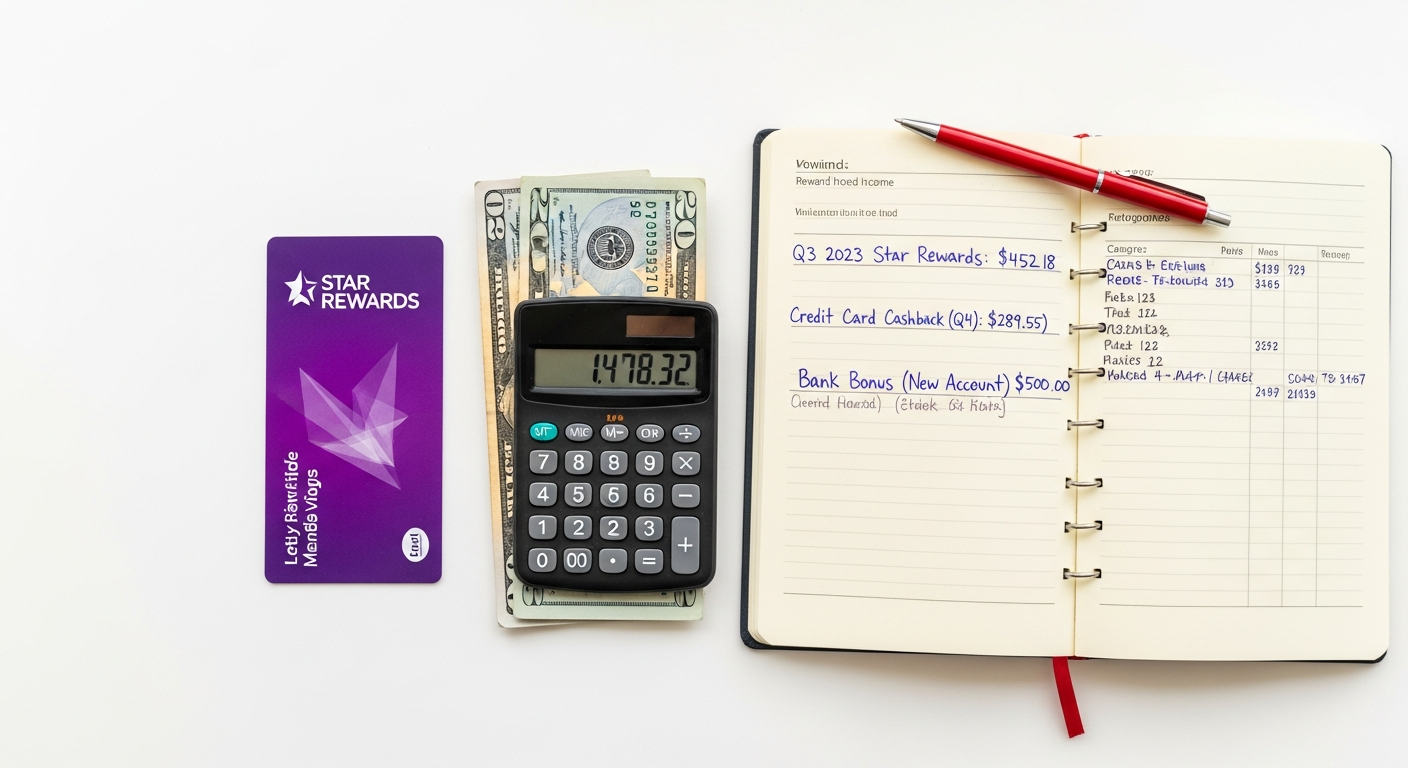
2. Why is it Important to Maintain Meticulous Records for Rewards?
This is perhaps the most important strategy. Keep a detailed log of all significant bonuses you receive, especially those that are not tied to spending. Include:
- Date received
- Issuer (e.g., bank, credit card company)
- Type of reward (cash, points, gift card)
- Stated value or your estimated fair market value (if not cash)
- The specific requirements met to earn the bonus (e.g., “opened checking account,” “referred friend,” “met $3,000 spend”)
- Whether a 1099 form was issued (and keep a copy)
This record-keeping will be invaluable when preparing your taxes and will serve as proof in case of an IRS inquiry. A simple spreadsheet can do wonders here.
3. How to Differentiate Between Taxable Rebates and Income?
Continually apply the “spend requirement” test. If you had to spend money to get the reward, it’s likely a non-taxable rebate. If you got it just for an action (opening an account, referring, taking a survey), it’s likely taxable income. This mental framework will help you quickly assess potential tax liabilities.
4. What is the Significance of the $600 Tax Reporting Threshold (and Below)?
Remember that while companies generally issue 1099 forms for $600 or more (or $10 for interest), you are still legally obligated to report all taxable income, regardless of the amount or whether you receive a form. Don’t fall into the trap of thinking small amounts are untaxable just because no form was issued.
5. How to Consider the Fair Market Value (FMV) of Taxable Points/Miles?
If you receive points or miles as taxable income, the issuer will typically assign an FMV. While you generally use this value, be aware that your personal redemption value might be higher or lower. The IRS is concerned with the value at the time you receive the bonus. If the issuer doesn’t provide a value, you might need to make a reasonable estimate, which could be based on a typical redemption rate (e.g., 1 cent per mile).
6. How to Plan for Estimated Tax Payments for Rewards Income if Necessary?
7. Why Should You Consult a Qualified Tax Professional for Rewards Taxes?
Conclusion: Mastering the Tax Implications of Rewards
The world of rewards programs offers incredible value, empowering savvy consumers to travel more, save money, and enjoy premium experiences. However, navigating the tax implications of rewards is a critical component of truly smart earning and management. While most points, miles, and cashback earned through everyday spending are considered non-taxable rebates, bonuses and incentives not tied to a direct purchase often fall under the category of taxable income.
From bank account opening bonuses reported on a Form 1099-INT to referral rewards and sweepstakes winnings that may generate a Form 1099-MISC, understanding the distinction between a rebate and income is paramount. By adopting proactive strategies such as meticulous record-keeping, scrutinizing offer terms, and applying the “spend requirement” test, you can confidently differentiate between taxable and non-taxable earnings.
Don’t let the fear of tax complexity deter you from maximizing your rewards. Instead, empower yourself with knowledge and diligent practices. When in doubt, remember that the IRS expects you to self-report all taxable income, regardless of whether a reporting form is issued. For specific guidance tailored to your unique financial situation, always consult a qualified tax professional. With this expert insight, you can continue to unlock the full potential of your rewards, ensuring that your pursuit of points, miles, and cashback remains both rewarding and tax-savvy. As reward programs continue to evolve, staying informed about new types of rewards, such as cryptocurrency incentives or unique loyalty program structures, will be key to future-proofing your financial planning.
Here are answers to some of the most common questions regarding the tax implications of rewards programs.
Frequently Asked Questions About Rewards Taxes
Are credit card points and miles earned from everyday spending taxable?
What about credit card sign-up bonuses? Are they taxable?
I received a $200 bonus for opening a new bank account. Is that taxable?
Do I need to report taxable rewards if I didn’t receive a Form 1099-MISC or 1099-INT?
How do I determine the value of points or miles if they are taxable?
Reviewed by Julian Thorne, Senior Editor, Loyalty & Consumer Engagement — Last reviewed: March 27, 2026