
best credit cards for groceries rewards 2026
On April 13, 2026 by pubmanThe Best Credit Cards for Grocery Rewards in 2026: The Travel Hacker’s Guide to Maximum Multipliers
For the dedicated points enthusiast, the grocery store isn’t just where you buy your weekly essentials; it is a high-velocity engine for generating the points and miles that fuel business-class flights and luxury hotel stays. As we move into 2026, the landscape of credit card rewards has shifted. The “dining out” craze of previous years has stabilized, and savvy travel hackers have returned to the foundational pillar of reward accumulation: the grocery category.
In 2026, grocery spend remains one of the largest “organic” spending categories for the average household. For those of us chasing the “Holy Grail” of travel rewards—transferable points—optimizing this category is the difference between one domestic flight and an around-the-world itinerary in a lie-flat seat. Whether you are deep in the Chase Trifecta, an Amex Gold loyalist, or a Capital One ecosystem newcomer, choosing the right card for your supermarket runs is essential. This guide breaks down the elite tier of grocery rewards cards for 2026, focusing on transferable currencies and high-yield multipliers.
The Evolution of Grocery Multipliers in 2026
The credit card market in 2026 has become increasingly sophisticated. Banks have realized that “lifestyle” spend—groceries, streaming, and utilities—is the most consistent way to keep a card “top of wallet.” For the travel hacker, this means we are seeing more aggressive competition among issuers to offer 3x, 4x, or even 5x points on grocery spend.
However, the definition of “grocery” has become more nuanced. In 2026, the Merchant Category Code (MCC) is king. While traditional supermarkets like Kroger, Publix, and Safeway remain standard, the rise of “online grocery” and “grocery delivery” services has created new avenues for earning. Furthermore, the distinction between a grocery store and a superstore (like Walmart or Target) is more rigid than ever. To maximize your strategy, you must align your card choice with where you actually shop, ensuring you don’t leave thousands of points on the table by using the wrong plastic at the wrong terminal.
1. The Gold Standard: American Express® Gold Card
In 2026, the American Express® Gold Card remains the undisputed heavyweight champion for grocery rewards. For the points enthusiast who values Membership Rewards (MR) points, no other card offers the same blend of high multipliers and ease of use.
The Amex Gold earns a staggering **4x Membership Rewards points** at U.S. supermarkets (on up to $25,000 in purchases per calendar year, then 1x). For a household spending $1,000 a month on groceries, that’s 48,000 MR points a year—nearly enough for a one-way business class ticket to Europe when transferred to partners like Air France-KLM Flying Blue or Avianca LifeMiles.
The “Travel Hacker” perspective: The value of MR points in 2026 continues to hover around 2.0 cents per point (cpp) when used for high-value transfers. This effectively gives you an 8% return on your grocery spend. While the annual fee on the Gold Card has seen adjustments over the years, the inclusion of monthly Uber Cash and dining credits often brings the effective cost close to zero for those who already use these services. In 2026, if you are not capping out that $25k limit, you are missing the most efficient point-earning opportunity in the market.
2. The Power Couple: Capital One Venture X & Savor Strategy
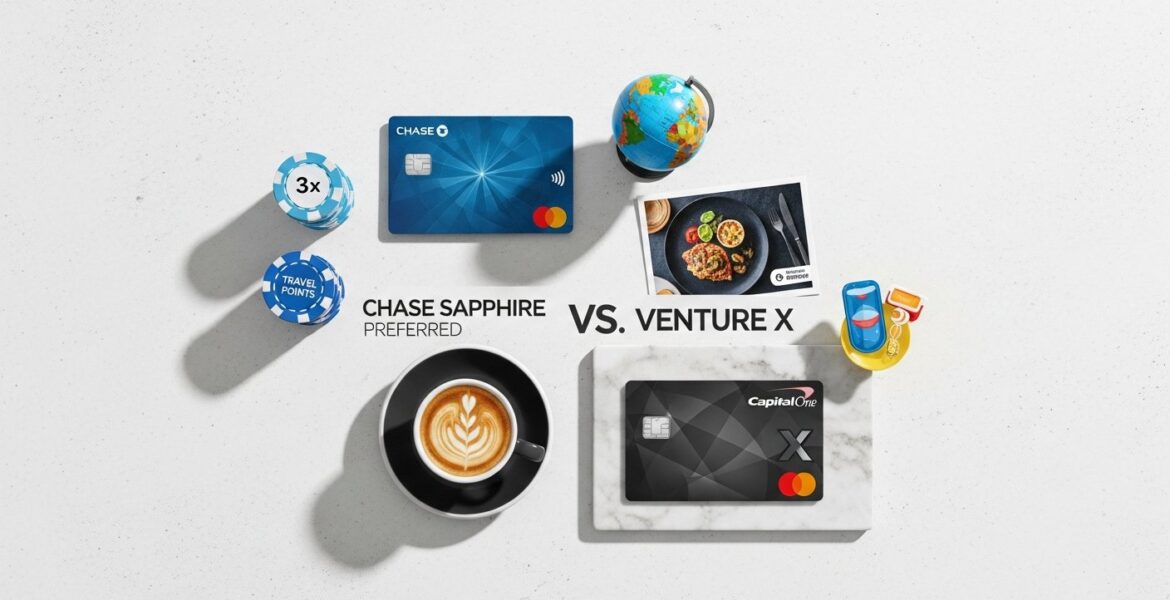
Capital One has disrupted the “Big Two” (Amex and Chase) by creating a seamless bridge between cash back and travel miles. For enthusiasts who prefer a simpler two-card setup in 2026, the combination of the **Capital One Venture X** and the **Capital One Savor** is formidable.
The Capital One Savor (and its no-annual-fee sibling, the SavorOne) earns **3% cash back on groceries**. On its own, that’s a solid return. However, for travel hackers, the magic happens when you pair it with the Venture X. Capital One allows you to convert that “cash back” into Venture Miles at a 1:1 ratio.
In 2026, this means you are earning **3x transferable miles per dollar** at grocery stores. While 3x is lower than the Amex Gold’s 4x, the Capital One ecosystem has several advantages:
* **No Spending Caps:** Unlike the Amex Gold, the Savor doesn’t typically feature the same restrictive annual caps on grocery spend.
* **Simpler Redemptions:** Capital One’s transfer partners, such as Turkish Airlines and British Airways, provide incredible value for international travel.
* **Worldwide Acceptance:** As a Mastercard, the Savor is often accepted at international grocery stores where Amex might be rejected, making it a better choice for digital nomads and frequent overseas travelers.
3. The Chase Trifecta: Leveraging the Freedom Flex and Unlimited
Chase remains a favorite for 2026 due to the unparalleled value of **World of Hyatt** transfers. However, Chase does not have a “permanent” high-multiplier grocery card in its mid-tier or premium lineup (like the Sapphire Preferred). Instead, the savvy points enthusiast relies on the **Chase Freedom FlexSM** and **Chase Freedom Unlimited®**.
The Chase Freedom Flex often features “Grocery Stores” as a **5% rotating quarterly category** (on up to $1,500 in combined purchases). For one quarter a year, this is the highest earning rate in the industry. Furthermore, Chase frequently offers “introductory” bonuses for new cardholders that include 5% back on groceries for the first year (up to $12,000).
To turn this “cash back” into valuable Ultimate Rewards (UR) points, you must hold a “feeder” card like the **Chase Sapphire Preferred®** or **Chase Sapphire Reserve®**. In the 2026 ecosystem, earning 5x UR points on groceries means you are effectively getting a 10% return when those points are transferred to Hyatt for luxury stays at properties like the Park Hyatt Tokyo or Alila Ventura Big Sur.
4. Advanced Tactics: Online Grocery and the “Kroger Pay” Workaround
In 2026, the definition of “Online Grocery” has become a loophole that points enthusiasts must exploit. Many cards, such as the **Chase Sapphire Preferred®**, offer a permanent **3x multiplier on online grocery purchases**.
This doesn’t just mean Instacart or Shipt. Many national chains allow you to order through their app for “curbside pickup” or even use their proprietary mobile wallet (like Kroger Pay) in-store, which often triggers the “online grocery” category. This allows Sapphire Preferred holders to earn 3x UR points on all their groceries without needing to wait for a rotating category on the Freedom Flex.
Additionally, we cannot ignore the **American Express® Blue Cash Preferred® Card**. While it earns “Cash Back,” it offers a massive **6% at U.S. supermarkets** (on up to $6,000 per year). For the pure travel hacker, cash is usually less desirable than points, but in 2026, a 6% “hedge” against rising travel costs is a valid component of a diversified portfolio.
5. The 2026 Merchant Landscape: Grocery vs. Superstores
A common pitfall for even seasoned hackers is the “Superstore Trap.” In 2026, most major issuers—specifically Amex and Chase—explicitly exclude **Walmart, Target, and Costco** from the “grocery” category. If you buy your milk and eggs at a Supercenter, your 4x Amex Gold will only earn 1x.
However, there are 2026 workarounds for the superstore shopper:
* **The Venture X Strategy:** Use the Capital One Venture X at Costco or Walmart for a flat 2x miles on everything. It’s the highest “catch-all” rate for these excluded merchants.
* **The Gift Card Arbitrage:** Use your Amex Gold at a standard grocery store (like Safeway) to buy gift cards for Amazon, Shell, or even certain clothing retailers. You earn 4x on the purchase of the gift card because the merchant is a grocery store. This allows you to effectively earn 4x on non-grocery spend. (Note: Always check the latest terms and conditions, as issuers occasionally crack down on “manufactured spend” using gift cards).
6. Business Cards for Grocery Spend
For the “Player 1/Player 2” teams or those with small businesses (including 1099 freelancers), the **American Express® Business Gold Card** is a vital tool in 2026. This card automatically earns **4x points** on the two categories where your business spends the most each month, and “U.S. purchases at grocery stores” is a qualifying category.
If your business involves catering, event planning, or simply significant “office supplies” that you source from grocery stores, this is an uncapped (up to $150,000 in combined category spend) way to flood your account with Membership Rewards points. In 2026, this remains the best way for high-spenders to earn grocery rewards far beyond the $25,000 limit on the personal Gold card.
FAQ: Maximizing Grocery Rewards in 2026
**Q1: Is the Amex Gold still worth the annual fee in 2026?**
Absolutely. For anyone spending at least $100 a week on groceries, the 4x multiplier generates enough points to far outweigh the annual fee, especially when the monthly dining and Uber credits are utilized. In the 2026 points climate, “earning while you eat” is the most sustainable way to keep your points balance high.
**Q2: Do Wholesale Clubs like Costco count as groceries?**
Generally, no. Most credit cards categorize Costco, Sam’s Club, and BJ’s as “Wholesale Clubs,” not “Grocery Stores.” To maximize rewards here, use a card with a high “base rate” like the Capital One Venture X (2x) or the Chase Freedom Unlimited (1.5x).
**Q3: Can I earn travel points at Walmart and Target?**
Directly, it is difficult. Most rewards cards view them as “Discount Stores.” However, using a 2x “catch-all” card or checking for specific “Target” or “Walmart” offers in your Amex Offers or Chase Offers portal can provide a boost. Some online grocery multipliers (like the 3x on the Sapphire Preferred) have been known to trigger on Walmart.com grocery orders, but this is inconsistent and should be tested with a small purchase.
**Q4: How do I handle the $25,000 cap on the Amex Gold?**
If you have a large family or high spend that exceeds $25,000 annually, you should have a “Plan B” card. Once you hit the cap, switch your spending to the Capital One Savor (3x) or the Chase Freedom Unlimited (1.5x) for the remainder of the year to ensure you are still earning more than the baseline 1x.
**Q5: Are points better than cash back for groceries?**
For the travel enthusiast, yes. A 4x point multiplier on the Amex Gold is worth roughly 8% in travel value. The best cash back card offers 6% (Blue Cash Preferred). While 6% is great, 8% towards a $5,000 business class seat is the “hack” that allows for luxury travel on a standard budget.
Conclusion: Crafting Your 2026 Grocery Strategy
As we navigate 2026, the “Best Credit Card for Groceries” isn’t a single winner, but rather the card that fits your specific loyalty ecosystem. If you value flexibility and high-value international transfers, the **American Express Gold** remains the king. If you prefer the simplicity of a “One-Two Punch” with no caps, the **Capital One Venture X and Savor** combo is unbeatable. And for those who swear by Hyatt and United, the **Chase Freedom** rotating categories provide the highest seasonal yield available.
The key to 2026 travel hacking is intentionality. Don’t just swipe whatever is in your wallet. Understand your MCCs, track your annual caps, and remember that every dollar spent on groceries is a mile earned toward your next destination. In the world of points and miles, the kitchen pantry is the ultimate gateway to the world.