


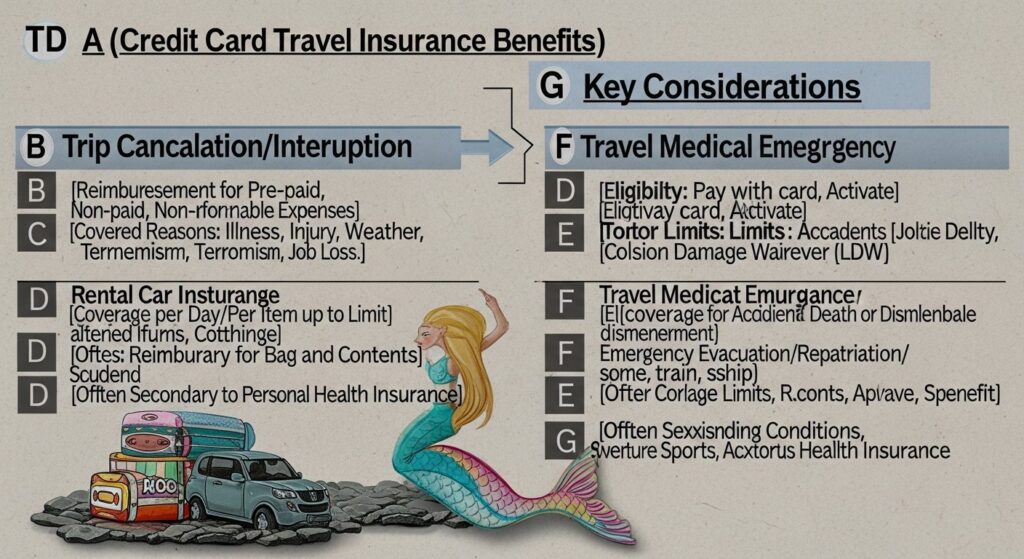
Maximize Your Travel Insurance Credit Card Benefits
For savvy travelers and smart shoppers, understanding the array of travel insurance credit card benefits can fundamentally transform how you approach trip planning and protection. These aren’t mere perks; they represent a significant layer of complimentary financial safeguarding against the myriad of unforeseen disruptions that can plague even the most meticulously planned journeys. From unexpected trip cancellations to lost luggage and rental car accidents, premium credit cards provide an often underutilized suite of protections. Leveraging these card-provided travel safeguards not only enhances peace of mind but also aligns perfectly with the goldpoints philosophy of maximizing rewards and smart shopping by potentially saving you hundreds on separate insurance policies.
What Key Travel Insurance Benefits Do Credit Cards Offer?
To truly maximize your rewards and shop smarter for travel, a clear grasp of the specific travel protection your credit card provides is essential. This section details the most common and valuable protections, illuminating how each benefit contributes to comprehensive coverage and the overall value proposition for cardholders.
Trip Cancellation and Interruption Coverage
This cornerstone of credit card travel perks offers crucial financial protection when your travel plans go awry. Trip cancellation coverage reimburses you for non-refundable expenses, suchs as flights, hotels, and prepaid tours, if your trip is canceled for a covered reason before departure. Covered reasons typically include severe weather events, sudden illness or injury to you or a close family member, jury duty, or a terrorist act. Trip interruption coverage, conversely, kicks in if your journey is cut short or altered after it has begun, reimbursing you for unused, non-refundable portions of your trip and often for additional transportation costs to get you home or to your next destination. Understanding the maximum payout limits and the specific list of covered perils outlined in your card’s Guide to Benefits is paramount.
Rental Car Collision Damage Waiver (CDW)
Often referred to as Loss Damage Waiver (LDW), this benefit typically covers damage to or theft of a rental vehicle. It replaces the often expensive collision damage waiver offered by rental car companies, which can save you a substantial amount per rental. A critical distinction here is whether your card offers “primary” or “secondary” coverage. Primary coverage means your credit card’s insurance pays first, before your personal auto insurance. Secondary coverage kicks in after your personal auto insurance has paid out, covering deductibles or gaps. Always be aware of excluded vehicles (e.g., exotic cars, large vans, trucks, certain luxury brands) and ensure the rental period doesn’t exceed the stated maximum (often 15-30 days). This benefit primarily covers damage to the rental vehicle itself, not liability for damage to other vehicles or property, nor medical injuries.
Baggage Delay and Lost Baggage Coverage
Few things are as frustrating as arriving at your destination without your luggage. Baggage delay protection provides reimbursement for essential items you need to purchase while your checked bags are delayed. There’s usually a minimum delay period (e.g., 6 hours) before this coverage activates, and often a daily or total maximum payout. Lost baggage coverage offers a more substantial reimbursement if your checked luggage is permanently lost or stolen. Both benefits require you to file a report with the airline first. Keep all receipts for emergency purchases and official airline documentation of the delay or loss.
Travel Accident Insurance
This is a broad category that provides coverage for accidental death or dismemberment during a covered trip. While a grim topic, it’s an important part of comprehensive travel protection. The benefit typically has high maximum payouts and covers common carrier accidents (e.g., plane, train, bus, ship). It’s crucial to understand the definitions of “covered accident” and “covered common carrier” as detailed in your card’s Guide to Benefits.
Emergency Medical and Evacuation Coverage
While less common on standard cards, many premium card travel benefits include some form of emergency medical assistance or evacuation. Emergency medical coverage may provide limited reimbursement for emergency medical expenses incurred while traveling abroad. Emergency medical evacuation covers the costs of transporting you to the nearest appropriate medical facility or even back home if medically necessary. These benefits are usually secondary to your personal health insurance but can be invaluable in foreign countries where your domestic plan may offer limited or no coverage. Review the specific coverage limits and definitions of “emergency” carefully.


How Do Credit Card Travel Insurance Benefits Compare to Standalone Policies?
For individuals focused on maximizing rewards and smart shopping, the question of whether credit card travel insurance suffices versus purchasing a separate, standalone travel insurance policy is critical. While card-provided travel protection offers undeniable value, it’s essential to understand its scope and limitations relative to dedicated insurance products.
Scope and Depth of Coverage
Credit card benefits are generally designed to be convenient and complimentary, often acting as a first line of defense or supplemental coverage. Standalone travel insurance policies, particularly comprehensive plans, typically offer much broader and deeper coverage. For instance, a standalone policy might cover a wider array of medical conditions, provide higher limits for medical emergencies (including pre-existing conditions if purchased early enough), include “Cancel for Any Reason” (CFAR) options, or cover activities often excluded by credit cards like adventure sports. Furthermore, standalone policies often provide primary medical coverage, while credit card benefits are frequently secondary, meaning your personal health insurance must pay first.
Cost and Value Proposition
The primary advantage of cardholder travel insurance is its cost: it’s “free” with your annual fee. For many casual travelers taking shorter, less complex trips, these complimentary travel coverage benefits are often sufficient. They offer a strong value proposition by negating the need for separate purchases for basic protections like trip delay or rental car CDW, thereby supporting the ethos of smart shopping. However, for complex itineraries, expensive trips, travelers with specific health concerns, or those undertaking high-risk activities, the investment in a comprehensive standalone policy may be justified for its superior coverage and peace of mind.
Eligibility and Activation Requirements
To activate credit card travel benefits, you almost always must pay for the entire trip (or a significant portion, like the deposit) using the eligible credit card. This is a crucial distinction and a common point of oversight. Standalone policies have their own enrollment criteria but generally don’t tie coverage to a specific payment method. Card benefits also have strict eligibility requirements regarding who is covered (cardholder, spouse, dependent children) and for what duration. Always read your Guide to Benefits carefully to ensure your trip and travelers qualify.
How Do You Activate and Utilize Credit Card Travel Protection?
Understanding how these card-provided travel protection mechanisms work is only half the battle; knowing how to properly activate and utilize them is where the true value for smart shoppers lies. This section provides a practical guide to ensuring you’re covered and how to navigate the claims process.
Booking Requirements for Coverage Activation
The golden rule for activating nearly all credit card travel safeguards is to pay for the qualifying travel expense with the eligible credit card. This includes flights, hotels, rental cars, and tour packages. For specific benefits like trip delay or interruption, certain minimum thresholds may apply (e.g., the trip must be at least 3 days long, or the delay must be over 6 hours). Ensure that your booking meets all specified criteria as outlined in your card’s Guide to Benefits. Using a different payment method or points earned from another loyalty program might inadvertently void your coverage.
- Use the Eligible Card: Always pay for your entire trip or the portion you want covered with the credit card that offers the desired benefits.
- Understand Minimums: Be aware of any minimum payment amounts required or trip durations to qualify for specific benefits.
- Check for Exclusions: Some benefits may exclude certain types of travel (e.g., business trips vs. leisure trips, certain destinations).
Understanding Your Guide to Benefits
Your credit card’s Guide to Benefits is the authoritative document detailing every aspect of your complimentary travel coverage. This comprehensive booklet or online resource outlines:
- Specific coverage limits (e.g., $10,000 for trip cancellation, $500 for baggage delay).
- Deductibles, if any.
- Eligibility requirements for the cardholder and family members.
- Detailed lists of covered perils and explicit exclusions.
- Step-by-step instructions for filing a claim, including notification deadlines and required documentation.
It is not enough to assume; you must review this document thoroughly, ideally before you even book your trip.
Filing a Claim: Step-by-Step Process
When an unfortunate event occurs, a smooth claims process can make all the difference. While specifics vary by card issuer (Chase, Amex, Capital One) and card network (Visa Infinite, Mastercard World Elite), a general framework applies:
- Initial Notification: Contact the benefits administrator as soon as possible after the covered event. Many policies have strict notification deadlines (e.g., within 20 or 60 days of the incident).
- Gather Documentation: Collect all necessary paperwork. This is critical for a successful claim.
- Original travel itinerary and proof of purchase with the eligible card.
- Receipts for all expenses you are claiming.
- Police reports (for theft), medical statements (for illness/injury), airline delay/loss reports, or weather statements from official sources.
- Any communication from the airline, hotel, or tour operator regarding the disruption.
- Your cardholder agreement and Guide to Benefits.
- Complete Claim Forms: The benefits administrator will provide specific claim forms to fill out. Be thorough and accurate.
- Submit Documentation: Send all required documents within the specified timeframe (often 90-120 days from the date of loss).
- Follow Up: Keep detailed records of all communications and follow up regularly on the status of your claim.

What Are the Common Limitations and Exclusions of Cardholder Travel Insurance?
While the utility of premium card travel benefits is undeniable, it’s equally important for smart shoppers to be aware of their boundaries. Overlooking these limitations can lead to unwelcome surprises during a claim.
Covered Perils and Exclusions
Every credit card travel insurance policy clearly defines what events (perils) are covered and, more importantly, what is explicitly excluded. Common exclusions often include:
- Pre-existing medical conditions: Unless specified, these are typically not covered.
- Acts of war or civil unrest: Most policies exclude incidents arising from these situations.
- Self-inflicted injuries or those under the influence: Claims related to intoxication or illegal activities are generally denied.
- Participation in dangerous sports: Bungee jumping, skydiving, or professional sports are often excluded without specific riders.
- Certain vehicle types for rental car CDW: Exotic cars, antique vehicles, and large passenger vans.
- Travel to specific high-risk countries: Government travel advisories may render coverage void.
Understanding what your policy *doesn’t* cover is just as vital as knowing what it does.
Deductibles and Payout Limits
Many credit card travel protection benefits come with maximum payout limits. For example, trip cancellation might be capped at $10,000 per person per trip, or baggage delay at $500 per person. Exceeding these limits means you’ll be responsible for the remainder. Some benefits may also have deductibles, which is the amount you must pay out-of-pocket before your insurance coverage begins. Always verify these figures in your Guide to Benefits.
Primary vs. Secondary Coverage
This is a critical distinction, especially for rental car collision damage waiver and emergency medical coverage.
- Primary Coverage: Your credit card’s insurance pays first, without involving your personal insurance policies. This can be advantageous as it often means no claim on your personal auto or health insurance, potentially preventing premium increases.
- Secondary Coverage: Your credit card’s insurance acts as a backup. It only pays after your primary insurance (e.g., your personal auto insurance or health insurance) has paid its maximum or when primary coverage doesn’t exist. This means you might need to file a claim with your personal insurer first.
Always seek out cards that offer primary coverage for benefits you highly value, such as rental car CDW, to truly maximize the benefit for smart shopping.
How Do You Choose the Right Credit Card for Travel Insurance Benefits?
With a plethora of premium credit cards available, selecting the one that best suits your travel style and risk profile, while aligning with a “Maximizing Rewards & Smart Shopping” strategy, requires careful consideration of its embedded travel safeguards.
Assessing Your Travel Needs and Frequency
Your ideal credit card for travel protection depends heavily on how often you travel, where you go, and what activities you engage in.
- Frequent Traveler: If you travel multiple times a year, a card with robust, broad coverage for common issues like trip delays, cancellations, and baggage problems offers immense ongoing value.
- International Traveler: Emergency medical evacuation and emergency medical coverage become critical considerations for overseas trips where your domestic health insurance may not apply.
- Adventure Seeker: If your trips involve activities like skiing, diving, or hiking, check for exclusions. A dedicated travel insurance policy might be necessary, but some cards offer better baseline coverage.
- Business Traveler: Ensure the card’s benefits cover business travel, as some policies are limited to leisure trips.
Match the card’s benefits to your typical travel scenarios.
Comparing Card Networks and Issuers
Different card networks (Visa, Mastercard, American Express, Discover) and issuers (Chase, American Express, Capital One, Citi) offer varying levels and types of complimentary travel coverage.
- Visa Infinite/Signature: Often known for strong rental car CDW (frequently primary), trip cancellation/interruption, and travel accident insurance.
- Mastercard World Elite: Typically offers solid trip delay, baggage delay, and some cell phone protection, alongside standard travel accident coverage.
- American Express: Known for robust lost/damaged baggage coverage, car rental loss and damage insurance (though often secondary), and some premium cards offer medical evacuation benefits.
It’s vital to research the specific card product, as benefits can differ even within the same network or issuer. A Chase Sapphire Reserve (Visa Infinite) will have different benefits than a Chase Freedom Unlimited (Visa Signature).
Annual Fees vs. Benefit Value
Premium travel cards, which offer the most comprehensive cardholder travel insurance, usually come with higher annual fees. For smart shoppers, the key is to weigh this annual fee against the monetary value of the benefits you will realistically use. If a card’s travel protection saves you from purchasing separate rental car insurance for multiple trips, or provides peace of mind that offsets the fee, it’s a worthwhile investment. Evaluate the annual fee in the context of all rewards (points, miles, statement credits) and protections offered.
What Are Common Mistakes When Relying on Credit Card Travel Perks?
While card-provided travel protection offers fantastic value, many cardholders make avoidable errors that can negate their benefits or lead to frustrating claim denials. Being aware of these pitfalls is crucial for smart shoppers.
1. Not Reading the Guide to Benefits
This is arguably the most common and costly mistake. Assuming what’s covered based on general knowledge or another card’s policy is a recipe for disappointment. Every card, even within the same issuer or network, has its own specific Guide to Benefits. Failure to understand eligibility requirements, covered perils, exclusions, and claim procedures means you’re operating in the dark. Always download and review the most current version of your card’s guide before booking travel.
2. Failing to Pay with the Eligible Credit Card
A fundamental requirement for nearly all credit card travel safeguards is that the qualifying travel expenses (flights, hotels, rental cars) must be paid for with the card offering the benefits. Using a different card, cash, or points from a different loyalty program for the main transaction can void your coverage. Even paying for just a portion with another method might invalidate the benefit, so always err on the side of using the eligible card for the entire purchase.
3. Missing Claim Notification or Documentation Deadlines
Credit card benefits administrators have strict timelines for both notifying them of an incident and submitting all required documentation. Forgetting to call within the first 20 or 60 days of an event, or failing to submit all paperwork within 90 or 120 days, can lead to an automatic denial, regardless of the validity of your claim. Keep meticulous records and adhere strictly to all deadlines.
4. Misunderstanding Primary vs. Secondary Coverage
As discussed, the distinction between primary and secondary coverage is critical. Many cardholders assume their rental car CDW or emergency medical coverage is primary when it’s actually secondary. This can lead to unexpected claims on personal insurance policies, higher deductibles, and potentially increased premiums. Always confirm the coverage type for key benefits.
5. Overlooking Exclusions and Limitations
Every policy has limitations. These might include maximum payout limits that are too low for an expensive trip, exclusions for certain activities (e.g., adventure sports), travel to specific regions, or pre-existing medical conditions. Not checking these can leave significant gaps in your protection, turning a seemingly comprehensive benefit into a false sense of security.
What is an Overview of Credit Card Travel Insurance Benefits?
This table provides a concise summary of the most common complimentary travel coverage benefits found on premium credit cards, along with key considerations for smart shoppers.
| Benefit Type | Common Coverage | Key Limitations/Exclusions | Activation Requirement | Best Suited For |
|---|---|---|---|---|
| Trip Cancellation & Interruption | Reimbursement for non-refundable expenses if trip canceled/interrupted for covered reasons. | Specific covered perils only (illness, weather, etc.), maximum payout limits, often excludes “cancel for any reason.” | Pay for trip with card. | Protecting significant pre-paid trip costs against unforeseen emergencies. |
| Rental Car Collision Damage Waiver (CDW) | Coverage for damage/theft of rental vehicle (not liability for others). | Excludes certain vehicles (luxury, exotic), often secondary to personal auto insurance, loss of use fees. | Decline rental company’s CDW; pay for rental with card. | Saving on expensive rental company insurance. |
| Baggage Delay | Reimbursement for essential purchases during baggage delay (e.g., toiletries, clothing). | Minimum delay period (e.g., 6 hours), daily/total maximum payouts, requires airline report. | Pay for common carrier fare with card. | Covering immediate needs when luggage is delayed. |
| Lost/Damaged Baggage | Reimbursement if checked luggage is permanently lost or damaged. | Maximum payout limits, requires airline report, may exclude certain valuables. | Pay for common carrier fare with card. | Financial recovery for loss of belongings. |
| Travel Accident Insurance | Compensation for accidental death or dismemberment during a covered common carrier trip. | Specific definitions of “accident” and “common carrier,” high payout limits but specific conditions. | Pay for common carrier fare with card. | High-level protection for extreme events. |
| Emergency Medical & Evacuation | Limited reimbursement for emergency medical care or transport to medical facility/home. | Often secondary to personal health insurance, high deductibles, strict definitions of “emergency,” maximum limits. | Pay for trip with card. | Covering critical health events, especially abroad. |
What is an Example of Premium Travel Card Benefits?
To illustrate the specific data points smart shoppers should look for, here’s a hypothetical example of the travel protection offered by a “Premium Travel Card X,” which aligns with the “Maximizing Rewards & Smart Shopping” entity.
| Attribute | Value (for Premium Travel Card X) |
|---|---|
| Annual Fee | $550 |
| Trip Cancellation Limit | Up to $20,000 per person, $40,000 per trip |
| Trip Interruption Limit | Up to $20,000 per person, $40,000 per trip |
| Rental Car Coverage Type | Primary Collision Damage Waiver (CDW) |
| Rental Car Coverage Max Value | Up to $75,000 |
| Baggage Delay Payout | Up to $500 per person, per ticket (for delays > 6 hours) |
| Lost/Damaged Baggage Payout | Up to $3,000 per passenger per trip |
| Emergency Medical Limit | Up to $2,500 (secondary coverage) |
| Emergency Evacuation Limit | Up to $100,000 (secondary coverage) |
| Travel Accident Payout | Up to $1,000,000 |
How to Maximize Value and Peace of Mind with Travel Insurance Credit Card Benefits
Navigating the landscape of travel protection can seem daunting, but by understanding and strategically leveraging your travel insurance credit card benefits, you empower yourself as a smart shopper and a confident traveler. These card-provided travel safeguards are not merely hidden perks; they are integral components of a robust financial strategy, offering tangible value and invaluable peace of mind against the uncertainties of travel. By diligently reviewing your card’s Guide to Benefits, adhering to activation requirements, and understanding coverage limitations, you can effectively reduce the need for separate insurance purchases and truly maximize the rewards and protections your credit card offers. This holistic approach to travel planning ensures that your journeys are not only enjoyable but also financially secure.
For more insights on optimizing your loyalty programs and enhancing your travel experiences, explore our comprehensive guide on Travel Rewards & Loyalty Programs.
Sources & References
- Visa. “Guide to Benefits for Visa Infinite Cardholders.” Visa.com. Accessed March 27, 2026. (Note: Specific Guide to Benefits documents are proprietary and vary by issuer. This is a generic reference to the existence of such guides.)
- Mastercard. “Mastercard World Elite Benefits.” Mastercard.us. Accessed March 27, 2026. (Note: Specific benefits vary by card issuer. This is a generic reference.)
- American Express. “Amex Platinum Card Benefits.” AmericanExpress.com. Accessed March 27, 2026. (Note: Specific benefits vary by card issuer. This is a generic reference.)
- “Understanding Travel Insurance: A Consumer’s Guide.” National Association of Insurance Commissioners (NAIC). Accessed March 27, 2026.
- Fodors Travel. “Do You Need Travel Insurance? Here’s How to Decide.” Fodors.com. Accessed March 27, 2026.
About the Author
Priya Devi, Smart Shopper & Rewards Expert — I love uncovering the best deals and loyalty strategies to make your shopping more rewarding and your wallet happier.
Reviewed by Julian Thorne, Senior Editor, Loyalty & Consumer Engagement — Last reviewed: March 27, 2026
Reviewed by Julian Thorne, Senior Editor, Loyalty & Consumer Engagement — Last reviewed: March 27, 2026