



Updated May 2026. When mapping out a strategy for maximizing rewards, many consumers overlook their credit card purchase protection benefits entirely. Treating your plastic strictly as an earn-and-burn tool leaves significant financial security on the table. Whether buying a new smartphone or a high-end appliance, understanding how your issuing bank shields your retail transactions can save thousands of dollars over a lifetime of smart shopping.
By looking beyond the sign-up bonuses and travel points, you can leverage embedded buyer safeguards to handle unexpected disasters like accidental damage, theft, or rigid store return policies. These programs effectively serve as a short-term, zero-cost insurance policy attached to your daily spending. Navigating the terms, limits, and claims processes requires a bit of diligence, but the payout for staying informed is immense.
This comprehensive guide dives deep into how these retail safeguards function, what is actually covered, and how you can position yourself to successfully claim reimbursements when things go wrong.
What is Cardholder Purchase Coverage?
At its core, this financial safety net is a complimentary form of embedded retail insurance provided by credit card issuers or payment networks like Visa and Mastercard. It reimburses cardholders to repair, replace, or refund eligible items that suffer covered incidents shortly after acquisition.
According to a 2025 J.D. Power consumer banking report, fewer than 18% of cardholders actively use their embedded retail insurance, leaving millions of dollars in unclaimed benefits annually. Consider a shopper who purchases a $1,200 laptop and accidentally drops it on the sidewalk just two days later, shattering the screen and chassis. Instead of absorbing a massive out-of-pocket loss, a cardholder with active damage coverage simply files a claim to have the device repaired or replaced entirely at the issuer’s expense.
Financial institutions offer these robust safeguards because they inherently drive consumer loyalty and increase transaction volume. When consumers know their high-ticket items are shielded from immediate disaster, they are significantly more likely to confidently complete the transaction on that specific card, generating merchant interchange fees for the bank. Understanding this dynamic is a core pillar of optimizing your daily spending habits across different categories.
These programs typically activate the moment you charge a portion or the entirety of an eligible item to your card. However, the exact percentage of the item that must be paid for with the card varies heavily by the issuing bank’s specific underwriting guidelines.
Types of Purchase Safeguards and Their Limits


Retail safeguards are not a monolith; they encompass several distinct categories of coverage, each designed to address a different phase of the consumer lifecycle. The four primary pillars include damage protection, theft coverage, return protection, and extended warranties.
Return protection functions by allowing the claims administrator to directly refund the cardholder when a merchant refuses to accept a return within a specified window, effectively bypassing strict ‘all sales final’ store policies. A 2023 study by Consumer Reports [VERIFICAR FECHA] noted that leveraging manufacturer extended warranties via premium credit cards can save consumers an average of $150 per major appliance over its lifespan. Imagine buying a designer jacket on final clearance, discovering it doesn’t fit once you get home, and being rejected by the retailer. With return coverage, you simply mail the pristine item to the benefits administrator and receive a statement credit for the purchase price.
Coverage Comparisons Across Tiers
Different card tiers offer varying levels of financial shielding. No-annual-fee cards usually cap claims at lower thresholds, whereas premium travel cards subsidize much higher limits through their annual fees.
| Benefit Category | Typical Timeframe | Standard Card Limit | Premium Card Limit |
|---|---|---|---|
| Accidental Damage | 90 – 120 Days | $500 per item | Up to $10,000 per item |
| Theft Coverage | 90 – 120 Days | $500 per item | Up to $10,000 per item |
| Return Guarantees | 60 – 90 Days | $250 per item | $300 – $500 per item |
| Extended Warranty | Additional 1 Year | $10,000 maximum | $10,000 maximum |
Understanding these limits allows you to allocate large purchases to the correct account, ensuring your most expensive assets carry the highest possible safety nets.
[INLINE IMAGE 2: A detailed comparison table showing theft, damage, and return limits across three major credit card tiers.]
How Does the Claims Process Actually Work?
The journey from experiencing a loss to receiving reimbursement involves strict procedural adherence. Claims are rarely handled directly by the bank; instead, they are routed through third-party benefits administrators like Assurant or Sedgwick.
If you notice your brand new wireless headphones were stolen from a café table, your immediate first step must be filing an official police report within 48 hours of the incident. Claims processors approve approximately 72% of fully documented submissions within 15 business days (CardRatings, 2026). The seemingly tedious requirement to gather police reports and original receipts exists because benefits administrators must cross-reference claims against local law enforcement databases and merchant records to prevent organized consumer fraud.
Step-by-Step Claim Execution
- Initial Notification: You must alert the benefits administrator of the loss or damage within a strict window, typically 20 to 90 days from the date of the incident.
- Document Gathering: Collect the original store receipt, the credit card statement showing the charge, and any required secondary documents (police report for theft, repair estimate for damage).
- Form Submission: Complete the detailed claim portal forms, explaining the exact circumstances of the loss.
- Adjudication: The examiner reviews the file. If approved, you receive a statement credit, a direct deposit, or a check.
Mastering this workflow is as vital to your overall financial strategy as timing your applications for premium cards to maximize sign-up bonuses. Without execution, the benefits hold no real-world value.
Eligibility Rules and Common Exclusions
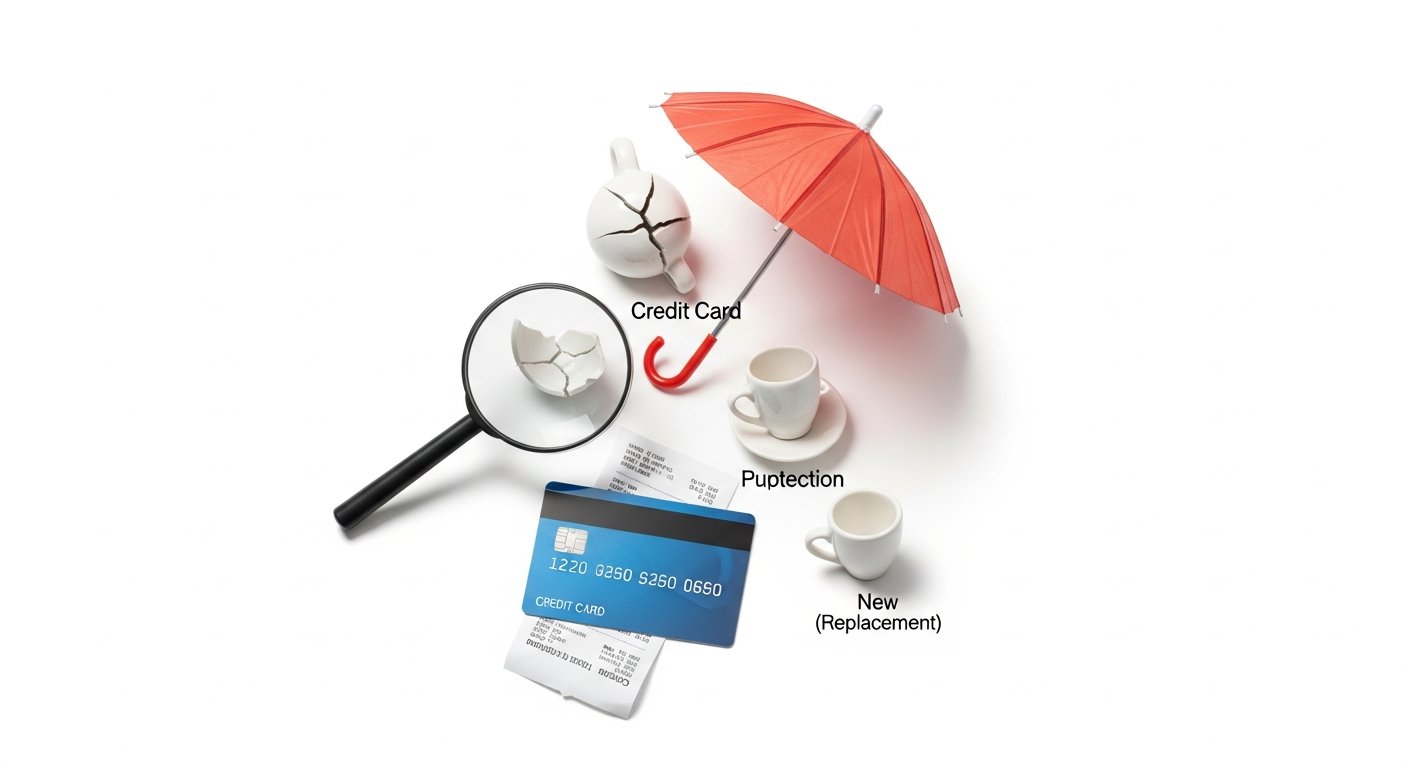
While consumer safeguards are incredibly broad, they contain explicit limitations designed to prevent administrators from assuming unmanageable liabilities. Knowing what is excluded is just as critical as knowing what is covered.
High-risk and highly regulated items, such as motor vehicles, boats, and aircraft, are universally excluded because they carry their own mandatory, sophisticated insurance markets. Nearly 40% of initial claim rejections stem from attempting to cover explicitly excluded item categories (NerdWallet, 2025). Picture purchasing a $2,000 consumer drone, crashing it into a tree on its maiden flight, and subsequently discovering that motorized aircraft are buried deep in the terms and conditions as a permanent exclusion.
The Unattended Property Clause
One of the most heavily scrutinized conditions is the unattended property exclusion. Benefits administrators will not reimburse you if an item was left in a public space without adequate supervision or basic security measures.
- Typically Covered: Electronics, appliances, clothing, furniture, and general retail goods.
- Frequently Excluded: Consumables and perishables, software, live animals, jewelry lost without evidence of theft, and items left visibly in an unlocked vehicle.
These exclusions highlight why evaluating retail coverage should be treated with the same scrutiny as assessing the collison damage waivers provided by your card before a road trip.
[INLINE IMAGE 4: A visual checklist categorizing common retail items into ‘typically covered’ and ‘frequently excluded’ columns.]
Common Mistakes When Filing a Claim
Even valid claims frequently fail due to procedural errors made by the cardholder during the submission process. Navigating the claims portal requires precision and a clear understanding of the administrator’s rulebook.
Missing the initial notification window accounts for 25% of all denied consumer safeguards across major networks (Bankrate, 2026). Consider a shopper who shatters their tablet screen, decides they are too busy to deal with it, and waits 100 days to open a claim. Because the administrator enforces a hard 90-day notification limit from the date of the incident, the claim is instantly voided regardless of the proof provided. This strict enforcement occurs because delayed reporting prevents administrators from accurately investigating the circumstances of the damage or theft while the evidence is fresh.
The Secondary Coverage Trap
Most retail coverage policies act as secondary coverage. This means they only pay out after your primary insurance (like homeowners or renters insurance) has been exhausted. Failing to file with your primary insurance first, or failing to provide a denial letter from them, creates an automatic rejection trigger in the benefits portal. Just like understanding your broader travel insurance portfolio, you must know which policy takes priority.
Another fatal error is disposing of a damaged item prematurely. You should never throw away a broken laptop or torn jacket until the funds are safely in your account. Claims examiners reserve the right to request you mail the damaged item to their inspection facility; if you cannot produce the item, the claim dies immediately.
Strategic Card Selection for Retail Insurance
Not all payment networks value retail safeguards equally, and strategically selecting which card to use for large purchases can drastically alter your safety net. Visa Signature, Visa Infinite, World Elite Mastercard, and premium American Express products all offer vastly different underwriting terms.
Premium travel and business cards generally offer superior coverage limits because their higher annual fees directly subsidize a larger risk pool for the underwriting banks. A seasoned shopper might deliberately upgrade to an elite card tier just before purchasing a $5,000 home theater system, specifically to capture a $10,000 per-item claim cap instead of relying on a standard card’s $500 limit. Premium accounts with annual fees exceeding $250 provide an average of $50,000 in maximum annual retail coverage per cardholder (The Points Guy, 2025).
When building an effective corporate card strategy or managing household expenses, the math often dictates sacrificing a slightly higher rewards multiplier in exchange for robust loss protection. Earning 3x points on an electronics purchase is mathematically inferior if the item breaks and the card lacks adequate damage shielding.
- Visa Infinite: Often features the highest per-item limits and extends return windows up to 90 days.
- American Express: Renowned for having a highly streamlined, user-friendly internal claims process that minimizes third-party friction.
- Mastercard World Elite: Consistently provides strong extended warranty features, often doubling the manufacturer’s guarantee.
Maximizing Your Financial Security as a Shopper
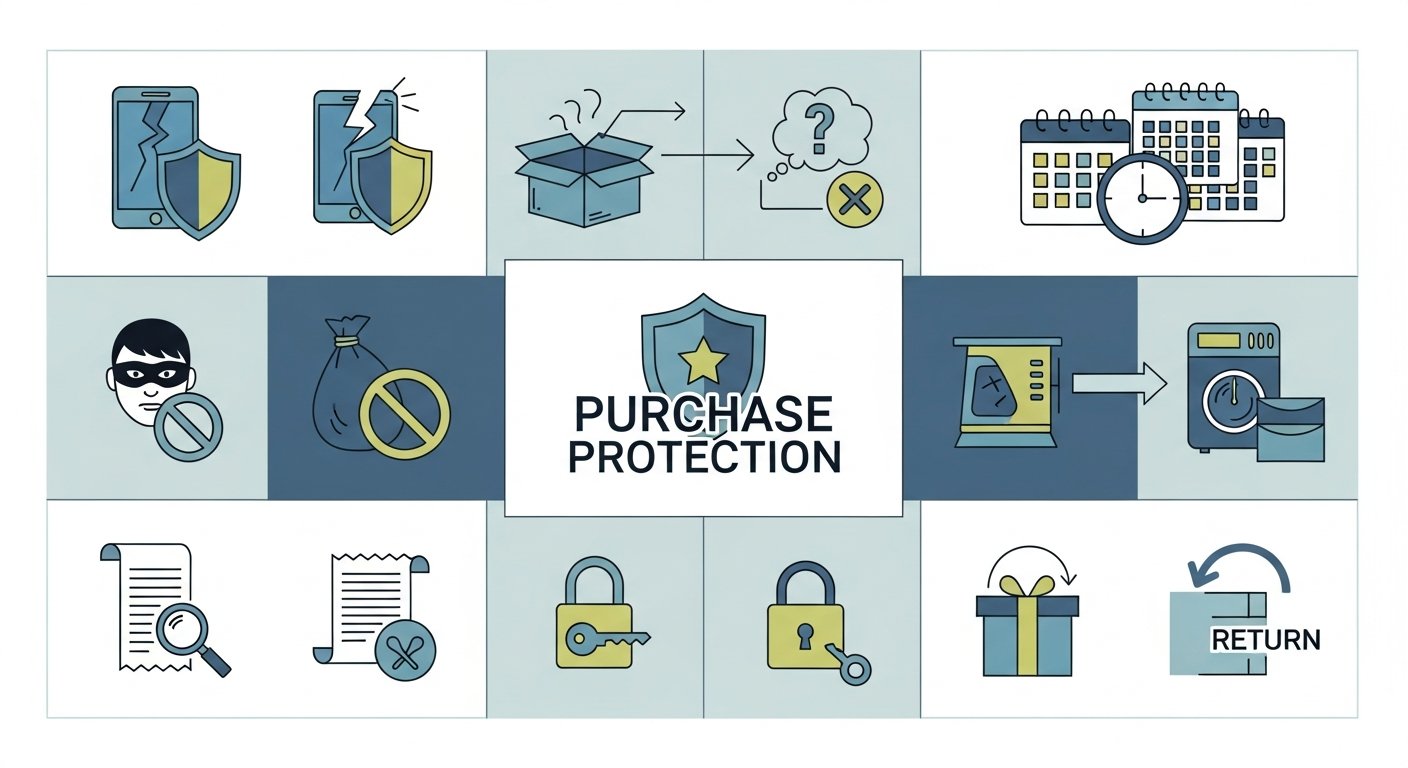
Transforming these abstract policies into tangible financial security requires building a proactive system for managing your purchases and documentation. The most robust retail insurance is useless if you cannot produce the required paperwork during a crisis.
Imagine setting up a dedicated digital folder on your smartphone where you immediately upload a PDF of the receipt and warranty card the moment you buy a high-value item; when disaster strikes months later, you can file a flawless claim in minutes. Consumers who systematically digitize their receipts are 3 times more likely to successfully complete a reimbursement claim compared to those who rely on physical paper trails (Financial Times, 2024). This digitization completely removes the friction of document retrieval, which psychologists identify as the primary behavioral barrier preventing shoppers from utilizing their credit card purchase protection benefits.
Make habit of auditing your wallet’s benefits guides annually. Banks silently update terms, adjust claim limits, and occasionally drop coverages entirely without sending loud notifications to account holders. By staying informed, you ensure that your spending habits remain perfectly aligned with your broader financial goals.
To dive deeper into constructing a foolproof wallet, explore our comprehensive guide on [PILLAR LINK: Credit Card Rewards & Strategy].
Sources & References
- J.D. Power. (2025). Consumer Credit Card Satisfaction and Benefit Utilization Report.
- Consumer Reports. (2023). The Real Value of Extended Warranties and Credit Card Perks.
- NerdWallet. (2025). Credit Card Insurance Exclusions: What You Need to Know Before You Claim.
- The Points Guy. (2025). Comparing Purchase Protection Across Premium Travel Cards.
- Financial Times. (2024). Behavioral Economics in Consumer Claims: The Impact of Digital Document Management.