



Credit Card Points Value: Your Ultimate Guide to Maximizing Rewards in 2026
Affiliate disclosure: This article may contain affiliate links. Recommendations are independent and editorially driven.
In the expansive and often intricate world of credit card rewards, few concepts are as pivotal, yet frequently misunderstood, as the true credit card points value. For the uninitiated, a point is just a point. But for savvy consumers and dedicated points and miles enthusiasts, understanding and optimizing the value of each point can transform aspirational travel plans into tangible experiences, generate significant savings, or even unlock unique luxury opportunities. At goldpoints, we believe that every point earned is a potential asset, and its true worth is not fixed but rather a dynamic equation influenced by a multitude of factors, from the issuing bank and loyalty program to your strategic redemption choices.
This comprehensive guide is designed to demystify the complexities surrounding credit card points value. We will delve deep into the mechanics of point valuation, explore the variables that dictate a point’s worth, and equip you with the knowledge and actionable strategies to consistently extract maximum utility from your hard-earned rewards. Whether your goal is to fly first class across continents, enjoy lavish hotel stays for a fraction of the cost, or simply optimize your cash back returns, mastering the art of valuing your points is the cornerstone of effective rewards management. Prepare to transform your approach to credit card rewards, turning passive accumulation into active, intelligent optimization.
Understanding the Fundamentals of Credit Card Points Value
Before we embark on the journey of maximizing your points, it’s essential to establish a firm understanding of what credit card points are and why their value is so crucial to monitor. It’s not merely about accumulating a large number; it’s about making those numbers translate into meaningful savings and experiences.
What Are Credit Card Points?
At their core, credit card points are a form of digital currency awarded by credit card issuers and loyalty programs as an incentive for using their products. Unlike cash, which has a universally recognized value, points are proprietary to the program that issues them. They are designed to be redeemed for various goods and services, often including travel, cash back, gift cards, or merchandise. The rate at which you earn points typically varies by card and spending category (e.g., 1 point per dollar on general purchases, 3 points per dollar on dining).
These points can be earned in several ways: through everyday spending, by meeting minimum spending requirements for lucrative sign-up bonuses, or via promotional offers. Once earned, they reside within your loyalty account until you decide to redeem them. The flexibility and potential for outsized value make them a preferred reward currency for many, particularly compared to fixed-value cash back programs, though cash back has its own undeniable advantages.
The Basic Premise: Why Value Matters
The primary reason why credit card points value matters is that not all points are created equal, and not all redemption options offer the same return. Imagine you have 10,000 points. If redeeming them for a $50 gift card, each point is worth 0.5 cents. However, if those same 10,000 points could be transferred to an airline partner and used for a flight that would otherwise cost $200, their value jumps to 2 cents per point. This stark difference illustrates why understanding point valuation is not just an academic exercise but a practical necessity for maximizing your rewards.
Ignoring the value proposition can lead to suboptimal redemptions, essentially leaving money on the table. It’s about ensuring that your efforts in earning points translate into the greatest possible benefit. This involves understanding the nuances of different programs, the myriad redemption avenues, and critically, how to calculate and compare their worth.
Common Valuation Metrics (CPP)
The most common metric used to assess credit card points value is “Cents Per Point” (CPP). This simple calculation allows you to compare the worth of different points and redemption options on a level playing field. The formula is:
- CPP = (Value of Redemption in Cents / Number of Points Used)
For example, if a flight costs $500 (50,000 cents) and you redeem 25,000 points for it, your CPP would be: 50,000 cents / 25,000 points = 2 cents per point. This metric helps in making informed decisions. Generally, goldpoints considers a CPP of 1.5 cents or higher to be good, and anything above 2 cents to be excellent, especially for flexible travel points. Cash back redemptions typically yield a fixed 1 CPP or sometimes less, depending on the card and program.
It’s important to note that published CPP values from various sources (including goldpoints) are often averages or reflect optimal redemption scenarios. Your personal CPP will depend on your specific redemption choices and travel patterns. Therefore, learning to calculate it for your own redemptions is a vital skill.
Factors Influencing Credit Card Points Value

The “value” of a credit card point is rarely static. It’s a dynamic figure that fluctuates based on a complex interplay of variables. Understanding these factors is key to strategically accumulating and redeeming points.
Issuing Bank and Loyalty Programs
The most significant determinant of a point’s base value is the credit card issuer and its associated loyalty program. Each bank operates its own unique system with distinct rules, redemption options, and transfer partners. For instance:
- Chase Ultimate Rewards (UR): Often cited for its high value, especially when transferred to travel partners like Southwest, United, or Hyatt. Points are typically worth 1-1.5 cents each for cash back or direct travel booked through their portal (depending on the card), but can soar to 2 cents or more via strategic transfers.
- American Express Membership Rewards (MR): Known for a vast array of airline and hotel transfer partners, MR points can yield exceptional value for premium travel. Cash back or statement credits are usually poor value (0.6-0.7 cents per point), pushing users towards travel redemptions.
- Citi ThankYou Points (TYP): Offers a strong lineup of airline transfer partners, particularly for international travel. Value can be high, though cash back options can be less competitive than Chase.
- Capital One Miles: A flexible currency that can be redeemed for travel statement credits (fixed 1 cent per mile) or transferred to a growing list of airline and hotel partners, often at favorable rates, leading to higher value.
Each program has its sweet spots and pitfalls, making a one-size-fits-all valuation impossible. Exploring the specifics of each major credit card rewards program is essential for any serious points earner.
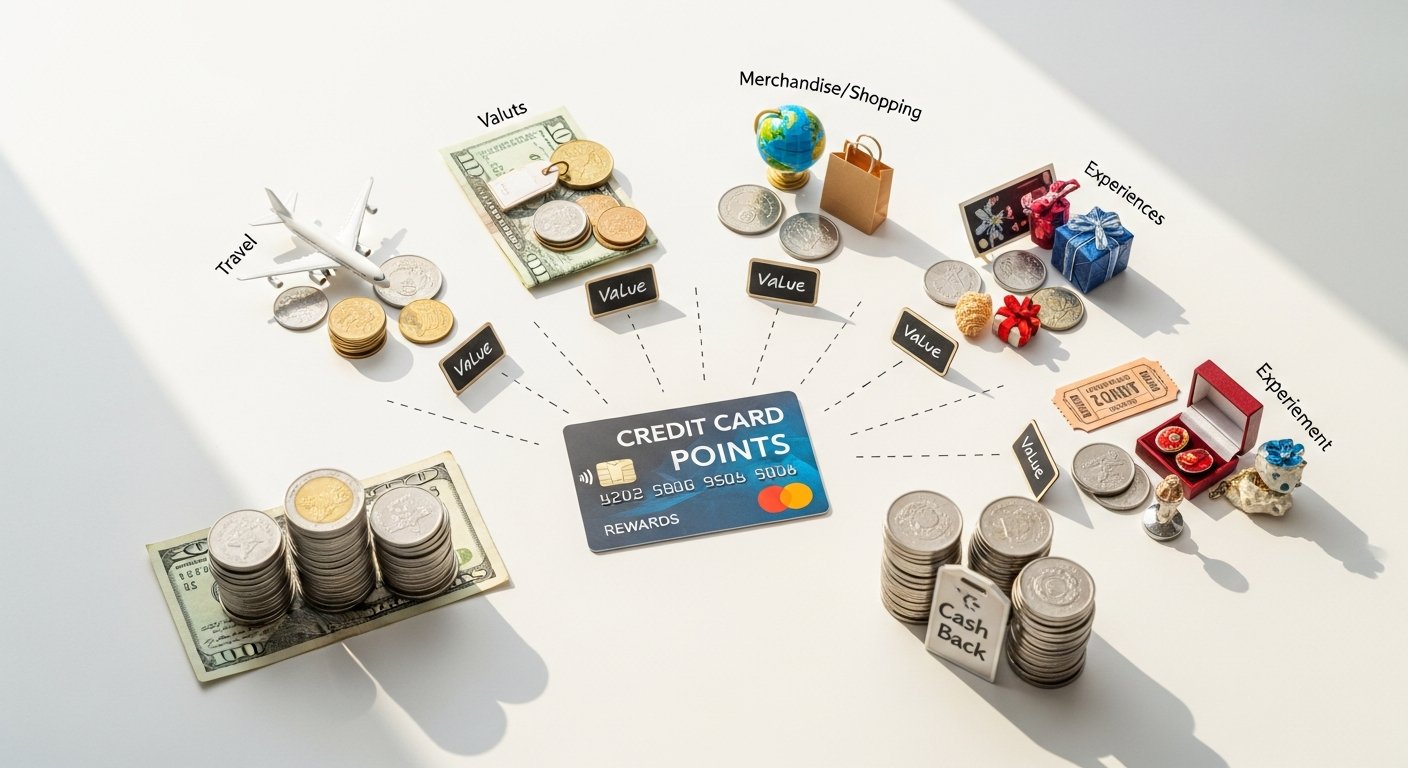
Redemption Options (Cash Back, Travel, Gift Cards, Merchandise)
The chosen method of redemption profoundly impacts your points’ value. Generally, redemption options can be categorized by their typical CPP:
- Travel Redemptions: Often provide the highest value. This includes booking flights or hotels directly through the bank’s travel portal (e.g., Chase Travel Portal) or, more powerfully, transferring points to airline or hotel loyalty programs. Premium cabin flights (business or first class) and luxury hotel stays frequently yield CPPs of 2 cents or more.
- Cash Back: Typically offers a fixed value, usually 0.5 cents to 1 cent per point. While convenient and flexible, it rarely provides the maximum possible value. Cards that directly earn cash back often provide a better return for this option than points cards redeemed for cash.
- Gift Cards: Value varies widely, often falling between 0.8 to 1 cent per point. Occasionally, promotional discounts can boost this, but it’s generally not a top-tier redemption.
- Merchandise: Almost universally the lowest value redemption, often less than 0.7 cents per point. It’s usually advisable to avoid redeeming points for merchandise unless there’s no other viable option or an extremely rare promotional offer.
The savvy points earner will almost always gravitate towards travel redemptions due to their superior value potential.
Transfer Partners (Airlines, Hotels)
For many flexible points programs (like Ultimate Rewards, Membership Rewards, ThankYou Points, and Capital One Miles), the ability to transfer points to airline and hotel loyalty programs is where the magic truly happens. These transfers unlock the potential for truly outsized value. Each program has its own set of partners and transfer ratios (e.g., 1:1, 1:0.8, etc.).
- Airline Partners: Transferring points to an airline allows you to book award flights, often at a much better CPP than booking through the credit card issuer’s portal or redeeming for cash. Examples include transferring Chase points to United or Southwest, or Amex points to Delta or British Airways.
- Hotel Partners: Similarly, transferring points to hotel chains like Hyatt (from Chase) or Marriott (from Amex, Chase, Citi) can provide exceptional value, especially for premium stays or during peak seasons when cash rates are high.
The key to maximizing value through transfer partners lies in identifying “sweet spots”—specific routes, cabin classes, or hotel categories where the number of points required is disproportionately low compared to the cash price. This often requires research and flexibility but yields the highest returns on your credit card points value.
[INLINE IMAGE 1: place after second H2 | alt=”credit card points value concept illustration”]
Promotional Offers and Bonuses
Credit card issuers and loyalty programs frequently roll out promotional offers that can temporarily inflate your points’ value. This could include:
- Transfer Bonuses: A common promotion where transferring points to a specific partner yields an extra percentage (e.g., a 25% bonus when transferring Amex MR to Virgin Atlantic). These can dramatically increase your CPP.
- Redemption Discounts: Occasional deals on gift cards or travel portal bookings.
- Category Bonuses: Earning extra points on specific spending categories (e.g., 5x points on groceries for a limited time). While these increase earning, they indirectly boost value by giving you more points to redeem at high CPPs.
Staying abreast of these limited-time offers, often highlighted by goldpoints, is crucial for opportunistic maximization of your credit card points value.
Card Type and Annual Fees
The type of credit card you hold also plays a role. Premium travel cards (e.g., Chase Sapphire Reserve, Amex Platinum) often offer higher redemption values for travel booked through their portals (e.g., 1.5 cents per point for CSR) and access to a wider range of transfer partners, justifying their higher annual fees. Entry-level cards or cash back cards might offer simpler redemption but at a lower, fixed value. The annual fee itself isn’t a direct factor in CPP, but it’s a cost that must be offset by the value you extract from the card’s rewards and benefits. A high CPP redemption can easily justify a significant annual fee if it unlocks a travel experience that would otherwise be unaffordable.
Dynamic vs. Fixed Value Points
Some points programs operate on a dynamic pricing model, particularly with airline and hotel awards. This means the number of points required for a redemption can fluctuate based on demand, cash price, or season. While this can make it harder to find consistent sweet spots, it also means that when cash prices are high, points can offer incredible leverage. Other points, like those from Capital One redeemed for travel statement credits, are fixed value (1 cent per mile), offering predictability but less potential for outsized gains. Understanding whether your points are subject to dynamic or fixed valuation is critical for planning redemptions.
Deconstructing Redemption Strategies for Maximum Value
Earning points is only half the battle; the true mastery lies in knowing how to redeem them. Strategic redemption is where the rubber meets the road, transforming a theoretical credit card points value into a tangible benefit. This section outlines the gold standard strategies for maximizing your rewards.
High-Value Travel Redemptions (Business/First Class, Luxury Hotels)
The undisputed champion of high-value point redemptions is often premium travel. Redeeming points for business or first-class flights, or stays at luxury hotels, can easily push your CPP well beyond 2 cents, sometimes even reaching 5-10 cents per point in extreme cases. Why? Because the cash price for these experiences is exorbitantly high, making them difficult to justify paying out-of-pocket for most people. Points, however, make them accessible.
- Premium Cabin Flights: Booking a lie-flat seat on a long-haul international flight using points can save thousands of dollars. The key is to leverage airline transfer partners and target specific award charts or dynamic pricing sweet spots. Flexibility with dates and destinations is often required to find availability.
- Luxury Hotel Stays: High-end hotel chains like Hyatt, Marriott, or Hilton have aspirational properties worldwide. Using points, especially with transfer bonuses or status benefits, can provide complimentary nights that would otherwise cost hundreds, if not thousands, of dollars per night.
These redemptions aren’t just about saving money; they’re about accessing experiences that enhance your quality of life and create unforgettable memories, all while demonstrating the immense power of understanding credit card points value.
Understanding Transfer Ratios and Sweet Spots
As mentioned, transferring points to airline and hotel partners is a cornerstone of high-value redemption. But it’s not enough to simply transfer. You need to understand the transfer ratios (e.g., 1:1, 1:0.8) and, more importantly, identify “sweet spots.”
- Sweet Spots: These are specific redemption opportunities within a partner’s loyalty program where the number of points required for a flight or hotel night is disproportionately low compared to its cash value. Examples often include specific regional flights, certain hotel categories during off-peak times, or even sometimes premium cabin awards that are priced very favorably on an airline’s award chart.
- Research is Key: Finding sweet spots requires research into individual airline and hotel award charts, understanding alliance partners (Star Alliance, Oneworld, SkyTeam), and staying updated on program changes. Resources like goldpoints provide regular updates and analyses of these opportunities.
Always calculate the CPP before transferring. A 1:1 transfer isn’t always better than a 1:0.8 transfer if the latter leads to a significantly higher CPP on the final redemption.
When to Redeem for Cash Back (Lower Value, but Flexible)
While travel redemptions generally offer the highest CPP, there are valid reasons to opt for cash back or statement credits:
- Simplicity and Convenience: Sometimes, you just need cash to cover an unexpected expense or to top up your savings. Cash back is straightforward and requires no complex booking or strategy.
- No Travel Plans: If you don’t travel frequently or have no immediate travel aspirations, holding onto points for a high-value travel redemption might not be practical. In such cases, 1 CPP cash back might be the best available value for your personal situation.
- Fixed Value Programs: For cards where cash back is the primary or only redemption option (e.g., 2% cash back cards), the decision is simpler.
- Offsetting Annual Fees: Some users prefer to redeem points for cash back to directly offset their credit card’s annual fee.
It’s crucial to acknowledge that while it typically yields a lower CPP, cash back offers unparalleled flexibility and liquidity. The “best” redemption is ultimately the one that best suits your immediate needs and financial goals, even if it’s not the highest theoretical credit card points value.
Avoiding Low-Value Redemptions (Merchandise, Statement Credits)
Just as there are high-value redemptions, there are also “value traps” that should generally be avoided. Redeeming points for merchandise through a bank’s shopping portal or for most statement credits (unless explicitly for cash back at 1 CPP or more) almost always yields a poor CPP, often less than 0.7 cents per point. This means you are getting significantly less than you could by optimizing for travel or even cash back.
Unless there’s an emergency or an extremely rare promotional offer, resist the urge to use points for items that can easily be purchased with cash. Your points are a valuable asset; treat them as such.
The Role of Elite Status in Maximizing Hotel/Airline Points
If you hold elite status with an airline or hotel chain (either earned through loyalty or granted via a credit card), your points can go even further. Elite benefits often include:
- Free upgrades: To higher cabin classes or larger hotel rooms.
- Bonus points: Earning extra points on paid stays/flights.
- Late checkout/early check-in: Enhancing the travel experience.
- Lounge access: Making airport waits more comfortable.
While these don’t directly change the CPP calculation, they enhance the overall value of your travel experience, effectively increasing the perceived worth of your points redemption. A points-funded trip enhanced by elite status can feel significantly more luxurious and valuable than its base cash equivalent.
Leveraging Shopping Portals and Partner Offers
Beyond direct redemptions, many credit card issuers and loyalty programs offer shopping portals (e.g., Chase Shop Through Chase, Amex Offers). While these are primarily earning opportunities rather than redemption, the extra points earned can amplify your overall points balance, providing more points to redeem at high value. Similarly, partner offers (e.g., bonus points for spending at specific merchants) contribute to your points arsenal, indirectly enhancing your potential for high-value redemptions.
A Deep Dive into Major Credit Card Loyalty Programs
To truly master credit card points value, it’s imperative to understand the nuances of the major loyalty ecosystems. Each program has its own strengths, weaknesses, and unique redemption avenues that influence the typical value of its points.
Chase Ultimate Rewards (UR)
Chase Ultimate Rewards is consistently ranked among the most valuable and flexible points programs. Points are primarily earned on cards like the Chase Sapphire Preferred, Chase Sapphire Reserve, and Chase Freedom Flex/Unlimited.
- Value Proposition: Points are typically worth 1 cent for cash back (1.25 or 1.5 cents for travel booked through Chase portal with Sapphire cards). However, their true power lies in 1:1 transfers to highly regarded airline and hotel partners.
- Key Transfer Partners: Southwest Airlines Rapid Rewards, United MileagePlus, World of Hyatt, Marriott Bonvoy, British Airways Executive Club, Virgin Atlantic Flying Club, Singapore Airlines KrisFlyer, Air France/KLM Flying Blue, and more.
- Sweet Spots:
- World of Hyatt: Often provides some of the highest CPPs, especially for luxury hotels. Category 1 hotels can be as low as 5,000 points, offering incredible value.
- United MileagePlus: Good for domestic and international Star Alliance flights.
- Southwest Rapid Rewards: Value is tied to the cash price of the flight, often yielding 1.4-1.6 CPP, making it a reliable option, especially with the Companion Pass.
- Virgin Atlantic Flying Club: Known for amazing redemptions on Delta One flights to Europe, albeit with fuel surcharges sometimes.
- Earning Strategy: Maximizing UR often involves a “Chase Trifecta” strategy, combining a premium Sapphire card for travel redemption bonuses with no-annual-fee Freedom cards for boosted earning in rotating categories or on everyday spend, then pooling points into the Sapphire account for transfer.
Our in-depth guide to Chase Ultimate Rewards provides further detail on maximizing this powerful currency.
American Express Membership Rewards (MR)
American Express Membership Rewards points are highly regarded for their extensive list of airline transfer partners, making them a favorite for international premium cabin travel. Cards include the Amex Platinum, Gold, Green, and EveryDay cards.
- Value Proposition: MR points generally offer poor value for cash back (0.6 cents per point) or gift cards. Their strength is almost exclusively in travel transfers.
- Key Transfer Partners: Delta SkyMiles, British Airways Executive Club, Air France/KLM Flying Blue, ANA Mileage Club, Cathay Pacific Asia Miles, Singapore Airlines KrisFlyer, Virgin Atlantic Flying Club, Marriott Bonvoy, Hilton Honors, and more.
- Sweet Spots:
- ANA Mileage Club: Incredible value for round-trip business and first-class flights on ANA and Star Alliance partners.
- Virgin Atlantic Flying Club: Can offer excellent value for Delta One flights, especially when transfer bonuses are active.
- Cathay Pacific Asia Miles: Good for Oneworld redemptions, including partner flights on Cathay Pacific, British Airways, and Qantas.
- Air France/KLM Flying Blue: Regular “Promo Rewards” offer discounted award flights to Europe.
- Earning Strategy: Amex cards often have high annual fees but come with generous earning rates (e.g., 4x on dining/groceries with the Gold card) and powerful statement credits that can offset the fee, making the points effectively cheaper to earn.
Citi ThankYou Points (TYP)
Citi ThankYou Points have evolved significantly, now offering a strong competitor in the flexible points space, especially for those interested in international travel. Key cards include the Citi Premier Card and Citi Custom Cash.
- Value Proposition: TYP are typically worth 1 cent per point for cash back (with certain cards) or gift cards. Like Amex and Chase, their maximum value comes from strategic transfers to airline partners.
- Key Transfer Partners: Turkish Airlines Miles&Smiles, Cathay Pacific Asia Miles, Virgin Atlantic Flying Club, EVA Air Infinity MileageLands, Singapore Airlines KrisFlyer, Etihad Guest, Choice Privileges, and more.
- Sweet Spots:
- Turkish Airlines Miles&Smiles: A hidden gem for domestic flights on United Airlines (Star Alliance partner), often requiring fewer miles than United’s own program.
- EVA Air Infinity MileageLands: Excellent for premium cabin redemptions on EVA and Star Alliance partners.
- Choice Privileges: Can offer incredible value for luxury hotel redemptions in Scandinavia and other parts of Europe.
- Earning Strategy: The Citi Premier offers competitive earning on travel and dining, while the Custom Cash provides 5x points on your top eligible spending category each billing cycle. Pooling these points allows for transfers.
Capital One Miles
Capital One Miles are a versatile currency, offering a straightforward redemption for travel statement credits or the potential for higher value through transfer partners. Cards include the Capital One Venture X, Venture Rewards, and Spark Miles for Business.
- Value Proposition: Miles are always worth 1 cent each when redeemed as a statement credit against eligible travel purchases. Transferring to partners can often yield higher value, particularly for premium travel.
- Key Transfer Partners: Air Canada Aeroplan, Air France/KLM Flying Blue, British Airways Executive Club, Turkish Airlines Miles&Smiles, Virgin Red (includes Virgin Atlantic), Emirates Skywards, and more. Many partners transfer at a 1:1 ratio.
- Sweet Spots:
- Turkish Airlines Miles&Smiles: Again, great for Star Alliance partners like United.
- Air Canada Aeroplan: A robust program for Star Alliance and other partners, with a unique stopover policy on award tickets.
- Virgin Red: Can offer excellent value for Virgin Atlantic flights or even other Virgin experiences.
- Earning Strategy: Capital One cards often offer simple, high flat-rate earning on all purchases (e.g., 2x miles per dollar), making them great for everyday, non-bonused spend.
Other Bank-Specific Programs (e.g., Bank of America, Wells Fargo)
While the above four are the primary players in flexible, transferable points, other banks offer their own rewards programs. These typically offer simpler redemption structures, often geared more towards cash back or fixed-value travel redemptions, with fewer or no transfer partners. Examples include:
- Bank of America Travel Rewards: Points are worth a fixed 1 cent each when redeemed for travel statement credits.
- Wells Fargo Autograph Card: Earns points that can be redeemed for cash back or travel, typically at 1 cent per point.
These cards can be excellent for simplicity and for those who prefer fixed-value rewards, but generally won’t offer the same potential for outsized credit card points value as the transferable points programs.
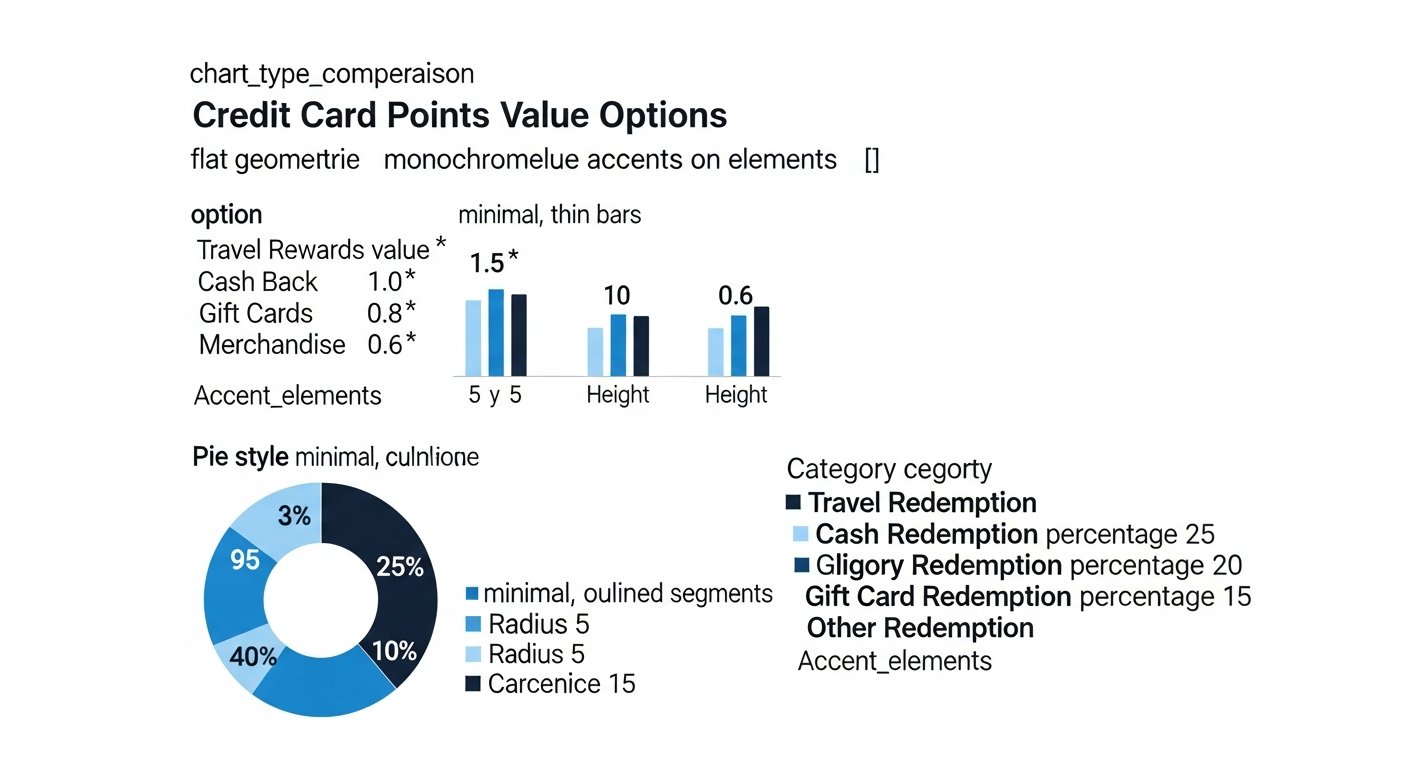
To help visualize the typical redemption values, here’s a comparison table:
| Loyalty Program | Cash Back Value (CPP) | Travel Portal Value (CPP) | Optimal Transfer Partner Value (CPP) | Key Strengths |
|---|---|---|---|---|
| Chase Ultimate Rewards | 1.0-1.0 (Freedom), 1.0 (Sapphire) | 1.25 (CSP), 1.5 (CSR) | 1.8-2.5+ (Hyatt, United, Southwest) | World of Hyatt transfers, US domestic travel |
| Amex Membership Rewards | 0.6-0.7 | 0.7-1.0 (Pay with Points) | 1.7-5.0+ (ANA, Virgin Atlantic, Singapore) | International premium travel, vast partner network |
| Citi ThankYou Points | 1.0 | 1.0 (for most cards) | 1.6-3.0+ (Turkish, EVA Air, Choice) | International travel, unique sweet spots |
| Capital One Miles | 0.5 (statement credit) | 1.0 (travel eraser) | 1.5-2.5+ (Aeroplan, Virgin Red, Emirates) | Flat-rate earning, broad 1:1 transfer partners |
| Bank of America Travel Rewards | N/A (cash back specific cards) | 1.0 (travel statement credit) | N/A | Simplicity, fixed travel value |
Note: CPP values are estimates and can fluctuate based on specific redemptions, promotions, and market conditions.
[INLINE IMAGE 2: place after fourth H2 | alt=”credit card points value comparison illustration”]
Advanced Strategies to Boost Your Points Value
Beyond understanding the fundamentals and choosing the right redemption, there are sophisticated strategies that goldpoints experts employ to consistently maximize their credit card points value and amplify their rewards.
The Power of Signup Bonuses
Undoubtedly, the single most impactful way to accumulate a massive influx of points is through credit card signup bonuses. These bonuses, offered when you meet a certain spending threshold within an introductory period (e.g., “Earn 75,000 points after spending $4,000 in the first three months”), can instantly provide enough points for significant travel. The value derived from a single signup bonus can easily outweigh years of organic spending for many users.
Strategy: Plan your credit card applications around periods of high spending (e.g., home renovations, large purchases, holiday season) to ensure you can comfortably meet the minimum spending requirements without overspending. Factor in the value of the bonus when considering annual fees. A 75,000-point bonus, potentially worth $1,500-$2,000 in travel, can easily justify a $95-$550 annual fee for the first year, providing immense net value. Continual strategic application for cards (while adhering to issuer rules and personal financial health) is a cornerstone of advanced points earning.
Strategic Card Churning (Ethical Considerations)
“Churning” refers to the practice of repeatedly applying for, earning the bonus on, and then potentially closing (or downgrading) credit cards to continuously cycle through signup bonuses. While highly effective for accumulating points, it comes with caveats:
- Issuer Rules: Banks have rules (e.g., Chase’s 5/24 rule, Amex’s once-per-lifetime rule for bonuses) that limit how frequently you can earn new bonuses. Understanding these rules is critical.
- Credit Score Impact: Multiple applications can temporarily ding your credit score, though the impact is usually minor and short-lived for those with excellent credit and responsible payment habits.
- Financial Responsibility: Only engage in churning if you are highly organized, always pay your bills on time and in full, and never spend beyond your means just to meet a bonus requirement.
At goldpoints, we advocate for responsible credit card use. Strategic application should always prioritize your financial well-being and long-term credit health over short-term point gains. When done responsibly, it’s an unparalleled way to boost your credit card points value by constantly injecting large point sums into your accounts.
Pairing Cards for Synergistic Benefits (e.g., Sapphire Reserve + Freedom Unlimited)
Many advanced points earners utilize a “credit card ecosystem” strategy, combining multiple cards from the same issuer to maximize earning and redemption flexibility. The Chase Ultimate Rewards “Trifecta” is a classic example:
- Chase Sapphire Reserve (or Preferred): Acts as the “hub” for point transfers and premium travel redemptions (e.g., 1.5 CPP on travel portal with CSR).
- Chase Freedom Unlimited: Earns a flat 1.5x points on all non-bonused spend.
- Chase Freedom Flex: Earns 5x points on rotating quarterly bonus categories.
By pooling points earned on the no-annual-fee Freedom cards into the Sapphire card’s account, all points can be transferred to travel partners or redeemed at the higher travel portal rate. This strategy ensures that virtually all your spending earns an elevated rate that can then be redeemed for maximum credit card points value.
Learn more about building your optimal credit card stack.
Maximizing Everyday Spend Categories
Beyond signup bonuses, optimizing your everyday spending is crucial for consistent point accumulation. This means using the right card for the right purchase. For example:
- Use a card that offers 4x points on groceries for all your supermarket purchases.
- Use a card with 3x or 4x points on dining for all restaurant bills.
- Use a card with 5x points on gas if that’s a bonus category.
- For all other spending, use a flat-rate card that earns 1.5x or 2x points.
This “category optimization” ensures that every dollar spent contributes significantly to your points balance, fueling your high-value redemptions. It requires a bit of organization but pays dividends in the long run.
Utilizing Authorized Users and Referrals
Many credit cards offer bonus points for adding authorized users, especially after they make their first purchase. This is a simple way to gain a few extra thousand points with minimal effort. Additionally, referring friends or family to a credit card can be a highly lucrative way to earn bonus points, often ranging from 10,000 to 20,000 points per successful referral, up to an annual limit. These referral bonuses further enhance your credit card points value by expanding your pool of redeemable points.
Hedging Against Devaluations
The world of loyalty programs is dynamic, and devaluations (where points become worth less) are an unfortunate reality. To hedge against this:
- Don’t Hoard Indefinitely: While it’s tempting to save points for a “dream trip,” holding them for too long increases the risk of devaluation. Aim for a “earn and burn” strategy where you accumulate points for a specific redemption within a reasonable timeframe (e.g., 1-2 years).
- Diversify: Don’t concentrate all your points in one program. Diversify across Chase, Amex, Citi, and Capital One to mitigate the impact of any single program’s devaluation.
- Stay Informed: goldpoints constantly monitors loyalty programs for upcoming changes and devaluations. Staying informed allows you to react quickly, potentially redeeming points before a negative change takes effect.
Proactive management and awareness are your best defenses against the fluctuating nature of credit card points value.
Calculating Your Personal Credit Card Points Value
While general valuations provide a useful benchmark, your personal credit card points value is what truly matters. Learning to calculate your own CPP for each redemption empowers you to make truly informed decisions tailored to your travel goals and financial situation.
Step-by-Step Guide to Calculating Cents Per Point (CPP)
Let’s break down how to calculate CPP with a practical example:
Scenario: You want to book a flight from New York (JFK) to London (LHR) in business class. The cash price for this flight is $3,000. Alternatively, you can redeem 100,000 points from your credit card program by transferring them to an airline partner.
- Determine the Cash Value of the Redemption: This is the price you would pay if you bought the flight with cash. In our example, it’s $3,000.
- Convert Cash Value to Cents: Multiply the dollar amount by 100.
- $3,000 x 100 = 300,000 cents.
- Identify the Number of Points Used: In our scenario, you’re using 100,000 points.
- Apply the CPP Formula: CPP = (Value of Redemption in Cents / Number of Points Used)
- CPP = 300,000 cents / 100,000 points = 3 cents per point.
In this example, your redemption yields a fantastic 3 CPP, significantly higher than the typical 1 CPP for cash back. This calculation helps you understand the direct financial benefit of using points for this specific travel. Always perform this calculation before you commit to a redemption, especially for transfers, to ensure you are getting a good deal.
Understanding Opportunity Cost
When calculating your personal CPP, it’s vital to consider the “opportunity cost.” This refers to the value of the next best alternative use of your points. For instance, if you redeem 10,000 points for a $100 gift card (1 CPP), but you know those same points could have been used for a flight worth $150 (1.5 CPP), your opportunity cost is 0.5 CPP (the difference in value you “lost” by not choosing the better option).
Opportunity cost doesn’t just apply to direct redemptions. It also applies to earning. If you’re using a card that earns 1 point per dollar on groceries, but you have another card that earns 4 points per dollar on groceries, the opportunity cost of using the first card is 3 points per dollar. Always consider what you could be gaining or losing by your choices.
The Intangible Value of Flexibility and Convenience
While CPP is a powerful metric, it doesn’t always capture the full picture of credit card points value. There are intangible benefits that contribute to your personal valuation:
- Flexibility: The ability to transfer points to various airlines and hotels provides immense flexibility, allowing you to adapt to changing travel plans or find award availability when cash tickets are expensive.
- Convenience: Sometimes, the ease of simply clicking a button to redeem
Credit Card Points Value: Your Ultimate Guide to Maximizing Rewards in 2026
Affiliate disclosure: This article may contain affiliate links. Recommendations are independent and editorially driven.
In the expansive and often intricate world of credit card rewards, few concepts are as pivotal, yet frequently misunderstood, as the true credit card points value. For the uninitiated, a point is just a point. But for savvy consumers and dedicated points and miles enthusiasts, understanding and optimizing the value of each point can transform aspirational travel plans into tangible experiences, generate significant savings, or even unlock unique luxury opportunities. At goldpoints, we believe that every point earned is a potential asset, and its true worth is not fixed but rather a dynamic equation influenced by a multitude of factors, from the issuing bank and loyalty program to your strategic redemption choices.
This comprehensive guide is designed to demystify the complexities surrounding credit card points value. We will delve deep into the mechanics of point valuation, explore the variables that dictate a point’s worth, and equip you with the knowledge and actionable strategies to consistently extract maximum utility from your hard-earned rewards. Whether your goal is to fly first class across continents, enjoy lavish hotel stays for a fraction of the cost, or simply optimize your cash back returns, mastering the art of valuing your points is the cornerstone of effective rewards management. Prepare to transform your approach to credit card rewards, turning passive accumulation into active, intelligent optimization.
Understanding the Fundamentals of Credit Card Points Value
Before we embark on the journey of maximizing your points, it’s essential to establish a firm understanding of what credit card points are and why their value is so crucial to monitor. It’s not merely about accumulating a large number; it’s about making those numbers translate into meaningful savings and experiences.
What Are Credit Card Points?
At their core, credit card points are a form of digital currency awarded by credit card issuers and loyalty programs as an incentive for using their products. Unlike cash, which has a universally recognized value, points are proprietary to the program that issues them. They are designed to be redeemed for various goods and services, often including travel, cash back, gift cards, or merchandise. The rate at which you earn points typically varies by card and spending category (e.g., 1 point per dollar on general purchases, 3 points per dollar on dining).
These points can be earned in several ways: through everyday spending, by meeting minimum spending requirements for lucrative sign-up bonuses, or via promotional offers. Once earned, they reside within your loyalty account until you decide to redeem them. The flexibility and potential for outsized value make them a preferred reward currency for many, particularly compared to fixed-value cash back programs, though cash back has its own undeniable advantages.
The Basic Premise: Why Value Matters
The primary reason why credit card points value matters is that not all points are created equal, and not all redemption options offer the same return. Imagine you have 10,000 points. If redeeming them for a $50 gift card, each point is worth 0.5 cents. However, if those same 10,000 points could be transferred to an airline partner and used for a flight that would otherwise cost $200, their value jumps to 2 cents per point. This stark difference illustrates why understanding point valuation is not just an academic exercise but a practical necessity for maximizing your rewards.
Ignoring the value proposition can lead to suboptimal redemptions, essentially leaving money on the table. It’s about ensuring that your efforts in earning points translate into the greatest possible benefit. This involves understanding the nuances of different programs, the myriad redemption avenues, and critically, how to calculate and compare their worth.
Common Valuation Metrics (CPP)
The most common metric used to assess credit card points value is “Cents Per Point” (CPP). This simple calculation allows you to compare the worth of different points and redemption options on a level playing field. The formula is:
- CPP = (Value of Redemption in Cents / Number of Points Used)
For example, if a flight costs $500 (50,000 cents) and you redeem 25,000 points for it, your CPP would be: 50,000 cents / 25,000 points = 2 cents per point. This metric helps in making informed decisions. Generally, goldpoints considers a CPP of 1.5 cents or higher to be good, and anything above 2 cents to be excellent, especially for flexible travel points. Cash back redemptions typically yield a fixed 1 CPP or sometimes less, depending on the card and program.
It’s important to note that published CPP values from various sources (including goldpoints) are often averages or reflect optimal redemption scenarios. Your personal CPP will depend on your specific redemption choices and travel patterns. Therefore, learning to calculate it for your own redemptions is a vital skill.
Factors Influencing Credit Card Points Value
The “value” of a credit card point is rarely static. It’s a dynamic figure that fluctuates based on a complex interplay of variables. Understanding these factors is key to strategically accumulating and redeeming points.
Issuing Bank and Loyalty Programs
The most significant determinant of a point’s base value is the credit card issuer and its associated loyalty program. Each bank operates its own unique system with distinct rules, redemption options, and transfer partners. For instance:
- Chase Ultimate Rewards (UR): Often cited for its high value, especially when transferred to travel partners like Southwest, United, or Hyatt. Points are typically worth 1-1.5 cents each for cash back or direct travel booked through their portal (depending on the card), but can soar to 2 cents or more via strategic transfers.
- American Express Membership Rewards (MR): Known for a vast array of airline and hotel transfer partners, MR points can yield exceptional value for premium travel. Cash back or statement credits are usually poor value (0.6-0.7 cents per point), pushing users towards travel redemptions.
- Citi ThankYou Points (TYP): Offers a strong lineup of airline transfer partners, particularly for international travel. Value can be high, though cash back options can be less competitive than Chase.
- Capital One Miles: A flexible currency that can be redeemed for travel statement credits (fixed 1 cent per mile) or transferred to a growing list of airline and hotel partners, often at favorable rates, leading to higher value.
Each program has its sweet spots and pitfalls, making a one-size-fits-all valuation impossible. Exploring the specifics of each major credit card rewards program is essential for any serious points earner.
Redemption Options (Cash Back, Travel, Gift Cards, Merchandise)
The chosen method of redemption profoundly impacts your points’ value. Generally, redemption options can be categorized by their typical CPP:
- Travel Redemptions: Often provide the highest value. This includes booking flights or hotels directly through the bank’s travel portal (e.g., Chase Travel Portal) or, more powerfully, transferring points to airline or hotel loyalty programs. Premium cabin flights (business or first class) and luxury hotel stays frequently yield CPPs of 2 cents or more.
- Cash Back: Typically offers a fixed value, usually 0.5 cents to 1 cent per point. While convenient and flexible, it rarely provides the maximum possible value. Cards that directly earn cash back often provide a better return for this option than points cards redeemed for cash.
- Gift Cards: Value varies widely, often falling between 0.8 to 1 cent per point. Occasionally, promotional discounts can boost this, but it’s generally not a top-tier redemption.
- Merchandise: Almost universally the lowest value redemption, often less than 0.7 cents per point. It’s usually advisable to avoid redeeming points for merchandise unless there’s no other viable option or an extremely rare promotional offer.
The savvy points earner will almost always gravitate towards travel redemptions due to their superior value potential.
Transfer Partners (Airlines, Hotels)
For many flexible points programs (like Ultimate Rewards, Membership Rewards, ThankYou Points, and Capital One Miles), the ability to transfer points to airline and hotel loyalty programs is where the magic truly happens. These transfers unlock the potential for truly outsized value. Each program has its own set of partners and transfer ratios (e.g., 1:1, 1:0.8, etc.).
- Airline Partners: Transferring points to an airline allows you to book award flights, often at a much better CPP than booking through the credit card issuer’s portal or redeeming for cash. Examples include transferring Chase points to United or Southwest, or Amex points to Delta or British Airways.
- Hotel Partners: Similarly, transferring points to hotel chains like Hyatt (from Chase) or Marriott (from Amex, Chase, Citi) can provide exceptional value, especially for premium stays or during peak seasons when cash rates are high.
The key to maximizing value through transfer partners lies in identifying “sweet spots”—specific routes, cabin classes, or hotel categories where the number of points required is disproportionately low compared to the cash price. This often requires research and flexibility but yields the highest returns on your credit card points value.
[INLINE IMAGE 1: place after second H2 | alt=”credit card points value concept illustration”]
Promotional Offers and Bonuses
Credit card issuers and loyalty programs frequently roll out promotional offers that can temporarily inflate your points’ value. This could include:
- Transfer Bonuses: A common promotion where transferring points to a specific partner yields an extra percentage (e.g., a 25% bonus when transferring Amex MR to Virgin Atlantic). These can dramatically increase your CPP.
- Redemption Discounts: Occasional deals on gift cards or travel portal bookings.
- Category Bonuses: Earning extra points on specific spending categories (e.g., 5x points on groceries for a limited time). While these increase earning, they indirectly boost value by giving you more points to redeem at high CPPs.
Staying abreast of these limited-time offers, often highlighted by goldpoints, is crucial for opportunistic maximization of your credit card points value.
Card Type and Annual Fees
The type of credit card you hold also plays a role. Premium travel cards (e.g., Chase Sapphire Reserve, Amex Platinum) often offer higher redemption values for travel booked through their portals (e.g., 1.5 cents per point for CSR) and access to a wider range of transfer partners, justifying their higher annual fees. Entry-level cards or cash back cards might offer simpler redemption but at a lower, fixed value. The annual fee itself isn’t a direct factor in CPP, but it’s a cost that must be offset by the value you extract from the card’s rewards and benefits. A high CPP redemption can easily justify a significant annual fee if it unlocks a travel experience that would otherwise be unaffordable.
Dynamic vs. Fixed Value Points
Some points programs operate on a dynamic pricing model, particularly with airline and hotel awards. This means the number of points required for a redemption can fluctuate based on demand, cash price, or season. While this can make it harder to find consistent sweet spots, it also means that when cash prices are high, points can offer incredible leverage. Other points, like those from Capital One redeemed for travel statement credits, are fixed value (1 cent per mile), offering predictability but less potential for outsized gains. Understanding whether your points are subject to dynamic or fixed valuation is critical for planning redemptions.
Deconstructing Redemption Strategies for Maximum Value
Earning points is only half the battle; the true mastery lies in knowing how to redeem them. Strategic redemption is where the rubber meets the road, transforming a theoretical credit card points value into a tangible benefit. This section outlines the gold standard strategies for maximizing your rewards.
High-Value Travel Redemptions (Business/First Class, Luxury Hotels)
The undisputed champion of high-value point redemptions is often premium travel. Redeeming points for business or first-class flights, or stays at luxury hotels, can easily push your CPP well beyond 2 cents, sometimes even reaching 5-10 cents per point in extreme cases. Why? Because the cash price for these experiences is exorbitantly high, making them difficult to justify paying out-of-pocket for most people. Points, however, make them accessible.
- Premium Cabin Flights: Booking a lie-flat seat on a long-haul international flight using points can save thousands of dollars. The key is to leverage airline transfer partners and target specific award charts or dynamic pricing sweet spots. Flexibility with dates and destinations is often required to find availability.
- Luxury Hotel Stays: High-end hotel chains like Hyatt, Marriott, or Hilton have aspirational properties worldwide. Using points, especially with transfer bonuses or status benefits, can provide complimentary nights that would otherwise cost hundreds, if not thousands, of dollars per night.
These redemptions aren’t just about saving money; they’re about accessing experiences that enhance your quality of life and create unforgettable memories, all while demonstrating the immense power of understanding credit card points value.
Understanding Transfer Ratios and Sweet Spots
As mentioned, transferring points to airline and hotel partners is a cornerstone of high-value redemption. But it’s not enough to simply transfer. You need to understand the transfer ratios (e.g., 1:1, 1:0.8) and, more importantly, identify “sweet spots.”
- Sweet Spots: These are specific redemption opportunities within a partner’s loyalty program where the number of points required for a flight or hotel night is disproportionately low compared to its cash value. Examples often include specific regional flights, certain hotel categories during off-peak times, or even sometimes premium cabin awards that are priced very favorably on an airline’s award chart.
- Research is Key: Finding sweet spots requires research into individual airline and hotel award charts, understanding alliance partners (Star Alliance, Oneworld, SkyTeam), and staying updated on program changes. Resources like goldpoints provide regular updates and analyses of these opportunities.
Always calculate the CPP before transferring. A 1:1 transfer isn’t always better than a 1:0.8 transfer if the latter leads to a significantly higher CPP on the final redemption.
When to Redeem for Cash Back (Lower Value, but Flexible)
While travel redemptions generally offer the highest CPP, there are valid reasons to opt for cash back or statement credits:
- Simplicity and Convenience: Sometimes, you just need cash to cover an unexpected expense or to top up your savings. Cash back is straightforward and requires no complex booking or strategy.
- No Travel Plans: If you don’t travel frequently or have no immediate travel aspirations, holding onto points for a high-value travel redemption might not be practical. In such cases, 1 CPP cash back might be the best available value for your personal situation.
- Fixed Value Programs: For cards where cash back is the primary or only redemption option (e.g., 2% cash back cards), the decision is simpler.
- Offsetting Annual Fees: Some users prefer to redeem points for cash back to directly offset their credit card’s annual fee.
It’s crucial to acknowledge that while it typically yields a lower CPP, cash back offers unparalleled flexibility and liquidity. The “best” redemption is ultimately the one that best suits your immediate needs and financial goals, even if it’s not the highest theoretical credit card points value.
Avoiding Low-Value Redemptions (Merchandise, Statement Credits)
Just as there are high-value redemptions, there are also “value traps” that should generally be avoided. Redeeming points for merchandise through a bank’s shopping portal or for most statement credits (unless explicitly for cash back at 1 CPP or more) almost always yields a poor CPP, often less than 0.7 cents per point. This means you are getting significantly less than you could by optimizing for travel or even cash back.
Unless there’s an emergency or an extremely rare promotional offer, resist the urge to use points for items that can easily be purchased with cash. Your points are a valuable asset; treat them as such.
The Role of Elite Status in Maximizing Hotel/Airline Points
If you hold elite status with an airline or hotel chain (either earned through loyalty or granted via a credit card), your points can go even further. Elite benefits often include:
- Free upgrades: To higher cabin classes or larger hotel rooms.
- Bonus points: Earning extra points on paid stays/flights.
- Late checkout/early check-in: Enhancing the travel experience.
- Lounge access: Making airport waits more comfortable.
While these don’t directly change the CPP calculation, they enhance the overall value of your travel experience, effectively increasing the perceived worth of your points redemption. A points-funded trip enhanced by elite status can feel significantly more luxurious and valuable than its base cash equivalent.
Leveraging Shopping Portals and Partner Offers
Beyond direct redemptions, many credit card issuers and loyalty programs offer shopping portals (e.g., Chase Shop Through Chase, Amex Offers). While these are primarily earning opportunities rather than redemption, the extra points earned can amplify your overall points balance, providing more points to redeem at high value. Similarly, partner offers (e.g., bonus points for spending at specific merchants) contribute to your points arsenal, indirectly enhancing your potential for high-value redemptions.
A Deep Dive into Major Credit Card Loyalty Programs
To truly master credit card points value, it’s imperative to understand the nuances of the major loyalty ecosystems. Each program has its own strengths, weaknesses, and unique redemption avenues that influence the typical value of its points.
Chase Ultimate Rewards (UR)
Chase Ultimate Rewards is consistently ranked among the most valuable and flexible points programs. Points are primarily earned on cards like the Chase Sapphire Preferred, Chase Sapphire Reserve, and Chase Freedom Flex/Unlimited.
- Value Proposition: Points are typically worth 1 cent for cash back (1.25 or 1.5 cents for travel booked through Chase portal with Sapphire cards). However, their true power lies in 1:1 transfers to highly regarded airline and hotel partners.
- Key Transfer Partners: Southwest Airlines Rapid Rewards, United MileagePlus, World of Hyatt, Marriott Bonvoy, British Airways Executive Club, Virgin Atlantic Flying Club, Singapore Airlines KrisFlyer, Air France/KLM Flying Blue, and more.
- Sweet Spots:
- World of Hyatt: Often provides some of the highest CPPs, especially for luxury hotels. Category 1 hotels can be as low as 5,000 points, offering incredible value.
- United MileagePlus: Good for domestic and international Star Alliance flights.
- Southwest Rapid Rewards: Value is tied to the cash price of the flight, often yielding 1.4-1.6 CPP, making it a reliable option, especially with the Companion Pass.
- Virgin Atlantic Flying Club: Known for amazing redemptions on Delta One flights to Europe, albeit with fuel surcharges sometimes.
- Earning Strategy: Maximizing UR often involves a “Chase Trifecta” strategy, combining a premium Sapphire card for travel redemption bonuses with no-annual-fee Freedom cards for boosted earning in rotating categories or on everyday spend, then pooling points into the Sapphire account for transfer.
Our in-depth guide to Chase Ultimate Rewards provides further detail on maximizing this powerful currency.
American Express Membership Rewards (MR)
American Express Membership Rewards points are highly regarded for their extensive list of airline transfer partners, making them a favorite for international premium cabin travel. Cards include the Amex Platinum, Gold, Green, and EveryDay cards.
- Value Proposition: MR points generally offer poor value for cash back (0.6 cents per point) or gift cards. Their strength is almost exclusively in travel transfers.
- Key Transfer Partners: Delta SkyMiles, British Airways Executive Club, Air France/KLM Flying Blue, ANA Mileage Club, Cathay Pacific Asia Miles, Singapore Airlines KrisFlyer, Virgin Atlantic Flying Club, Marriott Bonvoy, Hilton Honors, and more.
- Sweet Spots:
- ANA Mileage Club: Incredible value for round-trip business and first-class flights on ANA and Star Alliance partners.
- Virgin Atlantic Flying Club: Can offer excellent value for Delta One flights, especially when transfer bonuses are active.
- Cathay Pacific Asia Miles: Good for Oneworld redemptions, including partner flights on Cathay Pacific, British Airways, and Qantas.
- Air France/KLM Flying Blue: Regular “Promo Rewards” offer discounted award flights to Europe.
- Earning Strategy: Amex cards often have high annual fees but come with generous earning rates (e.g., 4x on dining/groceries with the Gold card) and powerful statement credits that can offset the fee, making the points effectively cheaper to earn.
Citi ThankYou Points (TYP)
Citi ThankYou Points have evolved significantly, now offering a strong competitor in the flexible points space, especially for those interested in international travel. Key cards include the Citi Premier Card and Citi Custom Cash.
- Value Proposition: TYP are typically worth 1 cent per point for cash back (with certain cards) or gift cards. Like Amex and Chase, their maximum value comes from strategic transfers to airline partners.
- Key Transfer Partners: Turkish Airlines Miles&Smiles, Cathay Pacific Asia Miles, Virgin Atlantic Flying Club, EVA Air Infinity MileageLands, Singapore Airlines KrisFlyer, Etihad Guest, Choice Privileges, and more.
- Sweet Spots:
- Turkish Airlines Miles&Smiles: A hidden gem for domestic flights on United Airlines (Star Alliance partner), often requiring fewer miles than United’s own program.
- EVA Air Infinity MileageLands: Excellent for premium cabin redemptions on EVA and Star Alliance partners.
- Choice Privileges: Can offer incredible value for luxury hotel redemptions in Scandinavia and other parts of Europe.
- Earning Strategy: The Citi Premier offers competitive earning on travel and dining, while the Custom Cash provides 5x points on your top eligible spending category each billing cycle. Pooling these points allows for transfers.
Capital One Miles
Capital One Miles are a versatile currency, offering a straightforward redemption for travel statement credits or the potential for higher value through transfer partners. Cards include the Capital One Venture X, Venture Rewards, and Spark Miles for Business.
- Value Proposition: Miles are always worth 1 cent each when redeemed as a statement credit against eligible travel purchases. Transferring to partners can often yield higher value, particularly for premium travel.
- Key Transfer Partners: Air Canada Aeroplan, Air France/KLM Flying Blue, British Airways Executive Club, Turkish Airlines Miles&Smiles, Virgin Red (includes Virgin Atlantic), Emirates Skywards, and more. Many partners transfer at a 1:1 ratio.
- Sweet Spots:
- Turkish Airlines Miles&Smiles: Again, great for Star Alliance partners like United.
- Air Canada Aeroplan: A robust program for Star Alliance and other partners, with a unique stopover policy on award tickets.
- Virgin Red: Can offer excellent value for Virgin Atlantic flights or even other Virgin experiences.
- Earning Strategy: Capital One cards often offer simple, high flat-rate earning on all purchases (e.g., 2x miles per dollar), making them great for everyday, non-bonused spend.
Other Bank-Specific Programs (e.g., Bank of America, Wells Fargo)
While the above four are the primary players in flexible, transferable points, other banks offer their own rewards programs. These typically offer simpler redemption structures, often geared more towards cash back or fixed-value travel redemptions, with fewer or no transfer partners. Examples include:
- Bank of America Travel Rewards: Points are worth a fixed 1 cent each when redeemed for travel statement credits.
- Wells Fargo Autograph Card: Earns points that can be redeemed for cash back or travel, typically at 1 cent per point.
These cards can be excellent for simplicity and for those who prefer fixed-value rewards, but generally won’t offer the same potential for outsized credit card points value as the transferable points programs.
To help visualize the typical redemption values, here’s a comparison table:
Loyalty Program Cash Back Value (CPP) Travel Portal Value (CPP) Optimal Transfer Partner Value (CPP) Key Strengths Chase Ultimate Rewards 1.0-1.0 (Freedom), 1.0 (Sapphire) 1.25 (CSP), 1.5 (CSR) 1.8-2.5+ (Hyatt, United, Southwest) World of Hyatt transfers, US domestic travel Amex Membership Rewards 0.6-0.7 0.7-1.0 (Pay with Points) 1.7-5.0+ (ANA, Virgin Atlantic, Singapore) International premium travel, vast partner network Citi ThankYou Points 1.0 1.0 (for most cards) 1.6-3.0+ (Turkish, EVA Air, Choice) International travel, unique sweet spots Capital One Miles 0.5 (statement credit) 1.0 (travel eraser) 1.5-2.5+ (Aeroplan, Virgin Red, Emirates) Flat-rate earning, broad 1:1 transfer partners Bank of America Travel Rewards N/A (cash back specific cards) 1.0 (travel statement credit) N/A Simplicity, fixed travel value Note: CPP values are estimates and can fluctuate based on specific redemptions, promotions, and market conditions.
[INLINE IMAGE 2: place after fourth H2 | alt=”credit card points value comparison illustration”]
Advanced Strategies to Boost Your Points Value
Beyond understanding the fundamentals and choosing the right redemption, there are sophisticated strategies that goldpoints experts employ to consistently maximize their credit card points value and amplify their rewards.
The Power of Signup Bonuses
Undoubtedly, the single most impactful way to accumulate a massive influx of points is through credit card signup bonuses. These bonuses, offered when you meet a certain spending threshold within an introductory period (e.g., “Earn 75,000 points after spending $4,000 in the first three months”), can instantly provide enough points for significant travel. The value derived from a single signup bonus can easily outweigh years of organic spending for many users.
Strategy: Plan your credit card applications around periods of high spending (e.g., home renovations, large purchases, holiday season) to ensure you can comfortably meet the minimum spending requirements without overspending. Factor in the value of the bonus when considering annual fees. A 75,000-point bonus, potentially worth $1,500-$2,000 in travel, can easily justify a $95-$550 annual fee for the first year, providing immense net value. Continual strategic application for cards (while adhering to issuer rules and personal financial health) is a cornerstone of advanced points earning.
Strategic Card Churning (Ethical Considerations)
“Churning” refers to the practice of repeatedly applying for, earning the bonus on, and then potentially closing (or downgrading) credit cards to continuously cycle through signup bonuses. While highly effective for accumulating points, it comes with caveats:
- Issuer Rules: Banks have rules (e.g., Chase’s 5/24 rule, Amex’s once-per-lifetime rule for bonuses) that limit how frequently you can earn new bonuses. Understanding these rules is critical.
- Credit Score Impact: Multiple applications can temporarily ding your credit score, though the impact is usually minor and short-lived for those with excellent credit and responsible payment habits.
- Financial Responsibility: Only engage in churning if you are highly organized, always pay your bills on time and in full, and never spend beyond your means just to meet a bonus requirement.
At goldpoints, we advocate for responsible credit card use. Strategic application should always prioritize your financial well-being and long-term credit health over short-term point gains. When done responsibly, it’s an unparalleled way to boost your credit card points value by constantly injecting large point sums into your accounts.
Pairing Cards for Synergistic Benefits (e.g., Sapphire Reserve + Freedom Unlimited)
Many advanced points earners utilize a “credit card ecosystem” strategy, combining multiple cards from the same issuer to maximize earning and redemption flexibility. The Chase Ultimate Rewards “Trifecta” is a classic example:
- Chase Sapphire Reserve (or Preferred): Acts as the “hub” for point transfers and premium travel redemptions (e.g., 1.5 CPP on travel portal with CSR).
- Chase Freedom Unlimited: Earns a flat 1.5x points on all non-bonused spend.
- Chase Freedom Flex: Earns 5x points on rotating quarterly bonus categories.
By pooling points earned on the no-annual-fee Freedom cards into the Sapphire card’s account, all points can be transferred to travel partners or redeemed at the higher travel portal rate. This strategy ensures that virtually all your spending earns an elevated rate that can then be redeemed for maximum credit card points value.
Learn more about building your optimal credit card stack.
Maximizing Everyday Spend Categories
Beyond signup bonuses, optimizing your everyday spending is crucial for consistent point accumulation. This means using the right card for the right purchase. For example:
- Use a card that offers 4x points on groceries for all your supermarket purchases.
- Use a card with 3x or 4x points on dining for all restaurant bills.
- Use a card with 5x points on gas if that’s a bonus category.
- For all other spending, use a flat-rate card that earns 1.5x or 2x points.
This “category optimization” ensures that every dollar spent contributes significantly to your points balance, fueling your high-value redemptions. It requires a bit of organization but pays dividends in the long run.
Utilizing Authorized Users and Referrals
Many credit cards offer bonus points for adding authorized users, especially after they make their first purchase. This is a simple way to gain a few extra thousand points with minimal effort. Additionally, referring friends or family to a credit card can be a highly lucrative way to earn bonus points, often ranging from 10,000 to 20,000 points per successful referral, up to an annual limit. These referral bonuses further enhance your credit card points value by expanding your pool of redeemable points.
Hedging Against Devaluations
The world of loyalty programs is dynamic, and devaluations (where points become worth less) are an unfortunate reality. To hedge against this:
- Don’t Hoard Indefinitely: While it’s tempting to save points for a “dream trip,” holding them for too long increases the risk of devaluation. Aim for a “earn and burn” strategy where you accumulate points for a specific redemption within a reasonable timeframe (e.g., 1-2 years).
- Diversify: Don’t concentrate all your points in one program. Diversify across Chase, Amex, Citi, and Capital One to mitigate the impact of any single program’s devaluation.
- Stay Informed: goldpoints constantly monitors loyalty programs for upcoming changes and devaluations. Staying informed allows you to react quickly, potentially redeeming points before a negative change takes effect.
Proactive management and awareness are your best defenses against the fluctuating nature of credit card points value.
Calculating Your Personal Credit Card Points Value
While general valuations provide a useful benchmark, your personal credit card points value is what truly matters. Learning to calculate your own CPP for each redemption empowers you to make truly informed decisions tailored to your travel goals and financial situation.
Step-by-Step Guide to Calculating Cents Per Point (CPP)
Let’s break down how to calculate CPP with a practical example:
Scenario: You want to book a flight from New York (JFK) to London (LHR) in business class. The cash price for this flight is $3,000. Alternatively, you can redeem 100,000 points from your credit card program by transferring them to an airline partner.
- Determine the Cash Value of the Redemption: This is the price you would pay if you bought the flight with cash. In our example, it’s $3,000.
- Convert Cash Value to Cents: Multiply the dollar amount by 100.
- $3,000 x 100 = 300,000 cents.
- Identify the Number of Points Used: In our scenario, you’re using 100,000 points.
- Apply the CPP Formula: CPP = (Value of Redemption in Cents / Number of Points Used)
- CPP = 300,000 cents / 100,000 points = 3 cents per point.
In this example, your redemption yields a fantastic 3 CPP, significantly higher than the typical 1 CPP for cash back. This calculation helps you understand the direct financial benefit of using points for this specific travel. Always perform this calculation before you commit to a redemption, especially for transfers, to ensure you are getting a good deal.
Understanding Opportunity Cost
When calculating your personal CPP, it’s vital to consider the “opportunity cost.” This refers to the value of the next best alternative use of your points. For instance, if you redeem 10,000 points for a $100 gift card (1 CPP), but you know those same points could have been used for a flight worth $150 (1.5 CPP), your opportunity cost is 0.5 CPP (the difference in value you “lost” by not choosing the better option).
Opportunity cost doesn’t just apply to direct redemptions. It also applies to earning. If you’re using a card that earns 1 point per dollar on groceries, but you have another card that earns 4 points per dollar on groceries, the opportunity cost of using the first card is 3 points per dollar. Always consider what you could be gaining or losing by your choices.
The Intangible Value of Flexibility and Convenience
While CPP is a powerful metric, it doesn’t always capture the full picture of credit card points value. There are intangible benefits that contribute to your personal valuation:
- Flexibility: The ability to transfer points to various airlines and hotels provides immense flexibility, allowing you to adapt to changing travel plans or find award availability when cash tickets are expensive.
- Convenience: Sometimes, the ease of simply clicking a button to redeem