


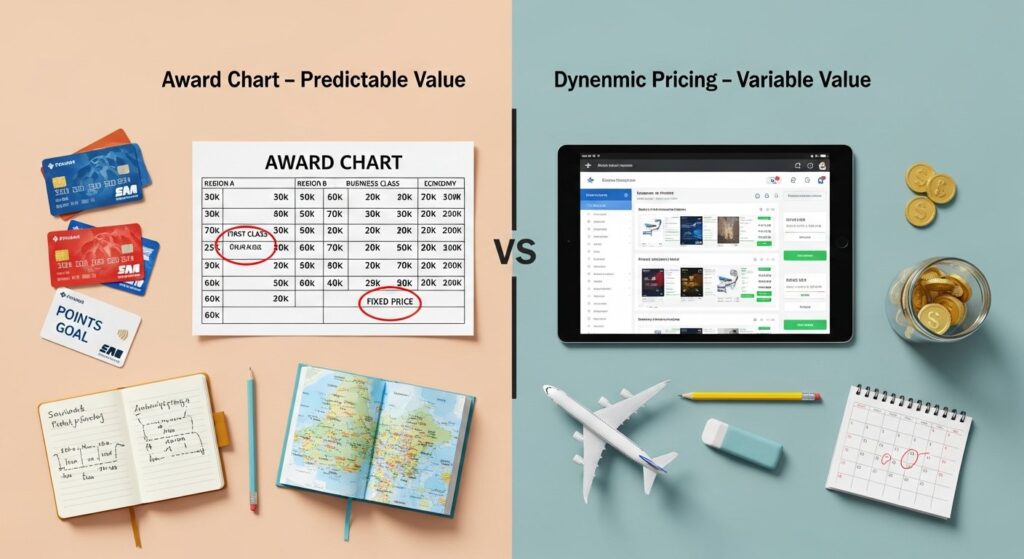
Airline Award Chart vs Dynamic Pricing: Mastering Your Points in 2026
Affiliate disclosure: This article may contain affiliate links. Recommendations are independent and editorially driven.
In the dynamic world of credit card rewards and travel points, understanding the nuances between an airline award chart vs dynamic pricing is paramount to maximizing the value of your hard-earned miles. For years, the traditional award chart served as a predictable beacon for aspiring travelers, offering fixed redemption rates for flights based on regions or distance. However, as airlines sought greater flexibility and revenue optimization, many shifted towards dynamic pricing models, where the cost in miles fluctuates with demand, cash prices, and other variables.
This comprehensive guide from goldpoints will delve deep into the mechanics of both systems, helping you discern their advantages, disadvantages, and, most importantly, how to navigate them effectively in 2026 to unlock incredible travel experiences. Whether you’re a seasoned points-and-miles enthusiast or just starting your journey, mastering the art of redeeming airline awards requires a clear understanding of these fundamental differences. We’ll explore which airlines still cling to award charts, which have fully embraced dynamic pricing, and how hybrid models attempt to offer the best of both worlds. By the end of this article, you’ll be equipped with the strategies to find sweet spots, calculate true value, and make informed decisions for your next award redemption.
Table of Contents
- TL;DR: Key Takeaways
- The Evolving Landscape of Airline Award Travel
- Understanding Airline Award Charts: The Traditional Model
- Demystifying Dynamic Pricing: The Modern Reality
- The Hybrid Approach: Blending Predictability and Flexibility
- Airline Award Chart vs Dynamic Pricing: A Comprehensive Comparison
- Strategies for Maximizing Value in Any System
- Future Outlook: What’s Next for Award Travel?
- Conclusion: Your Path to Smarter Redemptions
- Frequently Asked Questions
TL;DR: Key Takeaways

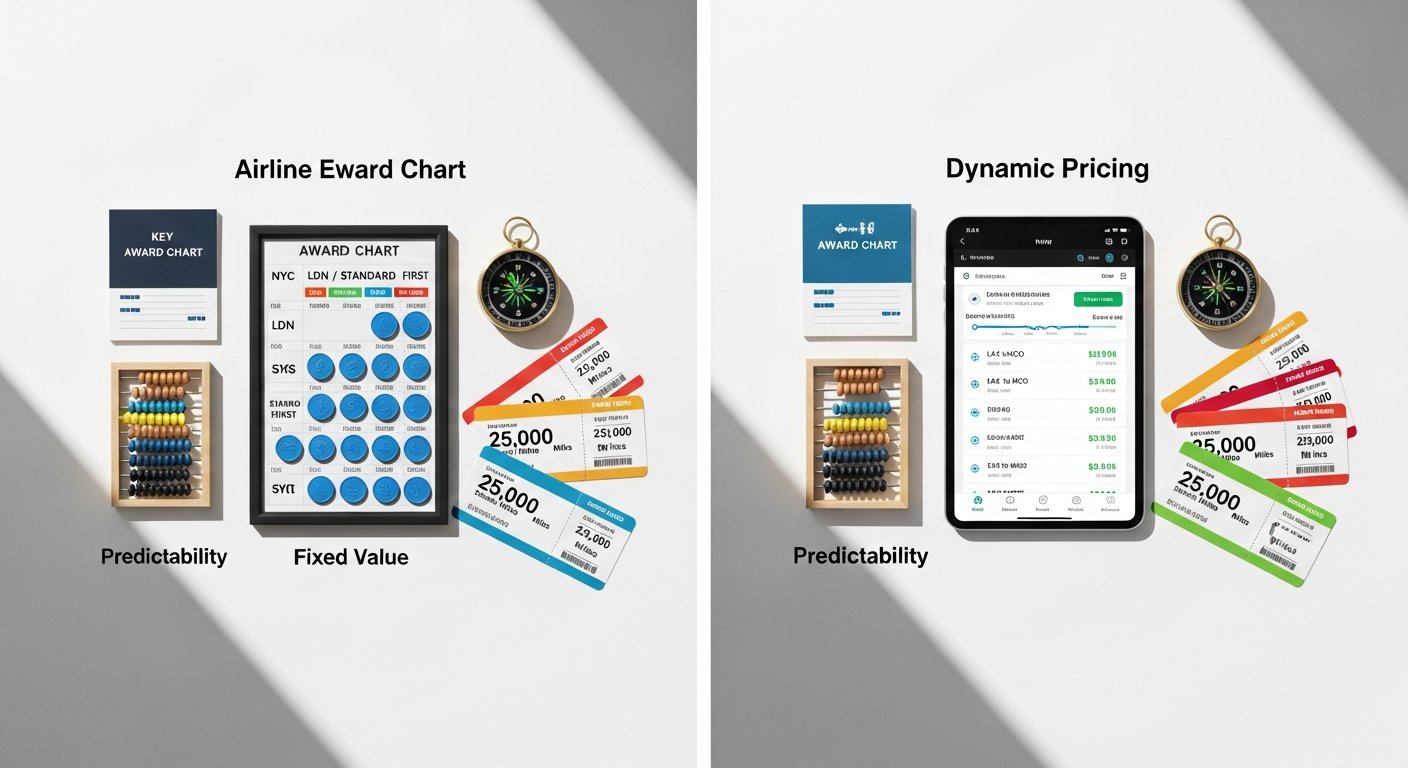
For the busy traveler, here’s the essential breakdown of the airline award chart vs dynamic pricing debate:
- Award Charts (Fixed Value): Offer predictable redemption costs based on region or distance. Great for finding “sweet spots” and aspirational travel, but availability can be limited. Maximize by planning far in advance and targeting specific routes.
- Dynamic Pricing (Variable Value): Mile costs fluctuate like cash prices, driven by demand, route popularity, and fare class availability. Offers greater availability but often lower cents-per-point (CPP) value. Best for last-minute bookings, less popular routes, or when cash prices are low.
- Hybrid Models: Many airlines now use a mix – award charts for partner airlines, dynamic pricing for their own metal, or charts with varying tiers. Requires careful research for each redemption.
- Maximizing Value: Regardless of the system, flexibility, leveraging transfer bonuses, understanding peak/off-peak seasons, and identifying specific program sweet spots are crucial. Always compare the miles cost to the cash cost to determine your CPP.
The Evolving Landscape of Airline Award Travel
For decades, the currency of frequent flyer miles felt tangible, governed by clear rules outlined in airline award charts. These charts were the sacred texts of points enthusiasts, offering a roadmap to aspirational travel. However, the travel industry is in a constant state of flux, driven by economic pressures, technological advancements, and shifting consumer behavior. The once-dominant award chart model has steadily given way to more fluid, revenue-based systems, colloquially known as dynamic pricing.
This fundamental shift has profound implications for how we earn, save, and redeem our travel points. The predictability that once allowed travelers to stockpile miles for a specific, high-value redemption has been challenged by algorithms that adjust mile costs in real-time. This evolution isn’t just a minor tweak; it’s a paradigm shift that demands a new approach to points-and-miles strategy. Understanding this transition is the first step in maintaining your edge as a savvy points maximizer in 2026 and beyond.
The Core Dilemma: Predictability vs. Flexibility
At the heart of the airline award chart vs dynamic pricing debate lies a fundamental tension: predictability versus flexibility. Award charts, by their very nature, offer predictability. You know exactly how many miles a flight between two zones will cost, regardless of the cash price on any given day. This predictability empowers travelers to set long-term redemption goals and strategically accumulate the necessary points.
Dynamic pricing, conversely, champions flexibility – for the airline, at least. By tying award costs to real-time market conditions, airlines can optimize their revenue, filling seats that might otherwise go empty and adjusting prices based on demand. For the consumer, this means potentially more award availability, but at highly variable costs that can make long-term planning more challenging. The dilemma for consumers is clear: Do you prefer the certainty of a fixed price, even if it means searching harder for availability, or the ubiquitous availability of a variable price, even if it might mean a lower return on your points?
This article will guide you through this dilemma, helping you understand when each system works in your favor and how to navigate the complex landscape of airline redemptions.
[INLINE IMAGE 1: place after second H2 | alt=”airline award chart vs dynamic pricing concept illustration”]
Understanding Airline Award Charts: The Traditional Model
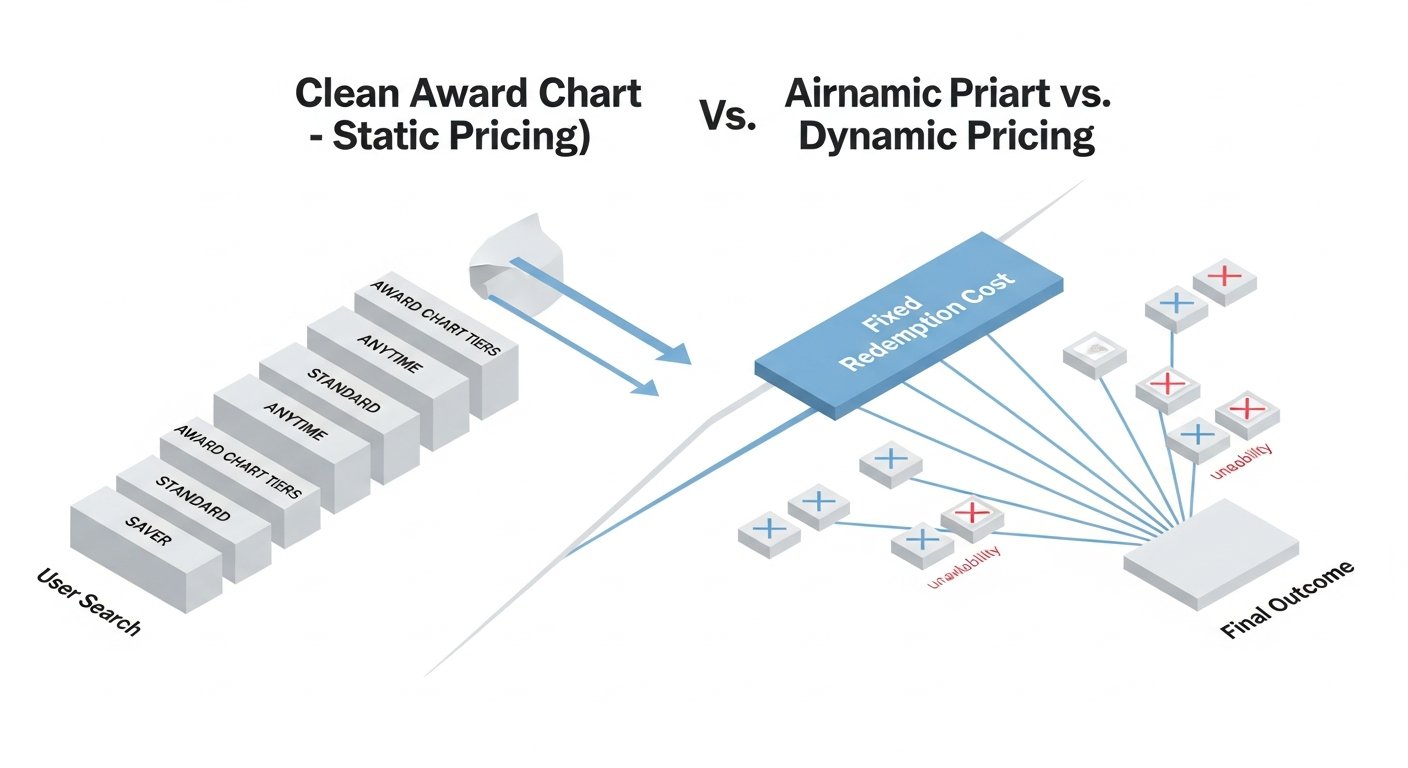
Before the widespread adoption of dynamic pricing, award charts were the standard for virtually all airline loyalty programs. These charts provided a clear, published schedule of how many miles were required for a flight between specific geographic regions or based on the distance flown. They were, in essence, a fixed menu of redemption options, allowing members to easily determine the cost of their desired travel.
The beauty of award charts lay in their transparency and the potential for outsized value. A first-class flight that might cost thousands of dollars in cash could be redeemed for a relatively fixed number of miles, often yielding a cents-per-point (CPP) valuation significantly higher than the average. This made aspirational travel dreams, like business class to Europe or first class to Asia, genuinely attainable for diligent points collectors.
How Award Charts Work
An award chart functions by segmenting the world into various zones or by calculating the total distance of a flight. Airlines then publish a table indicating the number of miles required for travel between these zones or within specific distance bands. Key characteristics include:
- Fixed Redemption Rates: The most defining feature is that the mileage cost for a specific route or zone pairing remains constant, regardless of the cash price of the ticket at the time of booking.
- Class-Based Tiers: Charts typically differentiate costs based on the class of service (Economy, Premium Economy, Business, First Class), with each class having its own fixed mileage requirement.
- Peak vs. Off-Peak: Some award charts introduce “peak” and “off-peak” pricing, where travel during high-demand periods costs more miles than during low-demand periods. While this adds a layer of variability, it’s still pre-defined and published on the chart.
- Partner Redemptions: Often, an airline’s award chart is most valuable when redeeming miles on their partner airlines within an alliance (e.g., Star Alliance, Oneworld, SkyTeam). These partner redemption rates tend to be more stable and chart-based, even if the operating airline’s own flights are dynamically priced.
Types of Award Charts: Zone, Distance, and Partner Specific
Award charts aren’t monolithic; they come in several common formats:
- Zone-Based Award Charts: This is the most common type. The world is divided into regions (e.g., North America, Europe, Asia 1, Asia 2, Oceania, South America). The chart then specifies the miles needed to fly from one zone to another (e.g., North America to Europe).
- Example: 60,000 miles for Business Class from the US to Europe, regardless of whether you fly from New York or Los Angeles.
- Distance-Based Award Charts: Less common but highly strategic, these charts base the mileage cost on the total distance flown. Longer flights require more miles. This can create “sweet spots” for short, expensive routes or for multi-stop itineraries that stay within a lower distance band.
- Example: JAL Mileage Bank’s distance-based chart for partner awards, where flights under 6,000 miles might cost X miles, and 6,001-10,000 miles cost Y miles.
- Partner-Specific Award Charts: Some airlines maintain separate award charts specifically for redemptions on their partner airlines, even if their own flights are dynamically priced. These are often the most lucrative charts for finding high-value redemptions.
- Example: British Airways Executive Club uses a distance-based chart for its own flights but a more favorable one for some partner airlines. ANA Mileage Club has different charts for ANA metal and Star Alliance partners.
Pros and Cons of Award Charts
Understanding the strengths and weaknesses of award charts is crucial for anyone engaging in the airline award chart vs dynamic pricing debate.
Pros:
- Predictability: You know exactly how many miles you need, enabling long-term savings goals.
- Aspirational Redemptions: Often the best way to book premium cabin flights (Business or First Class) for a fixed, often high-value, number of miles.
- “Sweet Spots”: Specific routes or regions where the fixed mileage cost offers exceptional value compared to the cash price. These are highly sought after by points enthusiasts.
- Easier Budgeting: Simplifies the planning process for your points budget.
- Value Protection: Insulates you from high cash prices during peak demand times.
Cons:
- Limited Availability: Airlines control the number of seats released at award chart rates, especially in premium cabins. Finding availability can be challenging, requiring flexibility and persistent searching.
- Less Flexible: If a specific flight or date isn’t available at the chart rate, you’re out of luck unless you pay the (often high) cash price.
- Devaluations: While fixed, award charts are subject to devaluations where airlines unilaterally increase the mileage requirements, often with little notice.
- Complex Routings: Some charts can be restrictive on routing rules (e.g., no backtracking, limited connections), making complex itineraries difficult.
Key Airlines Still Utilizing Award Charts in 2026
While dynamic pricing has become the norm for many major carriers, several airlines and their respective loyalty programs continue to offer traditional award charts, particularly for partner redemptions. These are the programs where you can often find the highest value for your points in 2026:
- Alaska Airlines Mileage Plan: Renowned for its valuable award charts, especially for partners like Cathay Pacific, Japan Airlines, Korean Air (though limited partner bookings), and Fiji Airways. While Alaska has made some adjustments, its partner award charts remain a goldmine for aspirational travel.
- ANA Mileage Club: Offers a strong zone-based award chart for Star Alliance partner redemptions, often featuring great value for business and first class to Asia and Europe. ANA also has a distance-based chart for multi-partner itineraries.
- Virgin Atlantic Flying Club: While it uses dynamic pricing for its own flights, its award chart for partners like ANA and Delta (on specific routes) can offer incredible value, particularly for upper-class cabins.
- Cathay Pacific Asia Miles: Maintains a distance-based award chart for its own flights and Oneworld partners, offering excellent value for round-the-world itineraries or specific long-haul premium redemptions.
- Japan Airlines (JAL) Mileage Bank: Uses a distance-based award chart for Oneworld and other partners, which can be fantastic for multi-stop trips or specific routes on airlines like Emirates or Hawaiian Airlines.
- Certain International Carriers: Smaller or more regionally focused airlines may also retain award charts, though their accessibility to US-based points collectors might vary.
It’s crucial to always check the most current award charts directly on the airline’s website, as they can change without prior extensive public notification. These programs often represent the best opportunities for significant value in the current landscape.
Explore the best credit cards for earning transferable points.
Demystifying Dynamic Pricing: The Modern Reality
Dynamic pricing represents a fundamental shift away from the fixed rules of award charts. In this model, the number of miles required for a flight is not static but fluctuates in real-time, much like the cash price of a ticket. This approach gives airlines immense flexibility in managing inventory and maximizing revenue, but it often means a less predictable and frequently less valuable experience for the points and miles user.
The transition to dynamic pricing has been a gradual but persistent trend across the industry, with most major U.S. carriers leading the charge. While it can be frustrating for those accustomed to finding “sweet spots,” understanding how dynamic pricing works is essential for adapting your strategy and still extracting value from your loyalty points in 2026.
How Dynamic Pricing Works
At its core, dynamic pricing ties the mileage cost of an award ticket directly to the cash price of that same ticket. However, it’s often more complex than a simple mathematical conversion. Here’s a breakdown:
- Revenue Management Algorithms: Airlines employ sophisticated algorithms that constantly adjust mileage prices based on numerous factors, including demand, remaining seat inventory, competitor pricing, route popularity, and even the time of day.
- Fluctuating Costs: The number of miles required for a specific flight can change minute-by-minute, day-by-day, mirroring the volatility of cash ticket prices. Peak travel dates or popular routes will almost always command significantly more miles.
- Base vs. Premium Redemptions: While costs are dynamic, there are often still “floor” or “base” rates for economy redemptions on off-peak dates, but these can quickly skyrocket. Premium cabin redemptions typically see the most dramatic fluctuations, often becoming astronomically expensive in miles.
- More Availability: A key advantage for airlines (and sometimes for consumers) is that virtually every seat for sale in cash can theoretically be purchased with miles. This means award availability is generally much wider than under a strict award chart system, albeit at varying costs.
Factors Influencing Dynamic Award Costs
The black box of dynamic pricing considers a multitude of variables. Here are the primary factors that cause award costs to go up or down:
- Cash Price: The most significant driver. If the cash price of a ticket is high, the mileage cost will almost certainly be high. If cash prices are low (e.g., during a sale), mile costs may also decrease.
- Demand: High demand for a particular flight, route, or date will drive up both cash and mileage costs. This is why holiday travel or major event dates are so expensive.
- Availability of Fare Classes: Airlines sell seats in various “fare classes” (e.g., Y, B, M for economy; J, C, D for business). Dynamic pricing models often align award availability and cost with specific cash fare classes. When cheaper cash fare classes sell out, the mileage cost for remaining seats in higher fare classes increases.
- Advance Booking: Generally, booking further in advance can yield lower mileage costs, though this isn’t a guarantee, especially for high-demand routes. Last-minute bookings are often very expensive.
- Seasonality: Peak travel seasons (summer, holidays) will always see higher mileage costs than off-peak seasons.
- Route Popularity: Major hub-to-hub routes or popular international destinations will typically be more expensive in miles than less popular or regional routes.
- Competitor Pricing: Airlines constantly monitor competitors. If a rival airline lowers prices, dynamic pricing might adjust mileage costs to remain competitive.
Pros and Cons of Dynamic Pricing
The shift to dynamic pricing has a distinct set of advantages and disadvantages for the points and miles traveler.
Pros:
- Wider Availability: Generally, if a seat is available for cash, it’s available for miles. This means fewer frustrations with “no award space” messages, especially in economy.
- Flexibility: Great for last-minute bookings or when your travel dates are not set far in advance, as you can often find some award option, even if expensive.
- Lower Costs for Cheap Cash Fares: When cash fares are very low (e.g., during airline sales or for off-peak domestic flights), dynamic pricing can sometimes offer decent value for redemptions, especially in economy.
- Convenience: Simpler searching for many, as you don’t need to consult a separate chart; the price is just displayed.
Cons:
- Unpredictability: The biggest drawback. It’s almost impossible to predict how many miles a specific flight will cost months in advance, making long-term planning difficult.
- Devalued Points: Aspirational premium cabin redemptions often become exorbitantly expensive, requiring hundreds of thousands (or even millions) of miles for flights that once cost a fixed, reasonable amount. The “sweet spots” are largely eliminated.
- Poor Value during Peak Travel: During high-demand periods, the cents-per-point (CPP) value can plummet dramatically, sometimes falling below 1 CPP, making points redemption a poor use compared to paying cash.
- Lack of Transparency: The algorithms are proprietary, so understanding *why* a flight costs a certain number of miles is opaque.
- Higher Cost for Partner Redemptions: Many airlines using dynamic pricing for their own flights will also price partner awards dynamically, though some still adhere to partner award charts.
Airlines Primarily Using Dynamic Pricing
Most major U.S. carriers have fully embraced dynamic pricing for their own flights. This means that if you’re flying directly with these airlines using their miles, you’ll encounter fluctuating costs:
- Delta Air Lines (SkyMiles): A pioneer in dynamic pricing, Delta’s mileage costs vary wildly based on demand, route, and time of booking. There’s no published award chart for their own flights.
- United Airlines (MileagePlus): Largely dynamic for its own flights, though it does offer some “saver” awards that align with partner award charts. However, most United-operated flights are dynamically priced.
- American Airlines (AAdvantage): While still showing some vestiges of award charts for partner flights, American’s own-metal redemptions have largely shifted to a dynamic model, with “Web Special” awards offering variable pricing.
- Southwest Airlines (Rapid Rewards): A true revenue-based program where points directly correlate to the cash price of a ticket (typically around 1.3-1.5 cents per point).
- JetBlue (TrueBlue): Similar to Southwest, JetBlue’s points value is tied directly to the cash fare, typically around 1.3-1.4 cents per point.
- Air Canada (Aeroplan): While Aeroplan has a distance-based award chart for partner awards, its own Air Canada flights are dynamically priced within published “bands.”
- Many European Carriers: Airlines like Air France/KLM (Flying Blue) and Lufthansa (Miles & More) also extensively use dynamic pricing for their own flights, though Flying Blue maintains some semblance of a ‘standard’ award chart for partner redemptions.
[INLINE IMAGE 2: place after fourth H2 | alt=”airline award chart vs dynamic pricing comparison illustration”]
The Hybrid Approach: Blending Predictability and Flexibility
The sharp contrast between the predictability of award charts and the variability of dynamic pricing has led many airlines to adopt a “hybrid” model. This approach attempts to balance revenue optimization for the airline with some level of perceived value or structure for the loyalty program member. In 2026, the hybrid model is arguably the most common and, in some ways, the most complex system to navigate.
For the savvy points and miles enthusiast, understanding these hybrid programs is crucial. They often present opportunities to leverage the best aspects of both systems – finding sweet spots on partner airlines while taking advantage of wider availability on the operating carrier’s own flights when cash prices are low.
Understanding Hybrid Models
A hybrid model isn’t a single, uniform system but rather a combination of elements from both traditional award charts and dynamic pricing. Here’s what that typically looks like:
- Separate Pricing for Own Flights vs. Partner Flights: This is the most prevalent hybrid strategy.
- Own Flights: Dynamically priced, meaning the mileage cost fluctuates with demand and cash prices.
- Partner Flights: Governed by a fixed award chart, often shared across an alliance (e.g., Star Alliance, Oneworld, SkyTeam). These partner charts are often where the best “sweet spots” are found.
- Published Award Bands with Dynamic Pricing Within: Some programs, like Air Canada Aeroplan, publish award charts that specify a range (e.g., “North America to Europe: 60,000-100,000 miles in Business Class”). While this provides a ceiling and floor, the actual price within that band is dynamically determined.
- Peak/Off-Peak Award Charts: Another form of hybrid pricing where an airline retains a fixed award chart but has distinct (and published) higher rates for peak travel dates and lower rates for off-peak dates. While still a chart, the variable nature based on demand dates makes it a hybrid.
- “Web Specials” or Promotional Awards: Airlines with dynamic pricing might occasionally release limited “Web Special” or “Saver” awards at significantly reduced, fixed-like rates to stimulate demand or compete. These are often temporary and limited.
The complexity of hybrid models means that a single loyalty program can offer drastically different redemption values depending on whether you’re flying on the operating airline or a partner, and on the specific route and time of year.
Programs Employing Hybrid Strategies
Many of the world’s most popular loyalty programs operate under a hybrid structure, offering a mix of dynamic pricing for their own flights and fixed award charts for partner redemptions. These are key programs to understand for goldpoints readers:
- American Airlines AAdvantage: For its own flights, AAdvantage extensively uses dynamic “Web Special” pricing, often with varying costs. However, it still maintains an award chart for partner redemptions (though this chart has seen significant changes over the years). Finding saver space on partners like Qatar Airways or Japan Airlines can still yield excellent value.
- United Airlines MileagePlus: United’s own flights are largely dynamically priced. However, for Star Alliance partner awards, MileagePlus generally adheres to a predictable “saver” award chart, making it possible to find good value on airlines like ANA, Lufthansa, or Turkish Airlines.
- Air Canada Aeroplan: Aeroplan represents one of the most sophisticated hybrid models. It uses a distance-based award chart for all Star Alliance partner redemptions (offering excellent sweet spots). For its own Air Canada flights, it employs dynamic pricing but within publicly accessible award bands, providing a degree of transparency while still allowing for flexibility.
- British Airways Executive Club: British Airways uses a distance-based award chart for its own flights, with separate charts for peak and off
Airline Award Chart vs Dynamic Pricing: Mastering Your Points in 2026
Affiliate disclosure: This article may contain affiliate links. Recommendations are independent and editorially driven.
In the dynamic world of credit card rewards and travel points, understanding the nuances between an airline award chart vs dynamic pricing is paramount to maximizing the value of your hard-earned miles. For years, the traditional award chart served as a predictable beacon for aspiring travelers, offering fixed redemption rates for flights based on regions or distance. However, as airlines sought greater flexibility and revenue optimization, many shifted towards dynamic pricing models, where the cost in miles fluctuates with demand, cash prices, and other variables.
This comprehensive guide from goldpoints will delve deep into the mechanics of both systems, helping you discern their advantages, disadvantages, and, most importantly, how to navigate them effectively in 2026 to unlock incredible travel experiences. Whether you’re a seasoned points-and-miles enthusiast or just starting your journey, mastering the art of redeeming airline awards requires a clear understanding of these fundamental differences. We’ll explore which airlines still cling to award charts, which have fully embraced dynamic pricing, and how hybrid models attempt to offer the best of both worlds. By the end of this article, you’ll be equipped with the strategies to find sweet spots, calculate true value, and make informed decisions for your next award redemption.
Table of Contents
- TL;DR: Key Takeaways
- The Evolving Landscape of Airline Award Travel
- Understanding Airline Award Charts: The Traditional Model
- Demystifying Dynamic Pricing: The Modern Reality
- The Hybrid Approach: Blending Predictability and Flexibility
- Airline Award Chart vs Dynamic Pricing: A Comprehensive Comparison
- Strategies for Maximizing Value in Any System
- Future Outlook: What’s Next for Award Travel?
- Conclusion: Your Path to Smarter Redemptions
- Frequently Asked Questions
TL;DR: Key Takeaways
For the busy traveler, here’s the essential breakdown of the airline award chart vs dynamic pricing debate:
- Award Charts (Fixed Value): Offer predictable redemption costs based on region or distance. Great for finding “sweet spots” and aspirational travel, but availability can be limited. Maximize by planning far in advance and targeting specific routes.
- Dynamic Pricing (Variable Value): Mile costs fluctuate like cash prices, driven by demand, route popularity, and fare class availability. Offers greater availability but often lower cents-per-point (CPP) value. Best for last-minute bookings, less popular routes, or when cash prices are low.
- Hybrid Models: Many airlines now use a mix – award charts for partner airlines, dynamic pricing for their own metal, or charts with varying tiers. Requires careful research for each redemption.
- Maximizing Value: Regardless of the system, flexibility, leveraging transfer bonuses, understanding peak/off-peak seasons, and identifying specific program sweet spots are crucial. Always compare the miles cost to the cash cost to determine your CPP.
The Evolving Landscape of Airline Award Travel
For decades, the currency of frequent flyer miles felt tangible, governed by clear rules outlined in airline award charts. These charts were the sacred texts of points enthusiasts, offering a roadmap to aspirational travel. However, the travel industry is in a constant state of flux, driven by economic pressures, technological advancements, and shifting consumer behavior. The once-dominant award chart model has steadily given way to more fluid, revenue-based systems, colloquially known as dynamic pricing.
This fundamental shift has profound implications for how we earn, save, and redeem our travel points. The predictability that once allowed travelers to stockpile miles for a specific, high-value redemption has been challenged by algorithms that adjust mile costs in real-time. This evolution isn’t just a minor tweak; it’s a paradigm shift that demands a new approach to points-and-miles strategy. Understanding this transition is the first step in maintaining your edge as a savvy points maximizer in 2026 and beyond.
The Core Dilemma: Predictability vs. Flexibility
At the heart of the airline award chart vs dynamic pricing debate lies a fundamental tension: predictability versus flexibility. Award charts, by their very nature, offer predictability. You know exactly how many miles a flight between two zones will cost, regardless of the cash price on any given day. This predictability empowers travelers to set long-term redemption goals and strategically accumulate the necessary points.
Dynamic pricing, conversely, champions flexibility – for the airline, at least. By tying award costs to real-time market conditions, airlines can optimize their revenue, filling seats that might otherwise go empty and adjusting prices based on demand. For the consumer, this means potentially more award availability, but at highly variable costs that can make long-term planning more challenging. The dilemma for consumers is clear: Do you prefer the certainty of a fixed price, even if it means searching harder for availability, or the ubiquitous availability of a variable price, even if it might mean a lower return on your points?
This article will guide you through this dilemma, helping you understand when each system works in your favor and how to navigate the complex landscape of airline redemptions.
[INLINE IMAGE 1: place after second H2 | alt=”airline award chart vs dynamic pricing concept illustration”]
Understanding Airline Award Charts: The Traditional Model
Before the widespread adoption of dynamic pricing, award charts were the standard for virtually all airline loyalty programs. These charts provided a clear, published schedule of how many miles were required for a flight between specific geographic regions or based on the distance flown. They were, in essence, a fixed menu of redemption options, allowing members to easily determine the cost of their desired travel.
The beauty of award charts lay in their transparency and the potential for outsized value. A first-class flight that might cost thousands of dollars in cash could be redeemed for a relatively fixed number of miles, often yielding a cents-per-point (CPP) valuation significantly higher than the average. This made aspirational travel dreams, like business class to Europe or first class to Asia, genuinely attainable for diligent points collectors.
How Award Charts Work
An award chart functions by segmenting the world into various zones or by calculating the total distance of a flight. Airlines then publish a table indicating the number of miles required for travel between these zones or within specific distance bands. Key characteristics include:
- Fixed Redemption Rates: The most defining feature is that the mileage cost for a specific route or zone pairing remains constant, regardless of the cash price of the ticket at the time of booking.
- Class-Based Tiers: Charts typically differentiate costs based on the class of service (Economy, Premium Economy, Business, First Class), with each class having its own fixed mileage requirement.
- Peak vs. Off-Peak: Some award charts introduce “peak” and “off-peak” pricing, where travel during high-demand periods costs more miles than during low-demand periods. While this adds a layer of variability, it’s still pre-defined and published on the chart.
- Partner Redemptions: Often, an airline’s award chart is most valuable when redeeming miles on their partner airlines within an alliance (e.g., Star Alliance, Oneworld, SkyTeam). These partner redemption rates tend to be more stable and chart-based, even if the operating airline’s own flights are dynamically priced.
Types of Award Charts: Zone, Distance, and Partner Specific
Award charts aren’t monolithic; they come in several common formats:
- Zone-Based Award Charts: This is the most common type. The world is divided into regions (e.g., North America, Europe, Asia 1, Asia 2, Oceania, South America). The chart then specifies the miles needed to fly from one zone to another (e.g., North America to Europe).
- Example: 60,000 miles for Business Class from the US to Europe, regardless of whether you fly from New York or Los Angeles.
- Distance-Based Award Charts: Less common but highly strategic, these charts base the mileage cost on the total distance flown. Longer flights require more miles. This can create “sweet spots” for short, expensive routes or for multi-stop itineraries that stay within a lower distance band.
- Example: JAL Mileage Bank’s distance-based chart for partner awards, where flights under 6,000 miles might cost X miles, and 6,001-10,000 miles cost Y miles.
- Partner-Specific Award Charts: Some airlines maintain separate award charts specifically for redemptions on their partner airlines, even if their own flights are dynamically priced. These are often the most lucrative charts for finding high-value redemptions.
- Example: British Airways Executive Club uses a distance-based chart for its own flights but a more favorable one for some partner airlines. ANA Mileage Club has different charts for ANA metal and Star Alliance partners.
Pros and Cons of Award Charts
Understanding the strengths and weaknesses of award charts is crucial for anyone engaging in the airline award chart vs dynamic pricing debate.
Pros:
- Predictability: You know exactly how many miles you need, enabling long-term savings goals.
- Aspirational Redemptions: Often the best way to book premium cabin flights (Business or First Class) for a fixed, often high-value, number of miles.
- “Sweet Spots”: Specific routes or regions where the fixed mileage cost offers exceptional value compared to the cash price. These are highly sought after by points enthusiasts.
- Easier Budgeting: Simplifies the planning process for your points budget.
- Value Protection: Insulates you from high cash prices during peak demand times.
Cons:
- Limited Availability: Airlines control the number of seats released at award chart rates, especially in premium cabins. Finding availability can be challenging, requiring flexibility and persistent searching.
- Less Flexible: If a specific flight or date isn’t available at the chart rate, you’re out of luck unless you pay the (often high) cash price.
- Devaluations: While fixed, award charts are subject to devaluations where airlines unilaterally increase the mileage requirements, often with little notice.
- Complex Routings: Some charts can be restrictive on routing rules (e.g., no backtracking, limited connections), making complex itineraries difficult.
Key Airlines Still Utilizing Award Charts in 2026
While dynamic pricing has become the norm for many major carriers, several airlines and their respective loyalty programs continue to offer traditional award charts, particularly for partner redemptions. These are the programs where you can often find the highest value for your points in 2026:
- Alaska Airlines Mileage Plan: Renowned for its valuable award charts, especially for partners like Cathay Pacific, Japan Airlines, Korean Air (though limited partner bookings), and Fiji Airways. While Alaska has made some adjustments, its partner award charts remain a goldmine for aspirational travel.
- ANA Mileage Club: Offers a strong zone-based award chart for Star Alliance partner redemptions, often featuring great value for business and first class to Asia and Europe. ANA also has a distance-based chart for multi-partner itineraries.
- Virgin Atlantic Flying Club: While it uses dynamic pricing for its own flights, its award chart for partners like ANA and Delta (on specific routes) can offer incredible value, particularly for upper-class cabins.
- Cathay Pacific Asia Miles: Maintains a distance-based award chart for its own flights and Oneworld partners, offering excellent value for round-the-world itineraries or specific long-haul premium redemptions.
- Japan Airlines (JAL) Mileage Bank: Uses a distance-based award chart for Oneworld and other partners, which can be fantastic for multi-stop trips or specific routes on airlines like Emirates or Hawaiian Airlines.
- Certain International Carriers: Smaller or more regionally focused airlines may also retain award charts, though their accessibility to US-based points collectors might vary.
It’s crucial to always check the most current award charts directly on the airline’s website, as they can change without prior extensive public notification. These programs often represent the best opportunities for significant value in the current landscape.
Explore the best credit cards for earning transferable points.
Demystifying Dynamic Pricing: The Modern Reality
Dynamic pricing represents a fundamental shift away from the fixed rules of award charts. In this model, the number of miles required for a flight is not static but fluctuates in real-time, much like the cash price of a ticket. This approach gives airlines immense flexibility in managing inventory and maximizing revenue, but it often means a less predictable and frequently less valuable experience for the points and miles user.
The transition to dynamic pricing has been a gradual but persistent trend across the industry, with most major U.S. carriers leading the charge. While it can be frustrating for those accustomed to finding “sweet spots,” understanding how dynamic pricing works is essential for adapting your strategy and still extracting value from your loyalty points in 2026.
How Dynamic Pricing Works
At its core, dynamic pricing ties the mileage cost of an award ticket directly to the cash price of that same ticket. However, it’s often more complex than a simple mathematical conversion. Here’s a breakdown:
- Revenue Management Algorithms: Airlines employ sophisticated algorithms that constantly adjust mileage prices based on numerous factors, including demand, remaining seat inventory, competitor pricing, route popularity, and even the time of day.
- Fluctuating Costs: The number of miles required for a specific flight can change minute-by-minute, day-by-day, mirroring the volatility of cash ticket prices. Peak travel dates or popular routes will almost always command significantly more miles.
- Base vs. Premium Redemptions: While costs are dynamic, there are often still “floor” or “base” rates for economy redemptions on off-peak dates, but these can quickly skyrocket. Premium cabin redemptions typically see the most dramatic fluctuations, often becoming astronomically expensive in miles.
- More Availability: A key advantage for airlines (and sometimes for consumers) is that virtually every seat for sale in cash can theoretically be purchased with miles. This means award availability is generally much wider than under a strict award chart system, albeit at varying costs.
Factors Influencing Dynamic Award Costs
The black box of dynamic pricing considers a multitude of variables. Here are the primary factors that cause award costs to go up or down:
- Cash Price: The most significant driver. If the cash price of a ticket is high, the mileage cost will almost certainly be high. If cash prices are low (e.g., during a sale), mile costs may also decrease.
- Demand: High demand for a particular flight, route, or date will drive up both cash and mileage costs. This is why holiday travel or major event dates are so expensive.
- Availability of Fare Classes: Airlines sell seats in various “fare classes” (e.g., Y, B, M for economy; J, C, D for business). Dynamic pricing models often align award availability and cost with specific cash fare classes. When cheaper cash fare classes sell out, the mileage cost for remaining seats in higher fare classes increases.
- Advance Booking: Generally, booking further in advance can yield lower mileage costs, though this isn’t a guarantee, especially for high-demand routes. Last-minute bookings are often very expensive.
- Seasonality: Peak travel seasons (summer, holidays) will always see higher mileage costs than off-peak seasons.
- Route Popularity: Major hub-to-hub routes or popular international destinations will typically be more expensive in miles than less popular or regional routes.
- Competitor Pricing: Airlines constantly monitor competitors. If a rival airline lowers prices, dynamic pricing might adjust mileage costs to remain competitive.
Pros and Cons of Dynamic Pricing
The shift to dynamic pricing has a distinct set of advantages and disadvantages for the points and miles traveler.
Pros:
- Wider Availability: Generally, if a seat is available for cash, it’s available for miles. This means fewer frustrations with “no award space” messages, especially in economy.
- Flexibility: Great for last-minute bookings or when your travel dates are not set far in advance, as you can often find some award option, even if expensive.
- Lower Costs for Cheap Cash Fares: When cash fares are very low (e.g., during airline sales or for off-peak domestic flights), dynamic pricing can sometimes offer decent value for redemptions, especially in economy.
- Convenience: Simpler searching for many, as you don’t need to consult a separate chart; the price is just displayed.
Cons:
- Unpredictability: The biggest drawback. It’s almost impossible to predict how many miles a specific flight will cost months in advance, making long-term planning difficult.
- Devalued Points: Aspirational premium cabin redemptions often become exorbitantly expensive, requiring hundreds of thousands (or even millions) of miles for flights that once cost a fixed, reasonable amount. The “sweet spots” are largely eliminated.
- Poor Value during Peak Travel: During high-demand periods, the cents-per-point (CPP) value can plummet dramatically, sometimes falling below 1 CPP, making points redemption a poor use compared to paying cash.
- Lack of Transparency: The algorithms are proprietary, so understanding *why* a flight costs a certain number of miles is opaque.
- Higher Cost for Partner Redemptions: Many airlines using dynamic pricing for their own flights will also price partner awards dynamically, though some still adhere to partner award charts.
Airlines Primarily Using Dynamic Pricing
Most major U.S. carriers have fully embraced dynamic pricing for their own flights. This means that if you’re flying directly with these airlines using their miles, you’ll encounter fluctuating costs:
- Delta Air Lines (SkyMiles): A pioneer in dynamic pricing, Delta’s mileage costs vary wildly based on demand, route, and time of booking. There’s no published award chart for their own flights.
- United Airlines (MileagePlus): Largely dynamic for its own flights, though it does offer some “saver” awards that align with partner award charts. However, most United-operated flights are dynamically priced.
- American Airlines (AAdvantage): While still showing some vestiges of award charts for partner flights, American’s own-metal redemptions have largely shifted to a dynamic model, with “Web Special” awards offering variable pricing.
- Southwest Airlines (Rapid Rewards): A true revenue-based program where points directly correlate to the cash price of a ticket (typically around 1.3-1.5 cents per point).
- JetBlue (TrueBlue): Similar to Southwest, JetBlue’s points value is tied directly to the cash fare, typically around 1.3-1.4 cents per point.
- Air Canada (Aeroplan): While Aeroplan has a distance-based award chart for partner awards, its own Air Canada flights are dynamically priced within published “bands.”
- Many European Carriers: Airlines like Air France/KLM (Flying Blue) and Lufthansa (Miles & More) also extensively use dynamic pricing for their own flights, though Flying Blue maintains some semblance of a ‘standard’ award chart for partner redemptions.
[INLINE IMAGE 2: place after fourth H2 | alt=”airline award chart vs dynamic pricing comparison illustration”]
The Hybrid Approach: Blending Predictability and Flexibility
The sharp contrast between the predictability of award charts and the variability of dynamic pricing has led many airlines to adopt a “hybrid” model. This approach attempts to balance revenue optimization for the airline with some level of perceived value or structure for the loyalty program member. In 2026, the hybrid model is arguably the most common and, in some ways, the most complex system to navigate.
For the savvy points and miles enthusiast, understanding these hybrid programs is crucial. They often present opportunities to leverage the best aspects of both systems – finding sweet spots on partner airlines while taking advantage of wider availability on the operating carrier’s own flights when cash prices are low.
Understanding Hybrid Models
A hybrid model isn’t a single, uniform system but rather a combination of elements from both traditional award charts and dynamic pricing. Here’s what that typically looks like:
- Separate Pricing for Own Flights vs. Partner Flights: This is the most prevalent hybrid strategy.
- Own Flights: Dynamically priced, meaning the mileage cost fluctuates with demand and cash prices.
- Partner Flights: Governed by a fixed award chart, often shared across an alliance (e.g., Star Alliance, Oneworld, SkyTeam). These partner charts are often where the best “sweet spots” are found.
- Published Award Bands with Dynamic Pricing Within: Some programs, like Air Canada Aeroplan, publish award charts that specify a range (e.g., “North America to Europe: 60,000-100,000 miles in Business Class”). While this provides a ceiling and floor, the actual price within that band is dynamically determined.
- Peak/Off-Peak Award Charts: Another form of hybrid pricing where an airline retains a fixed award chart but has distinct (and published) higher rates for peak travel dates and lower rates for off-peak dates. While still a chart, the variable nature based on demand dates makes it a hybrid.
- “Web Specials” or Promotional Awards: Airlines with dynamic pricing might occasionally release limited “Web Special” or “Saver” awards at significantly reduced, fixed-like rates to stimulate demand or compete. These are often temporary and limited.
The complexity of hybrid models means that a single loyalty program can offer drastically different redemption values depending on whether you’re flying on the operating airline or a partner, and on the specific route and time of year.
Programs Employing Hybrid Strategies
Many of the world’s most popular loyalty programs operate under a hybrid structure, offering a mix of dynamic pricing for their own flights and fixed award charts for partner redemptions. These are key programs to understand for goldpoints readers:
- American Airlines AAdvantage: For its own flights, AAdvantage extensively uses dynamic “Web Special” pricing, often with varying costs. However, it still maintains an award chart for partner redemptions (though this chart has seen significant changes over the years). Finding saver space on partners like Qatar Airways or Japan Airlines can still yield excellent value.
- United Airlines MileagePlus: United’s own flights are largely dynamically priced. However, for Star Alliance partner awards, MileagePlus generally adheres to a predictable “saver” award chart, making it possible to find good value on airlines like ANA, Lufthansa, or Turkish Airlines.
- Air Canada Aeroplan: Aeroplan represents one of the most sophisticated hybrid models. It uses a distance-based award chart for all Star Alliance partner redemptions (offering excellent sweet spots). For its own Air Canada flights, it employs dynamic pricing but within publicly accessible award bands, providing a degree of transparency while still allowing for flexibility.
- British Airways Executive Club: British Airways uses a distance-based award chart for its own flights, with separate charts for peak and off